Malta 3: Stone Age – Postmodernism 1

13 Sep

What have the Centre Pompidou, the new Bridge in Genoa and the Maltese Parliament House in common? All extraordinary, for sure and beautiful at second sight …

Right! Architects may come and architects may go …  Renzo Piano … forever  everywhere whether you like it or not.
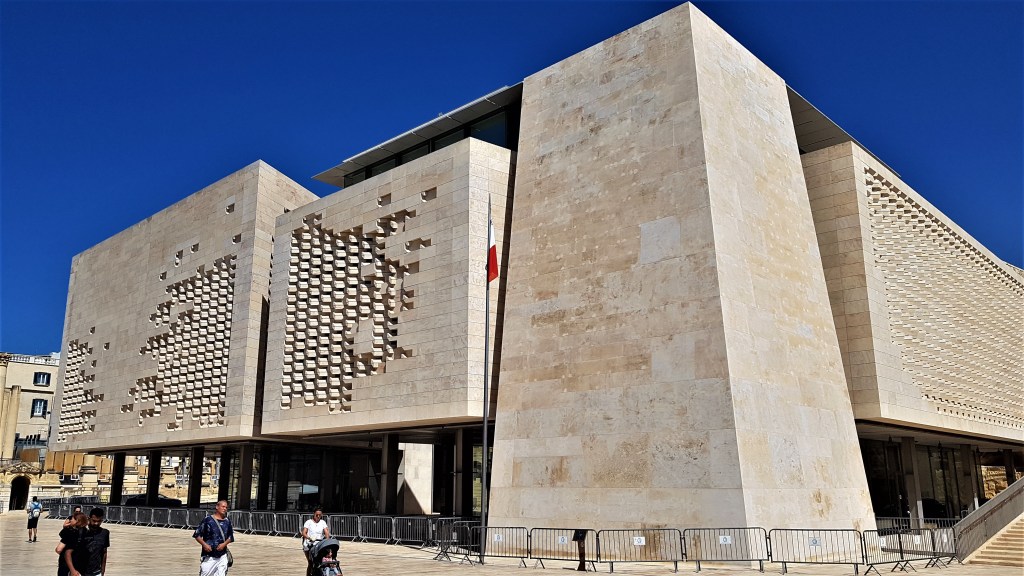
Parliament House, another limestone fort

The genius of it: the windows! Let the light in but not the sunshine. Nickname them any way you like, curse the cost, but in a sunshine country that’s a deal.

Majestic King’s Gate and the Royal Opera House, badly damaged or almost completely destroyed in 1942 (by youknowwhom) now re-thought and re-made by Enzo Piano. Not without controversy, but …get used to it.

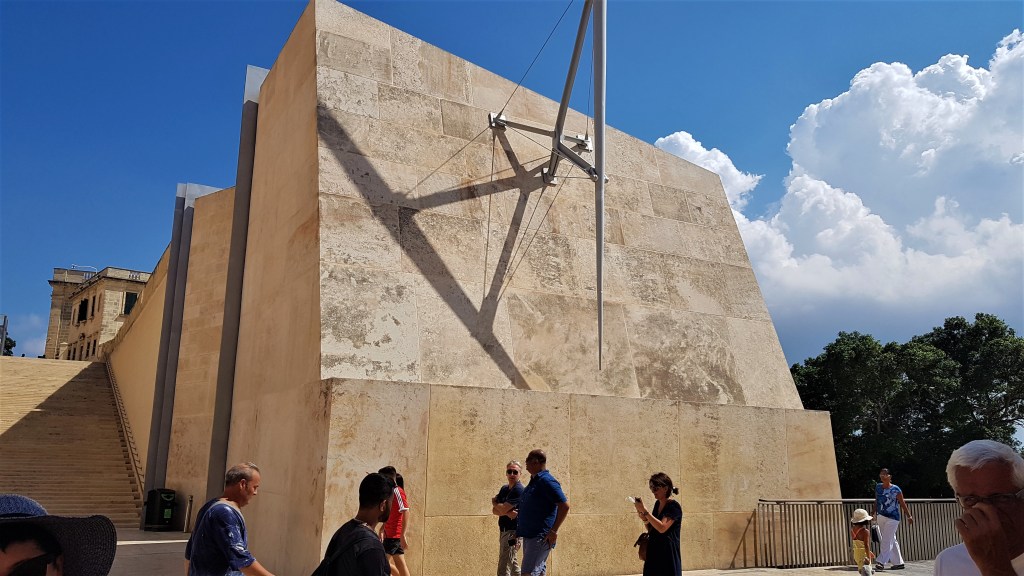
The massive gate, a bastion, seen from inside

One side of the gate, futurist and apparently designed to withstand a 15th century “bombard” cannon attack.

The remains of the Royal Opera House now fitted for open air concerts (by Renzo Piano), in front Jean de la Vallette who repulsed the Turks’ attacks and gave the capital its name.

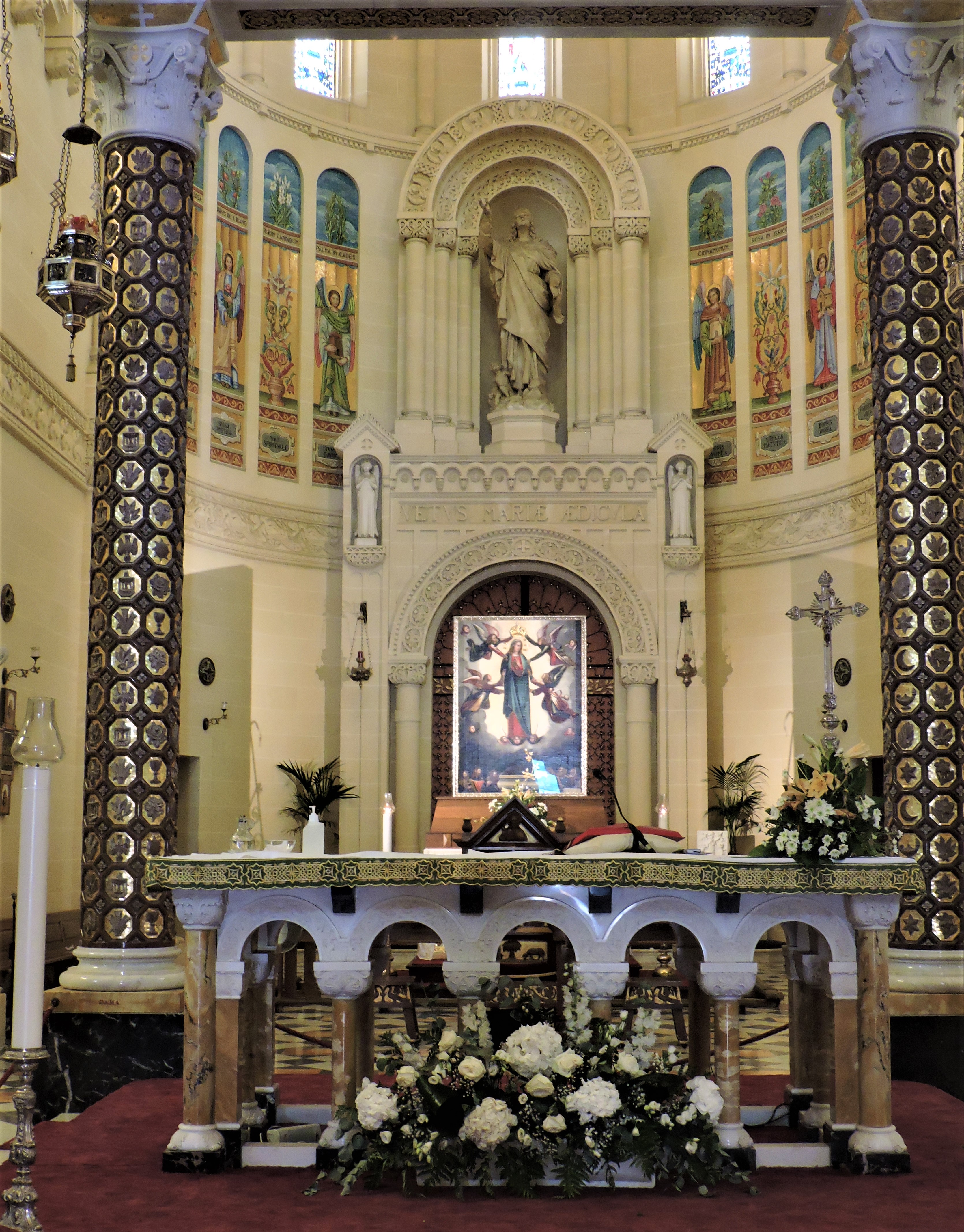
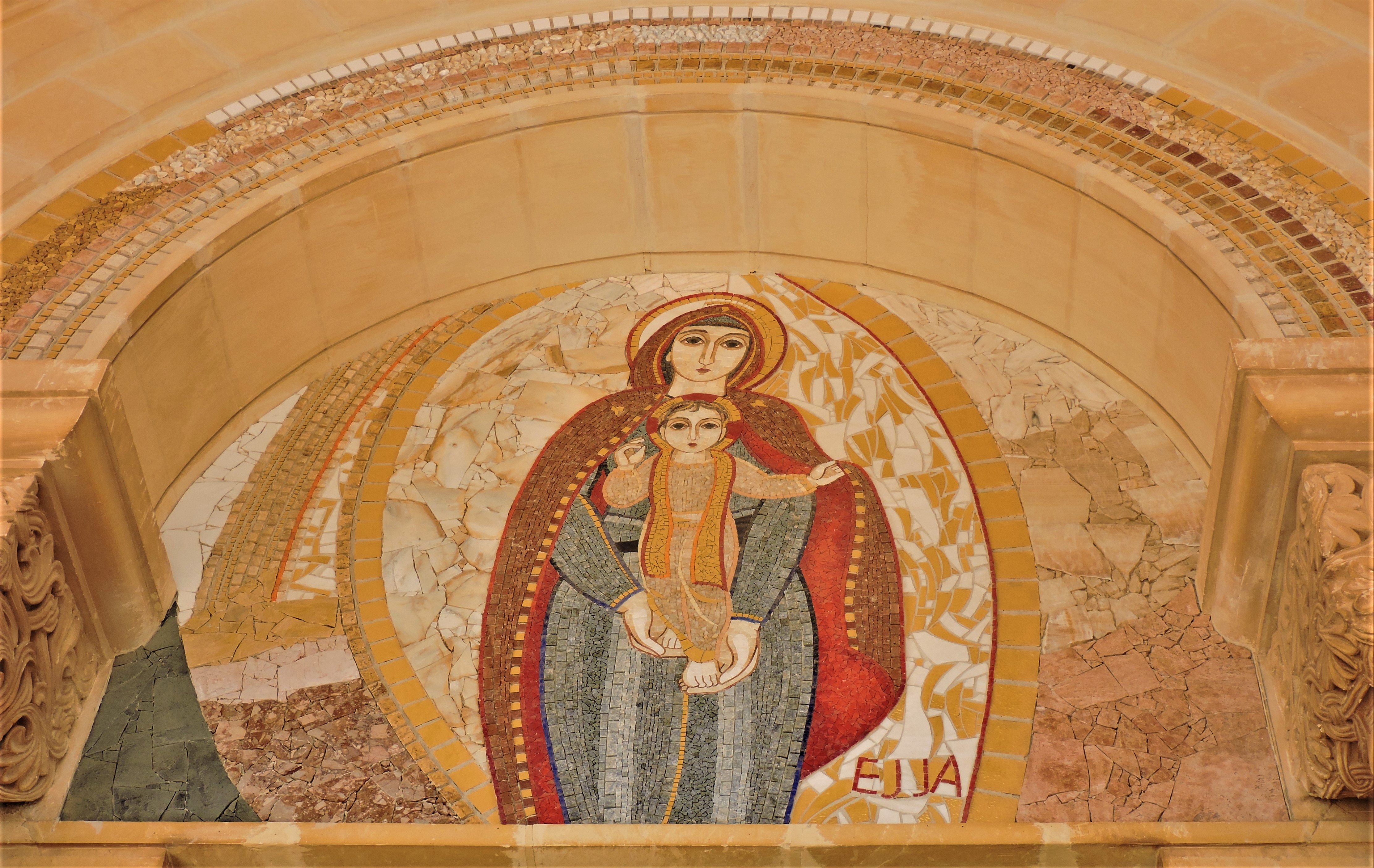
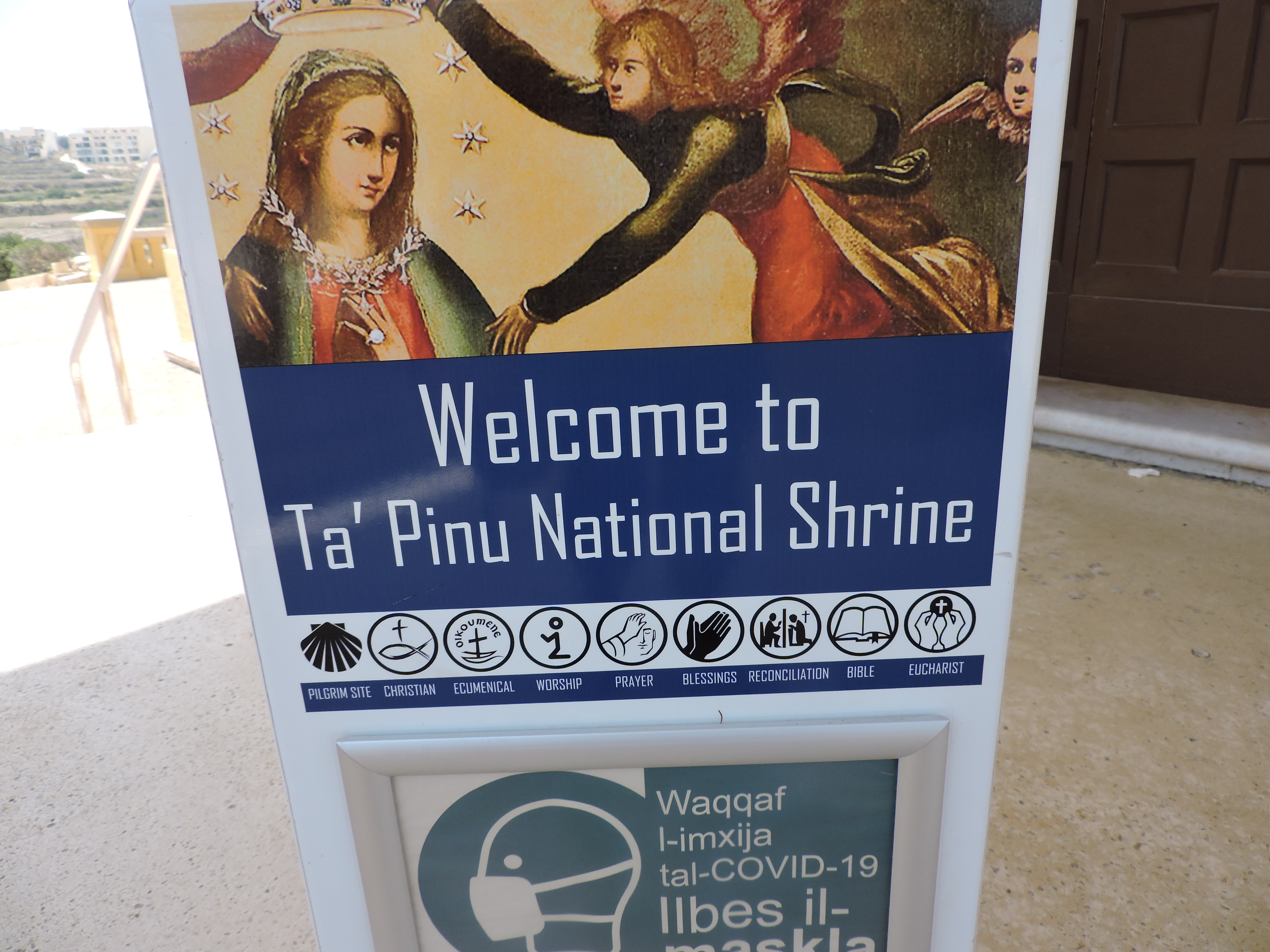
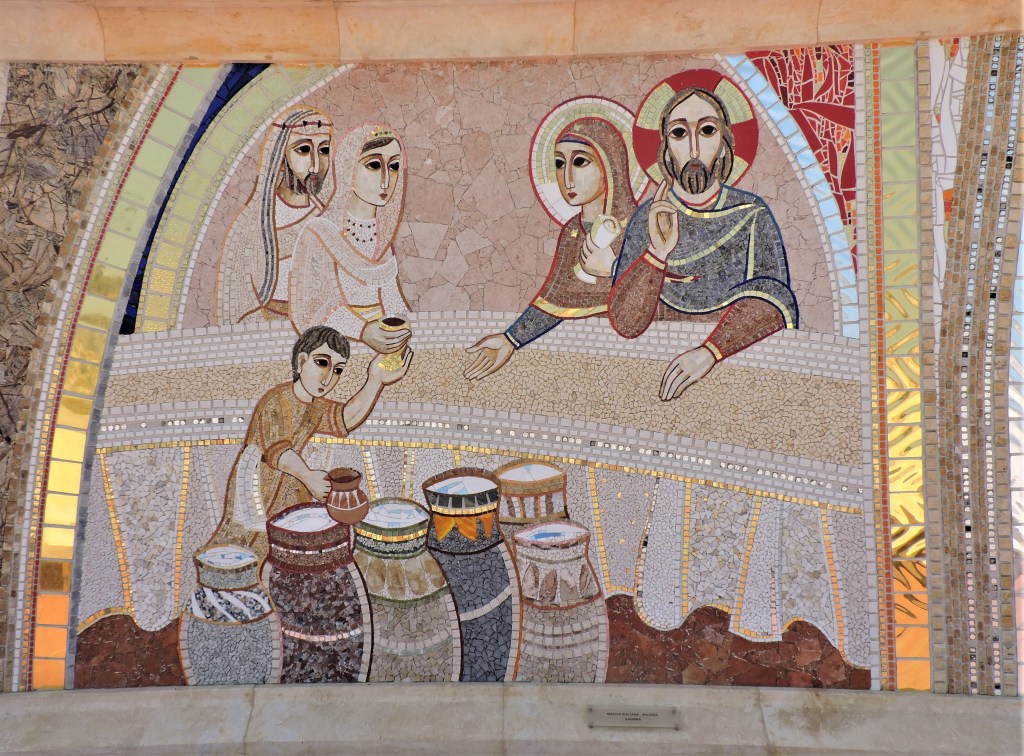
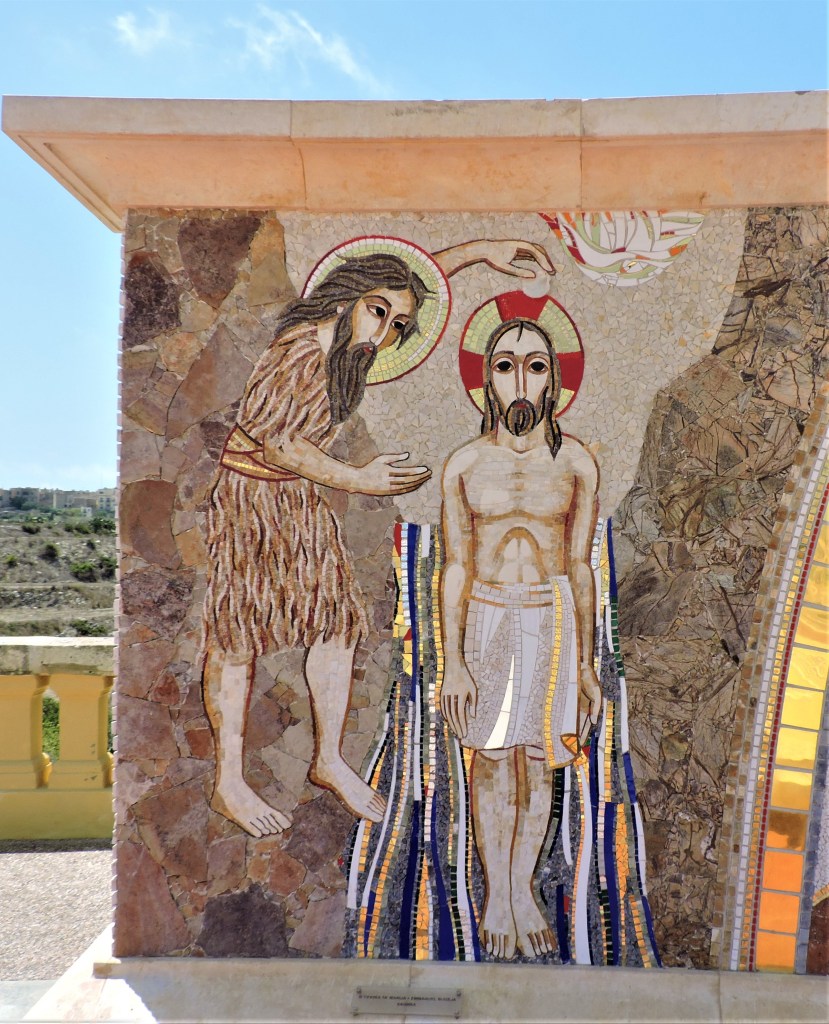
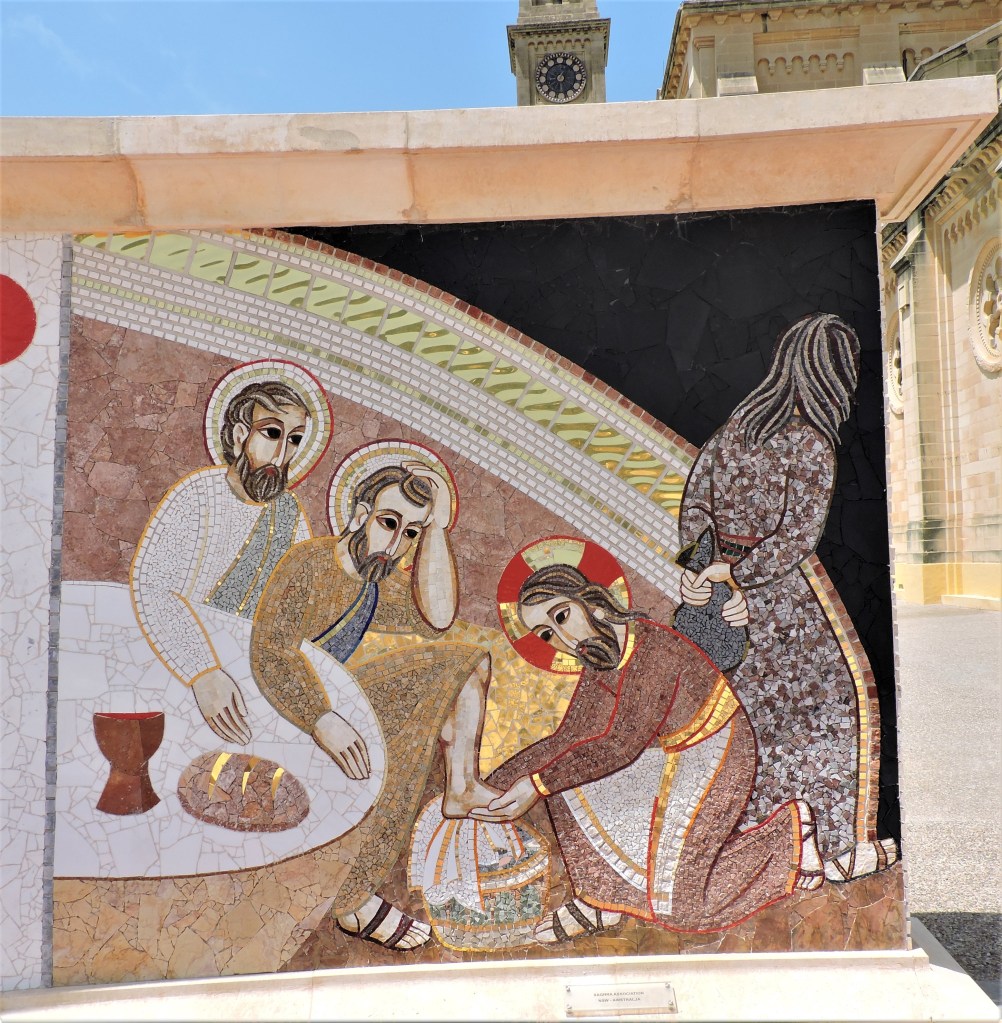
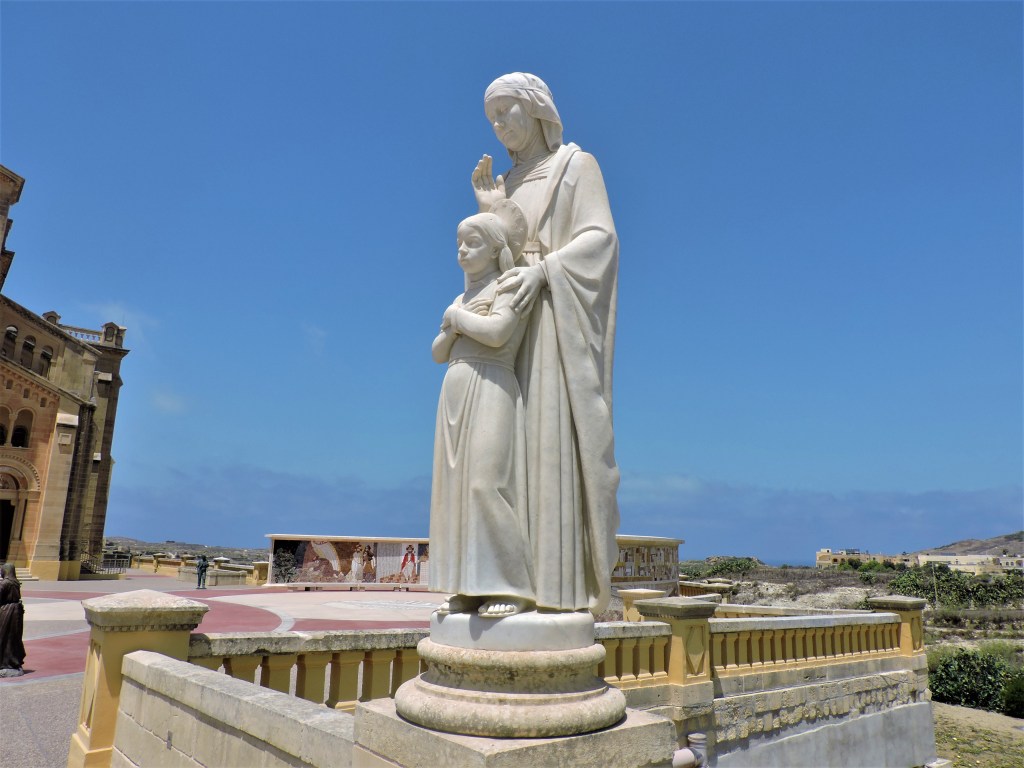
In the middle of the dry, sundrenched  countryside of Gozo: The Basilica of the Blessed Virgin of Ta‘ Pinu.

——————————————————————————————————————–

 A short lone pilgrimage across the large forecourt to the huge church,  quick photos right and left. 1920s Neo-Romanesque!  The newness, the clear lines, the unequivocal imagery, they calm your mind, clear your perception, open you up spiritually.

“Hearken!” The softest whisper touched my ear. I looked around. No one there, just a few statues along the way. The sun blinded me and I could feel the sweat running down my forehead. Before I could  take another step the voice went gently on: “Go into my church and recite a Hail Mary .”

——————————————————————————————————————–

“Is that you, Mother Mary?” I asked never having been able to reconcile myself to the fiction of the Virgin. No time for discussion, I still had 9 minutes left. “In what language?” was I about to ask not knowing the prayer in any. “Can I recite it in Latin, please?”

Inside the church I stopped in front of a marble angel that was sitting mindfully in an attempted lotus position as if floating in the air and chose him as my intermediary.

“Ave Maria, gratia plena, ehm, Mater Dei, ora pro nobis,ehm dunno, pecca …,  boh, nunc et in hora mortis, ehm, amen.”

I hoped she wouldn’t notice that I’d left out the bigger part of it.  “Go home and do something  good!” The sweet voice breathed in my ear. “Do something … good!” – What can I do? my humble self, what good?

“All I can do is teach,” I proposed helplessly, “ I can teach German!”.  

Silence.

“Mother Mary?” I felt a touch of wind on my cheek and heard an almost imperceptible wheeze.

——————————————————————————————————————–
Then … nothing. Back at the bus I thanked the driver who had just finished his cigarette and hopped on.  (When I got home I found that the Board of Education of Latium had changed my working conditions from bad to worse … I should have promised Mother Mary to build her a church!)

Which brings me to:

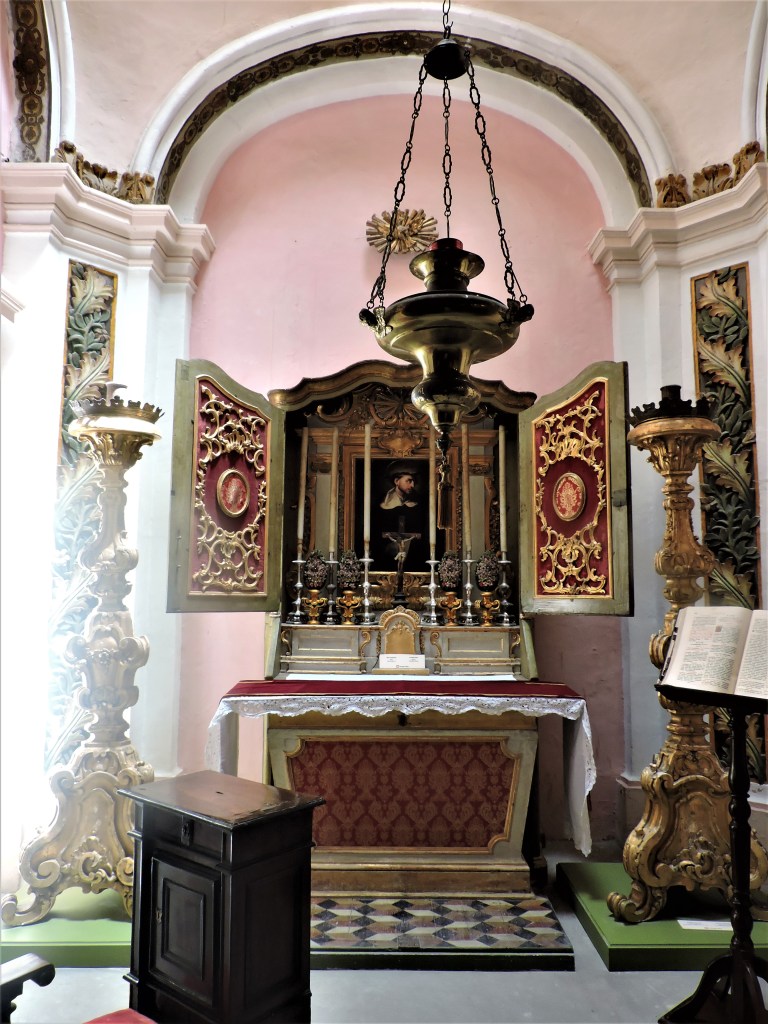
The Inquisitor’s Palace undramatically tells you what kind of treatment was reserved to heretics in the roughly 200 years (end of 16th century – end of 18th century). Below: the chapel, the confessional, the inspiration, the courtroom.

——————————————————————————————————————–
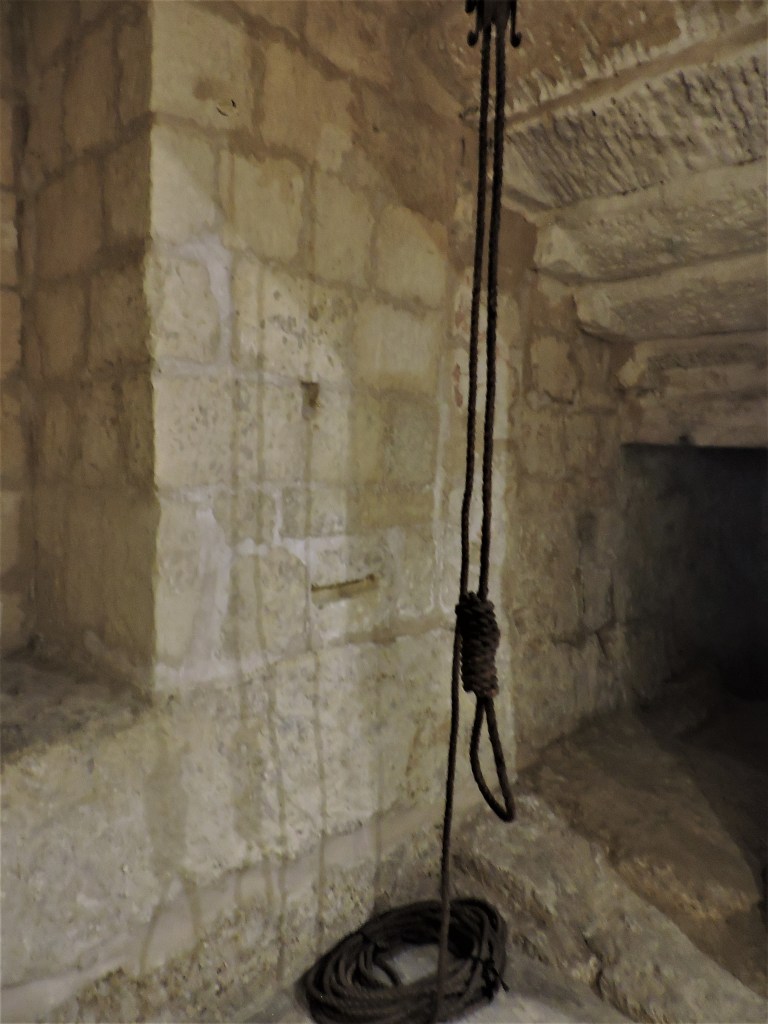
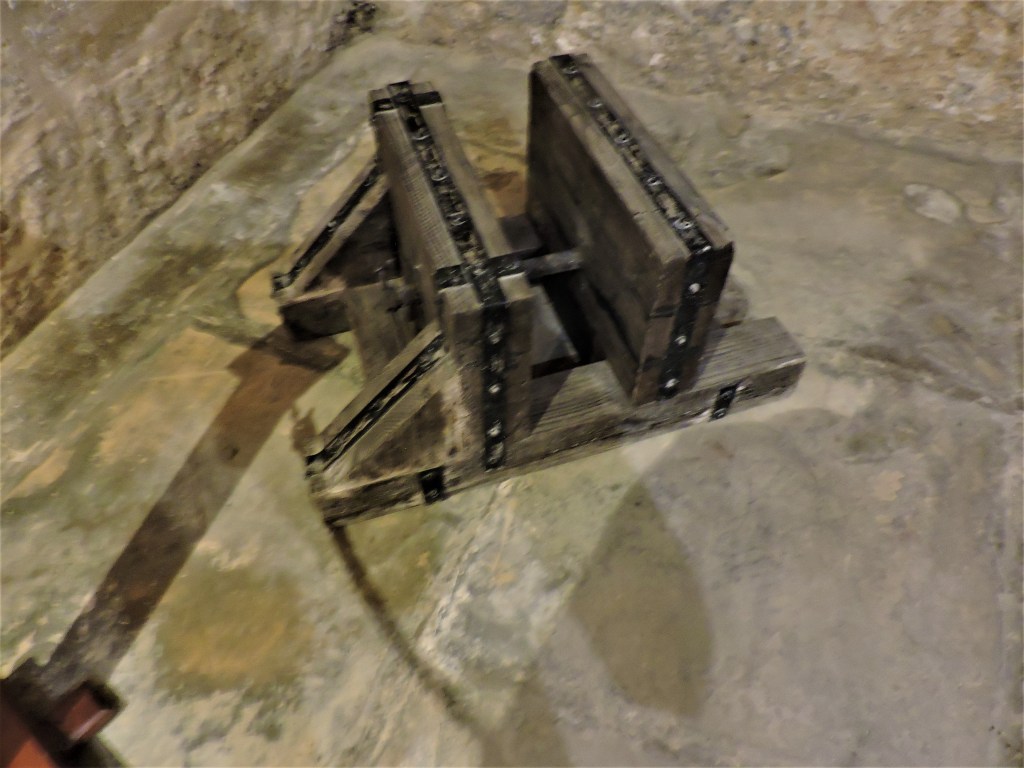
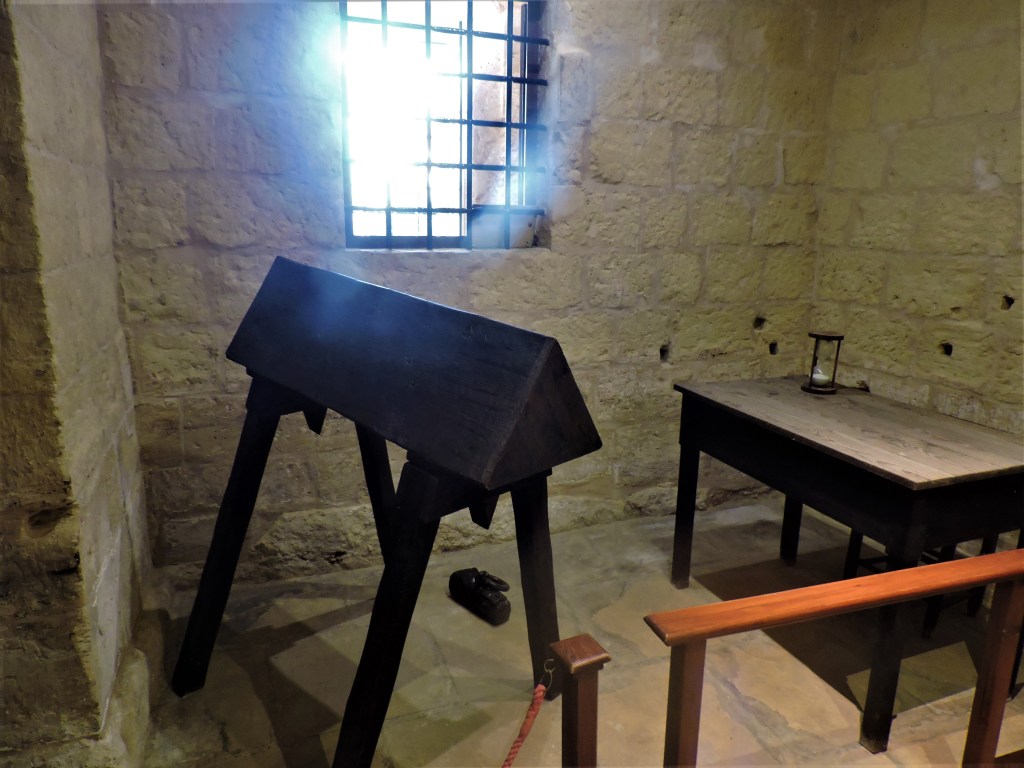
Here’s what you got for owning prohibited books, practising love magic, for heretical talk, apostasy to Islam, infringement of abstinence, abuse of sacramental oil, sorcery, bigamy (for women mainly):

hanging on a rope with your hands tied behind your back causing dislocation or bone fracture

pressing your ankles in the stringitore

or the cavaletto, you “ride” on it with the tormentors pulling at your legs. For justice’s sake the torture was timed by a sandglass. (center right on the table)

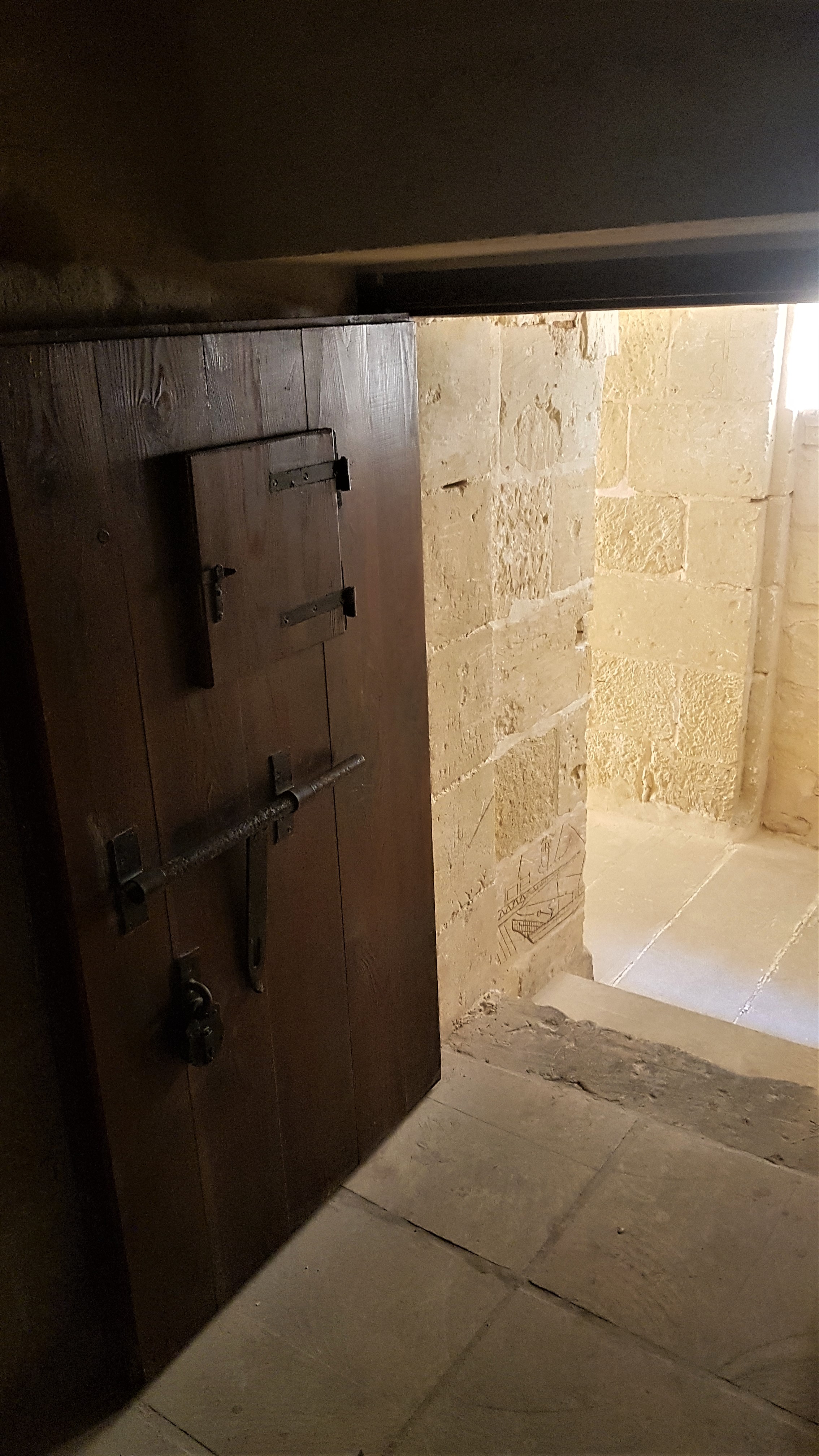
If you were “lucky” you could be condemned to vegetate in a dungeon for a couple of years fasting on dry bread and water, taking the Holy Comunion and reciting the rosary every Saturday. You could leave some graffitti on the limestone walls drawn with your fingernails so 20th /21st century tourists could be appalled by the horror of what human beings inflict on one another.

——————————————————————————————————————–
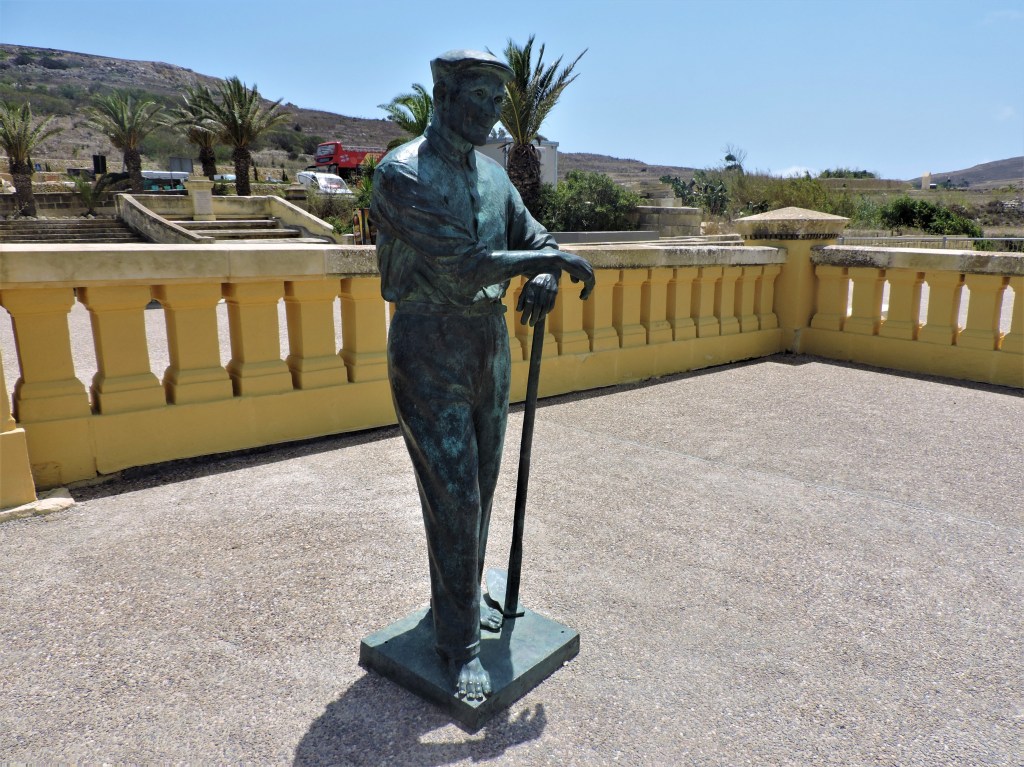
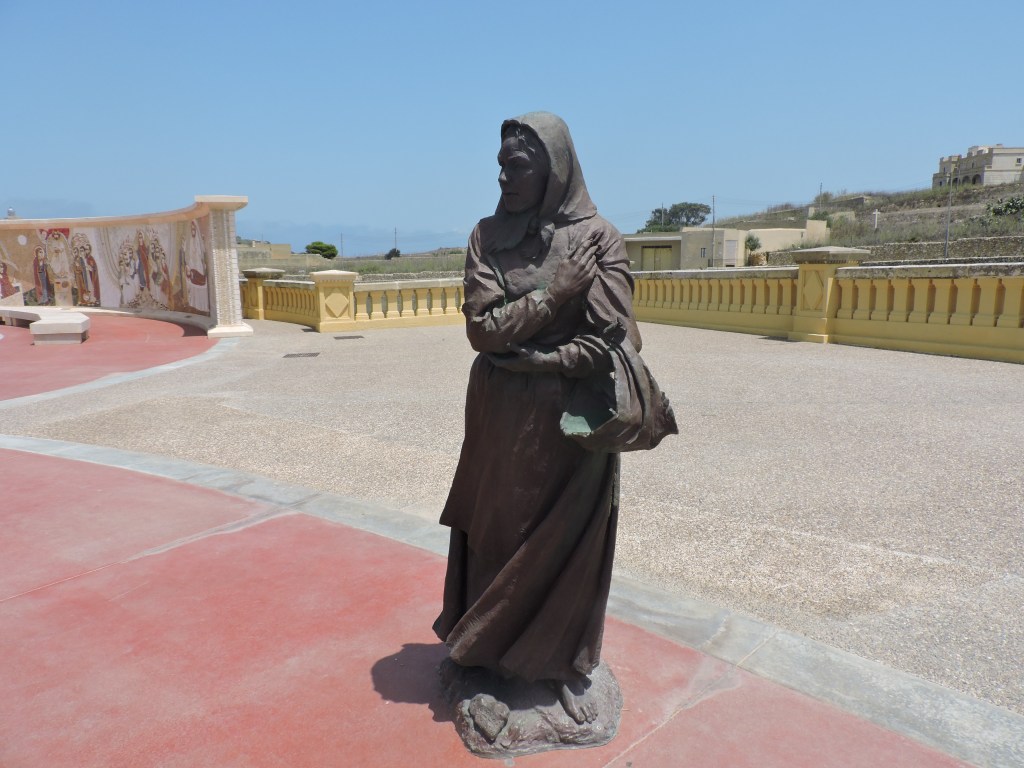
Not that we have changed a great deal nowadays:

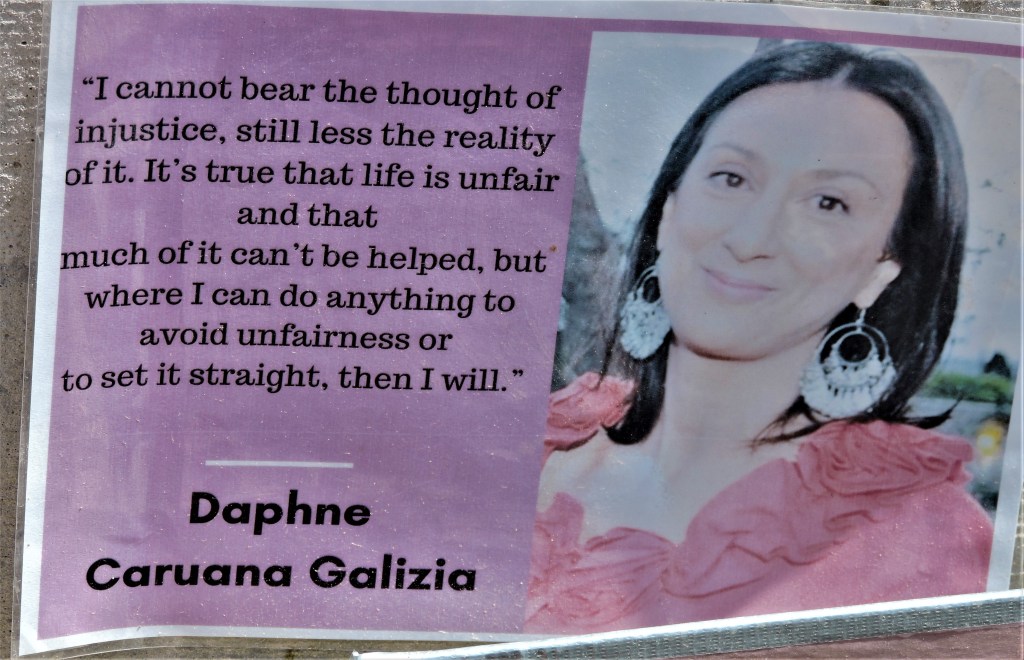
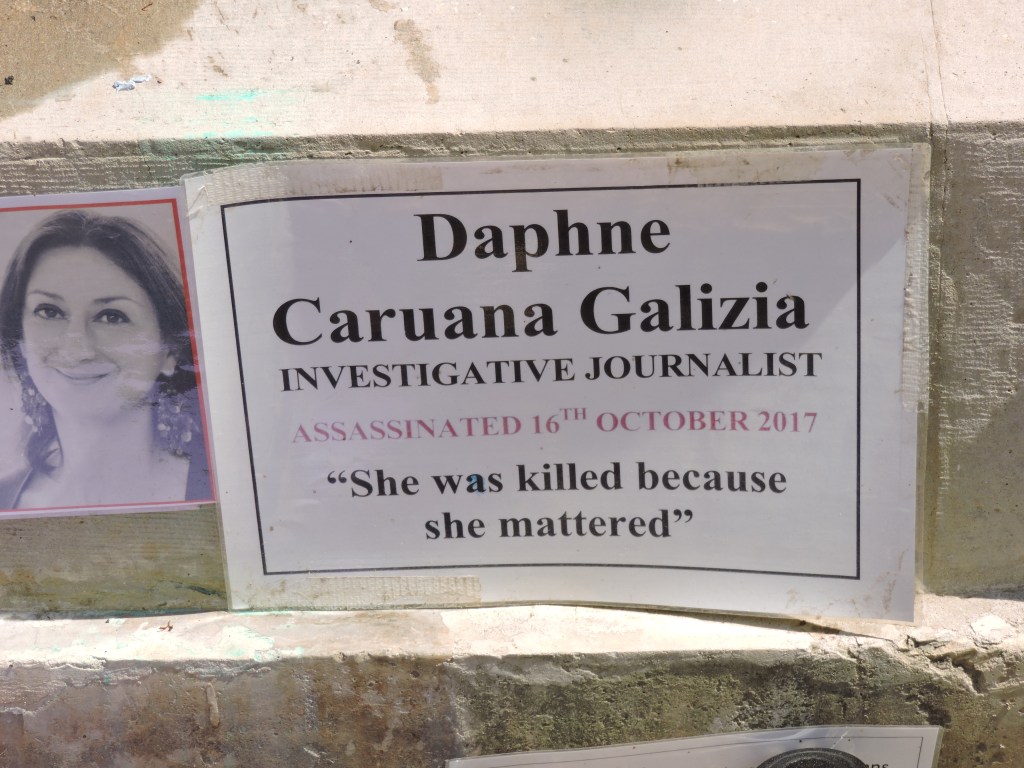
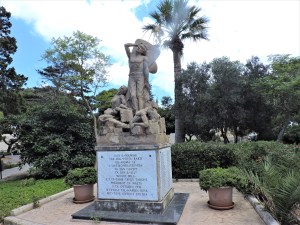
Monument to the Fallen of the Great Siege: a Memorial to Daphne Caruana Galizia

A journalist and an anti-corruption activist, a modern heretic ?

——————————————————————————————————————–
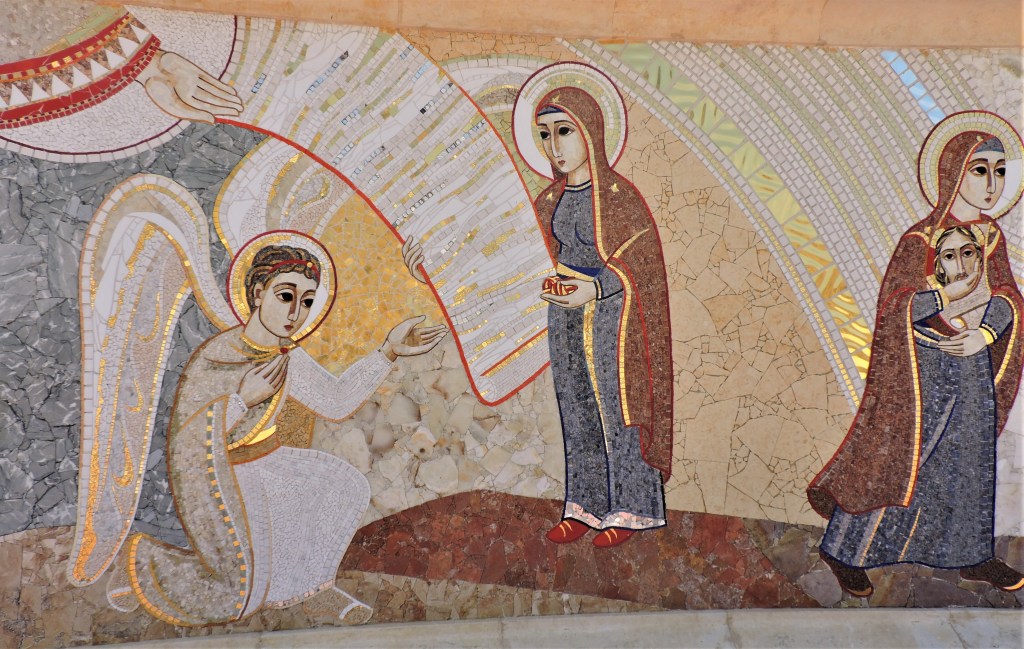
“The brave die never, though they sleep in dust: Their courage nerves a thousand living men.” Minot J. Savage

Next time, not so sad, the highlights from the stone age

cheers Gerburg

Malta 2: Who on earth is …?

7 Sep

… Mattia Preti?

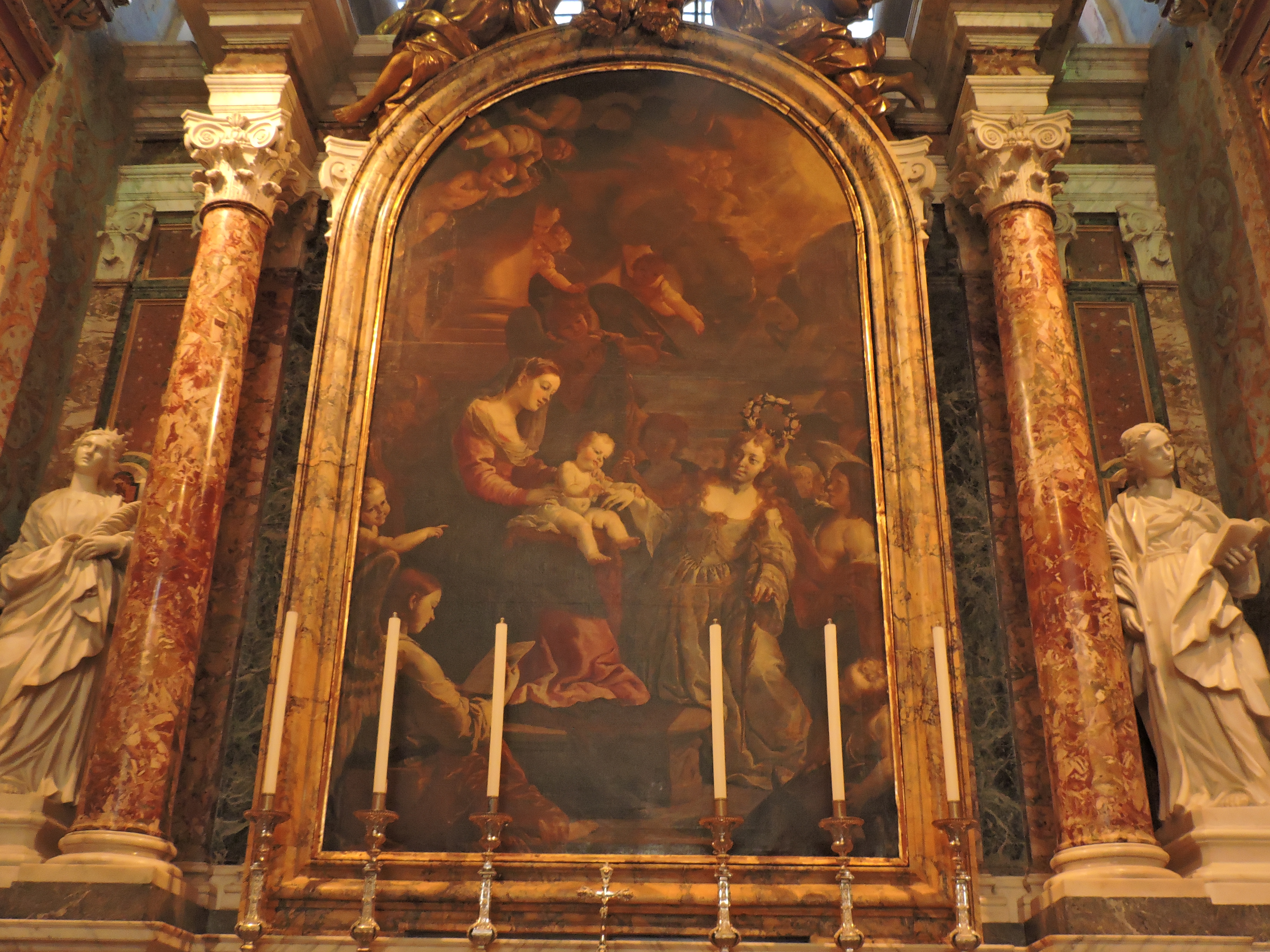
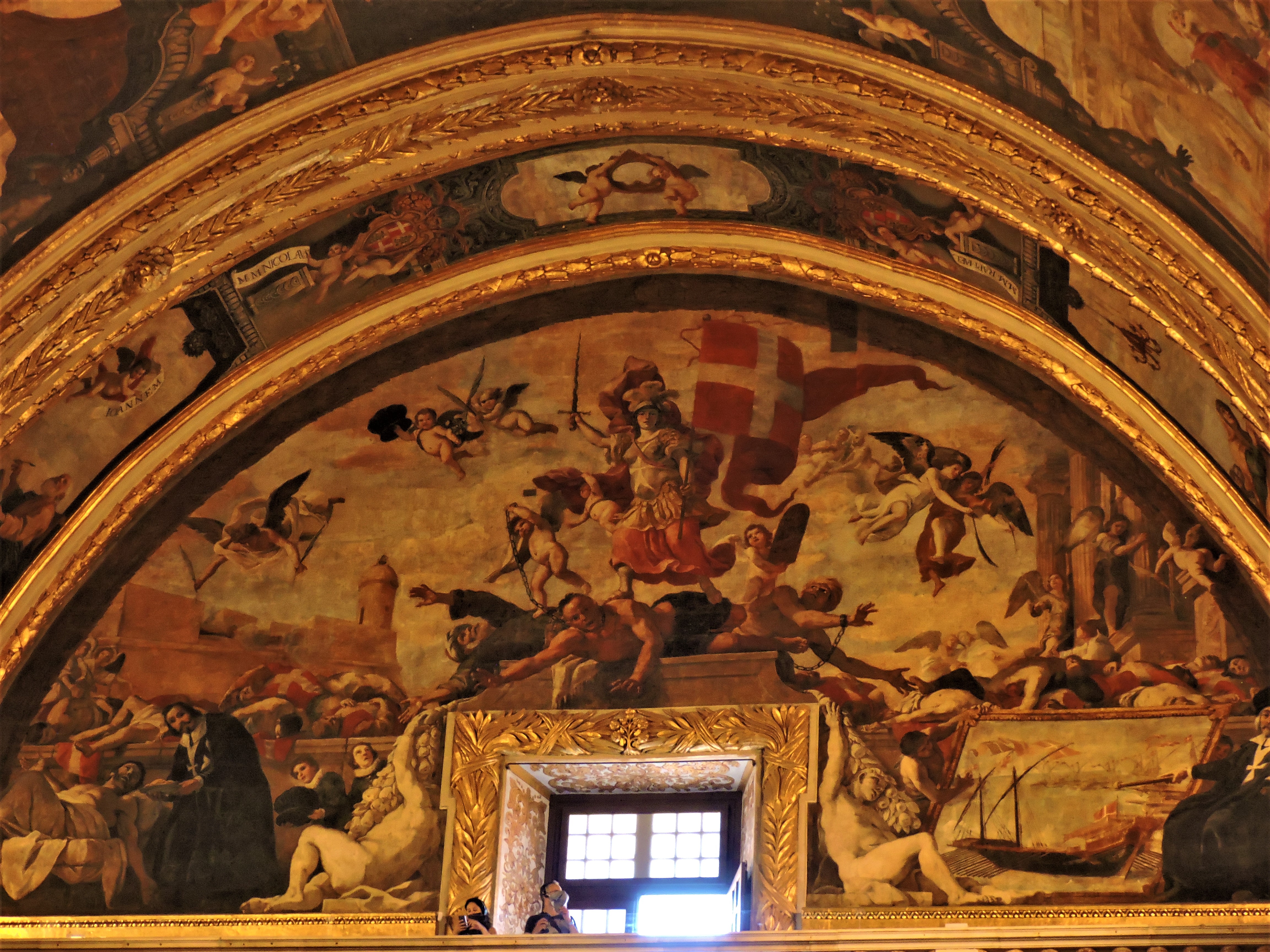
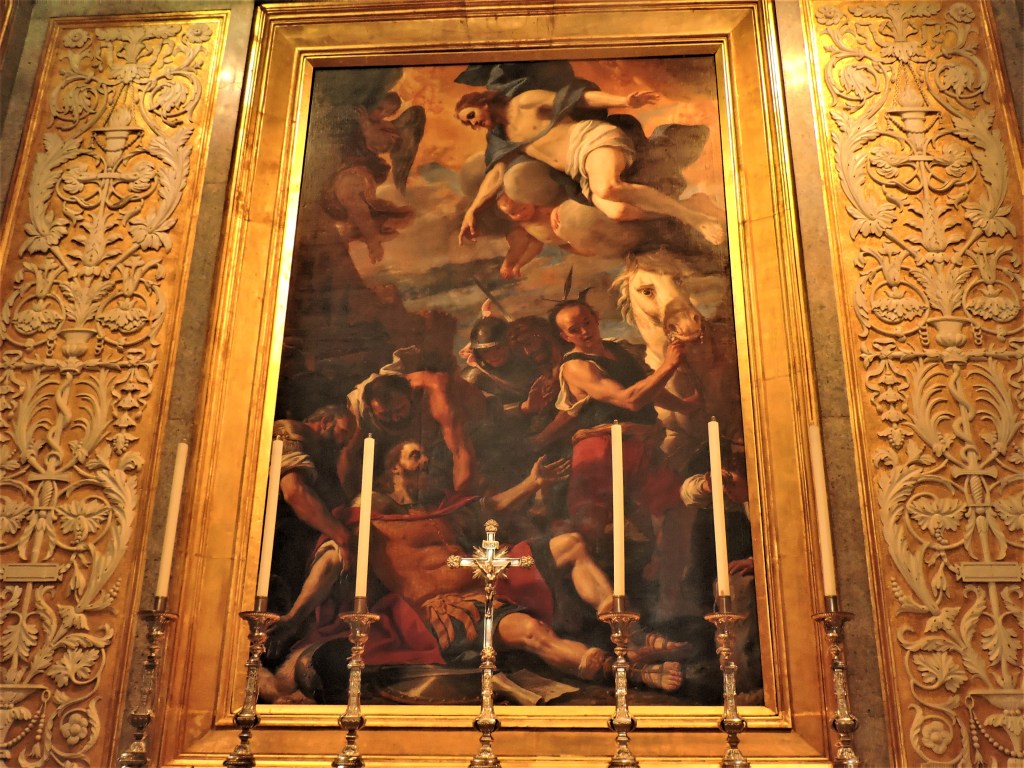
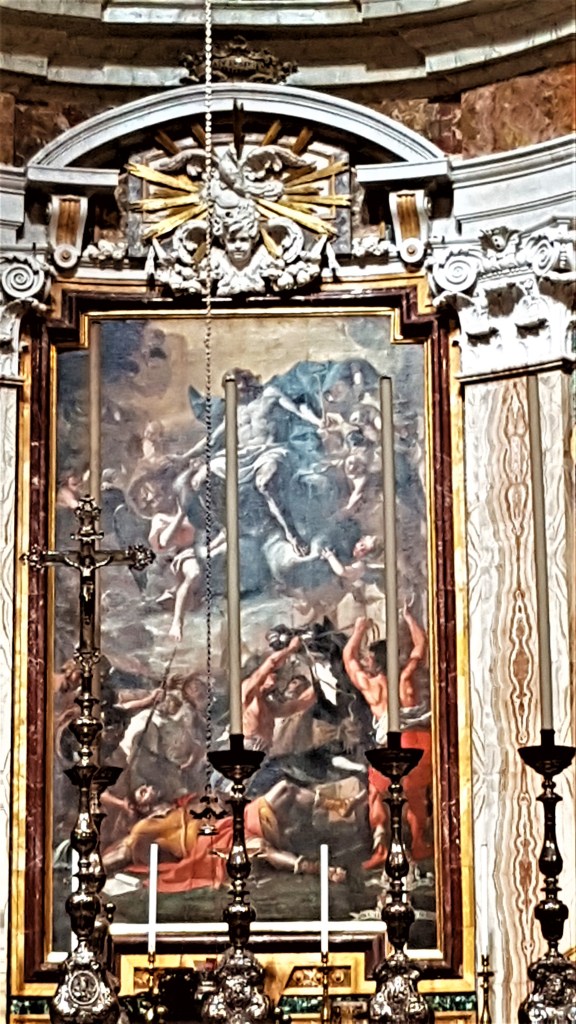
If you don’t know him, relax, there is at least one more person in this world who didn’t either but if you want to broaden your cultural horizon beyond Caravaggio, go to Malta and visit St Paul’s Cathedral in Mdina and St John’s Co-Cathedral in Valletta. And you’ll see. Here there are a few examples of Preti’s around 400 paintings, frescos, votive paintings in Malta alone.

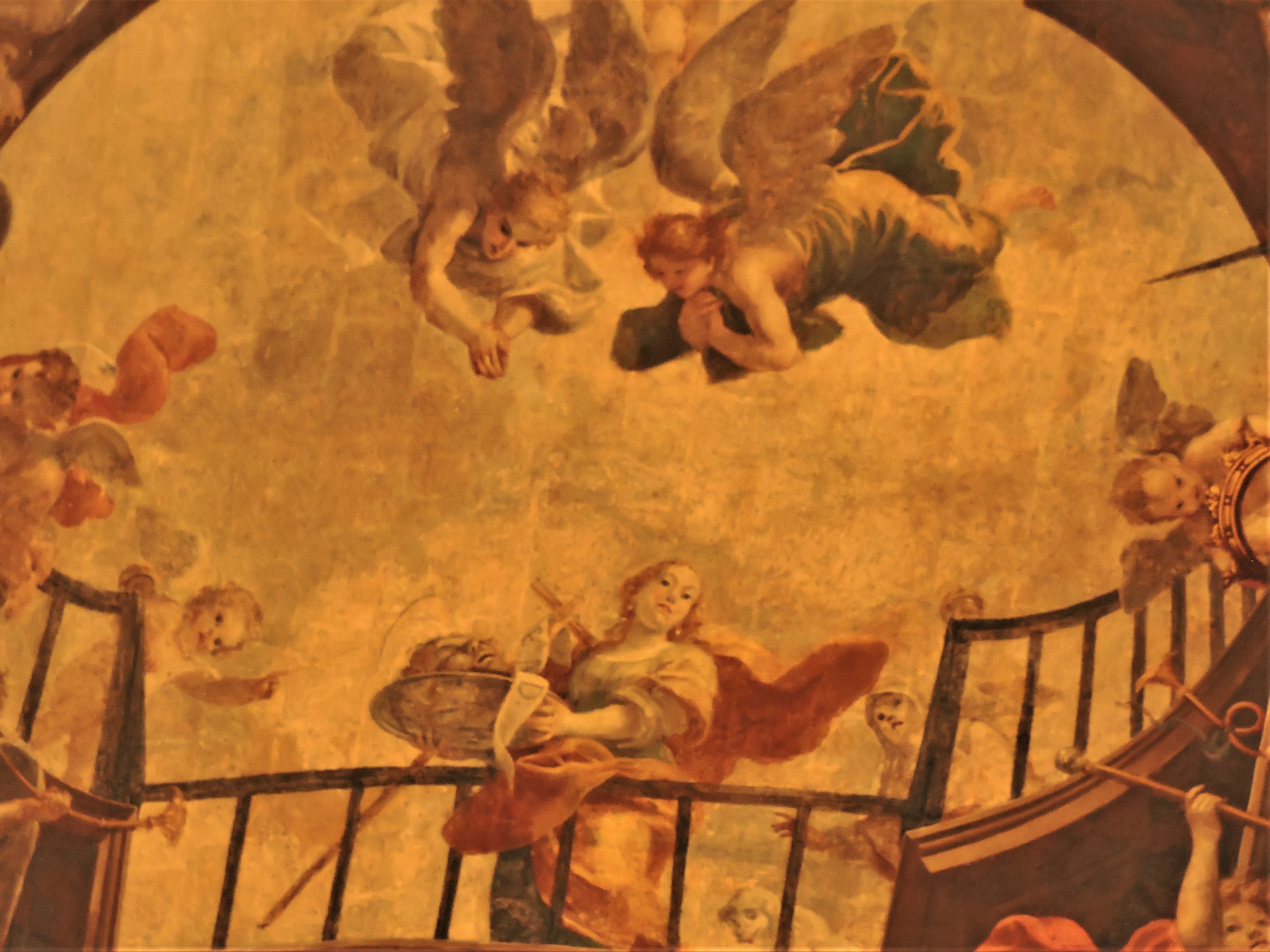
Caption to the pictures below: The Mystic Marriage of Saint Catherine in the Chapel of the Langue of Italy, The Allegory of the Triumph of the Order of St John, the ceiling in the Co-Cathedral in Saint John, underneath The Conversion of Saint Paul (one in the Co-Cathedral, one in St Paul’s in Mdina; dramatic, remember from Saul, through blindness, to Paul, you better believe it)

Malta, unfalteringly Christian since the Apostle Paul’s shipwreck, has 365 churches, and in this 4th densely populated nation that makes it 1165 inhabitants per church. (901 inhabitants per church in Italy, Malta can’t beat that). They look self-assertive, awe-inspiring  and quakeproof, elegant baroque outside, overwhelming baroque inside.

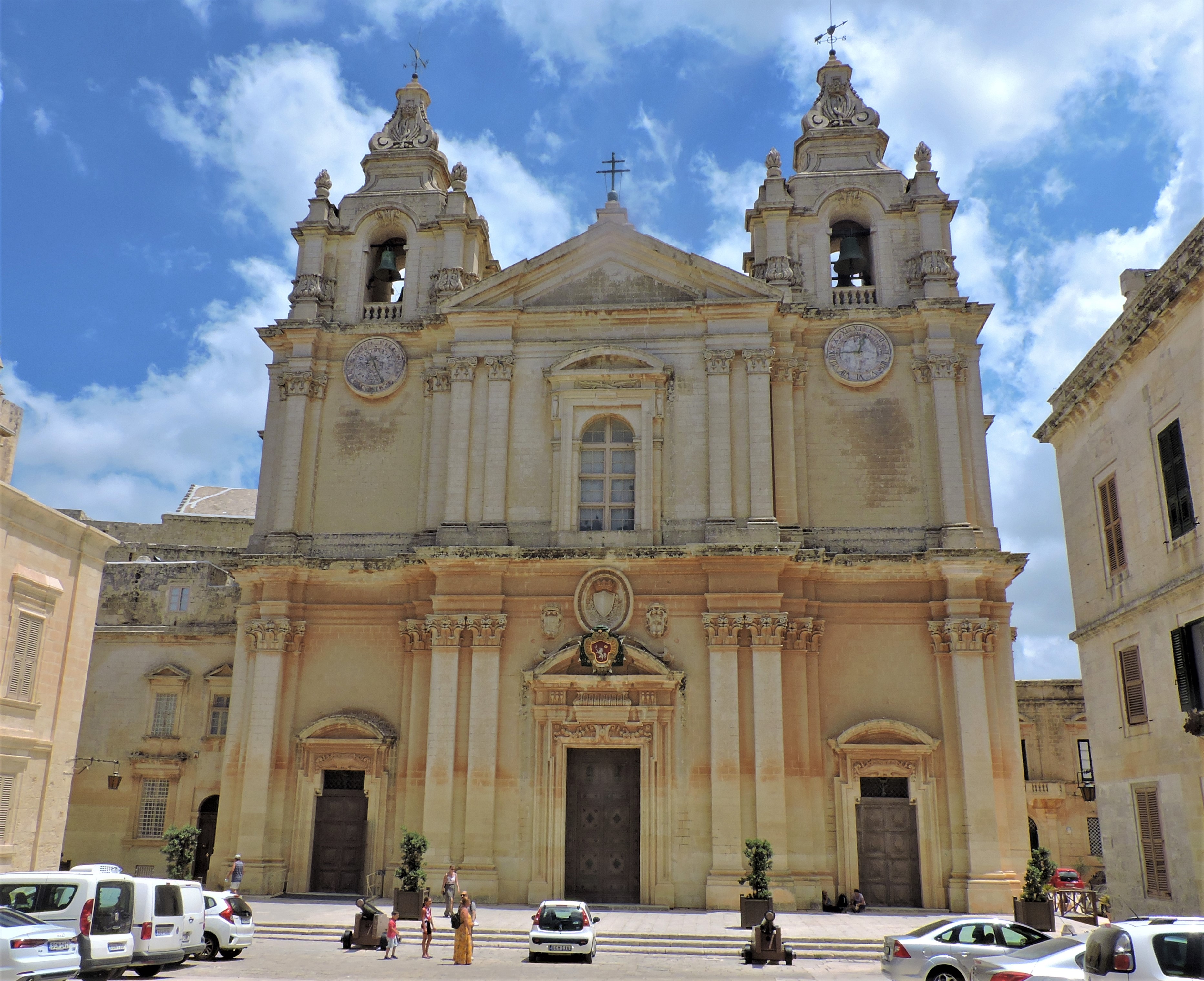
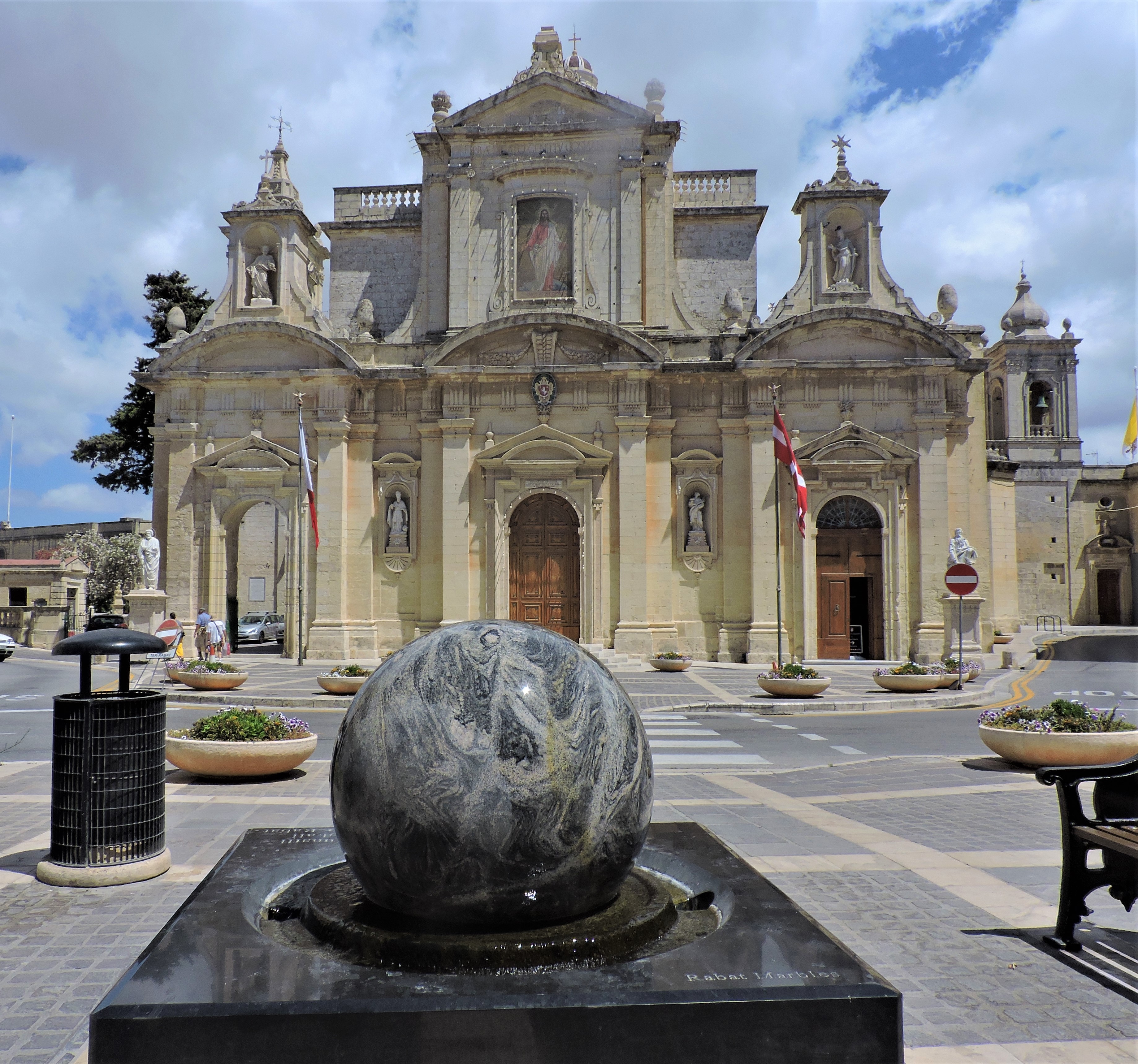
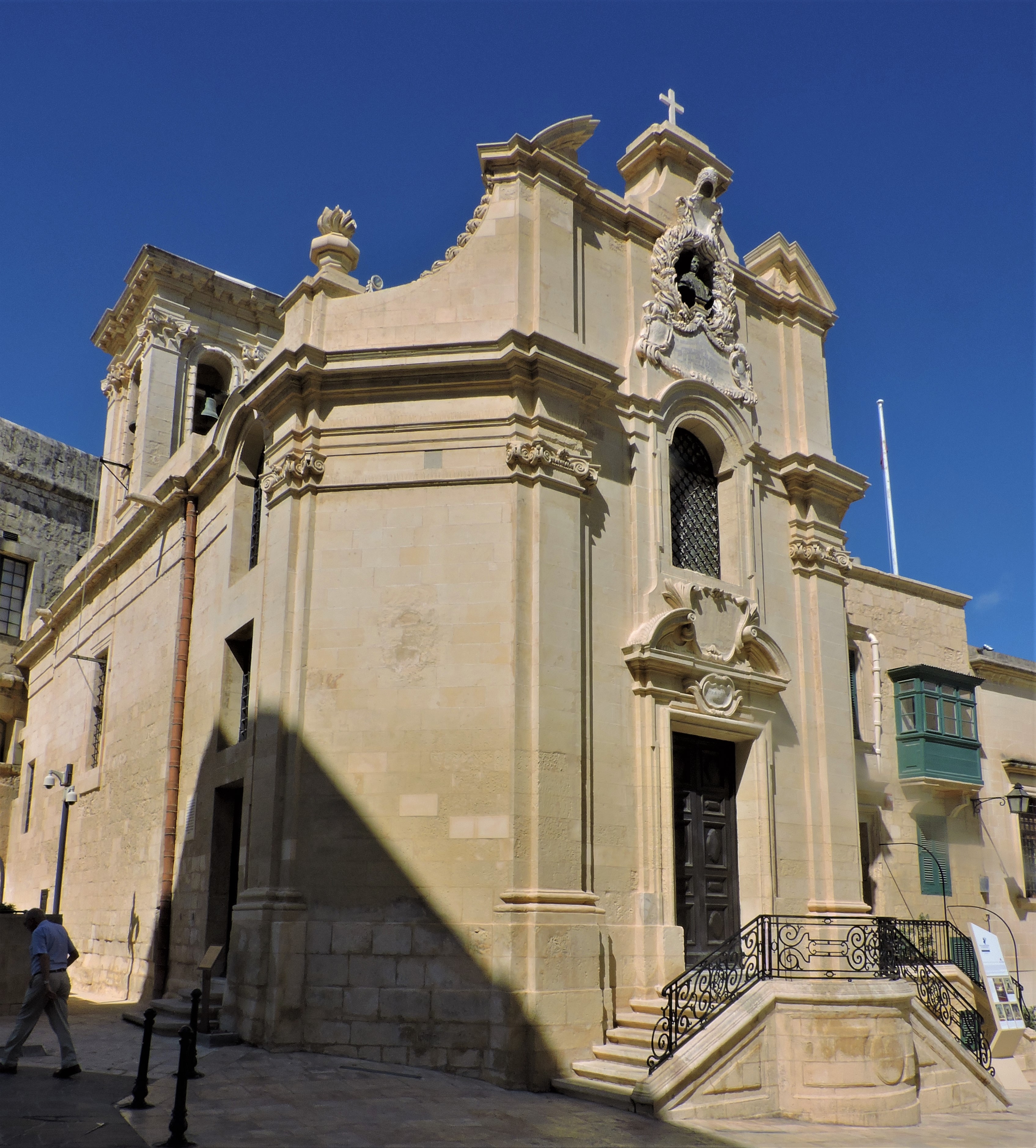
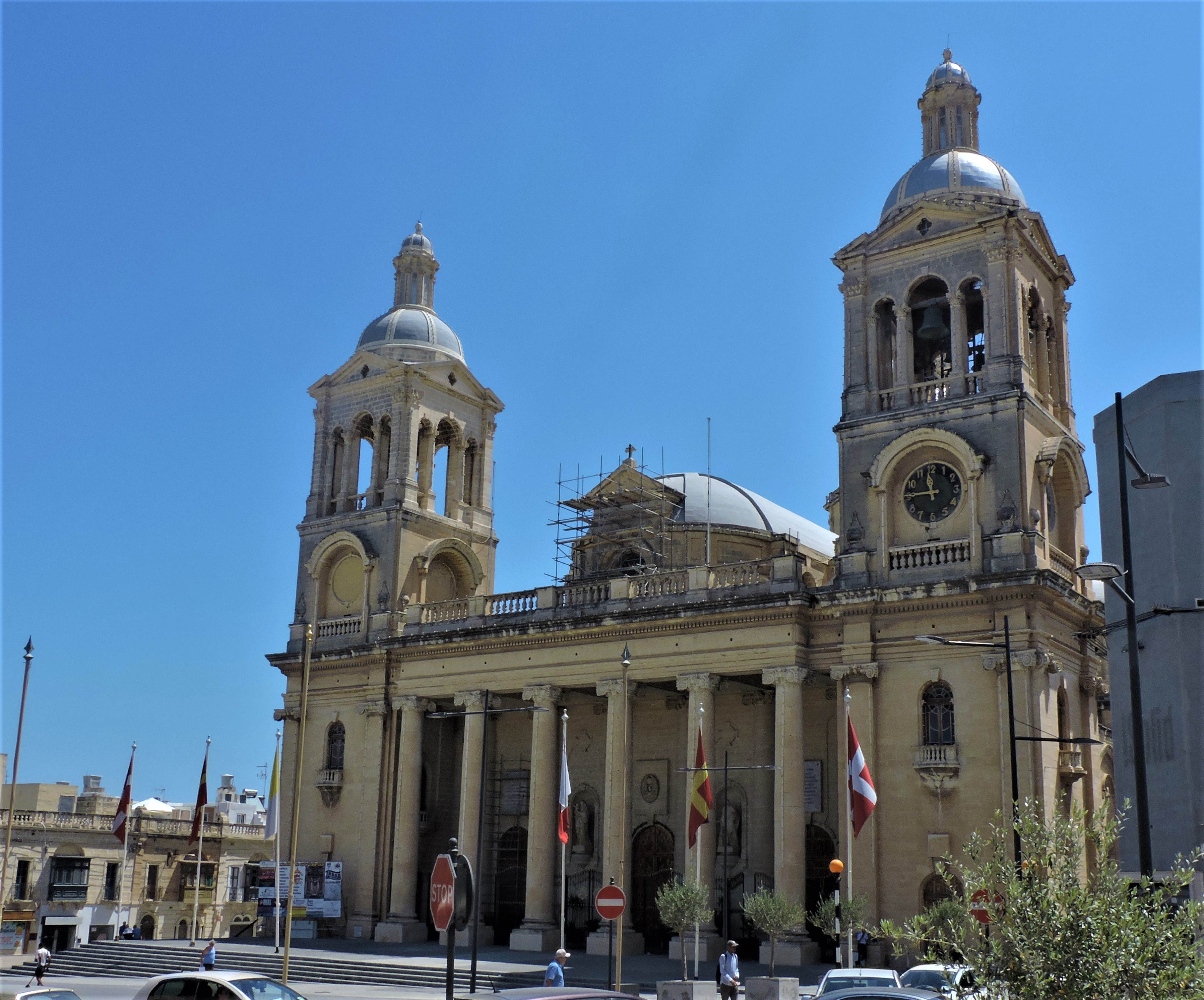
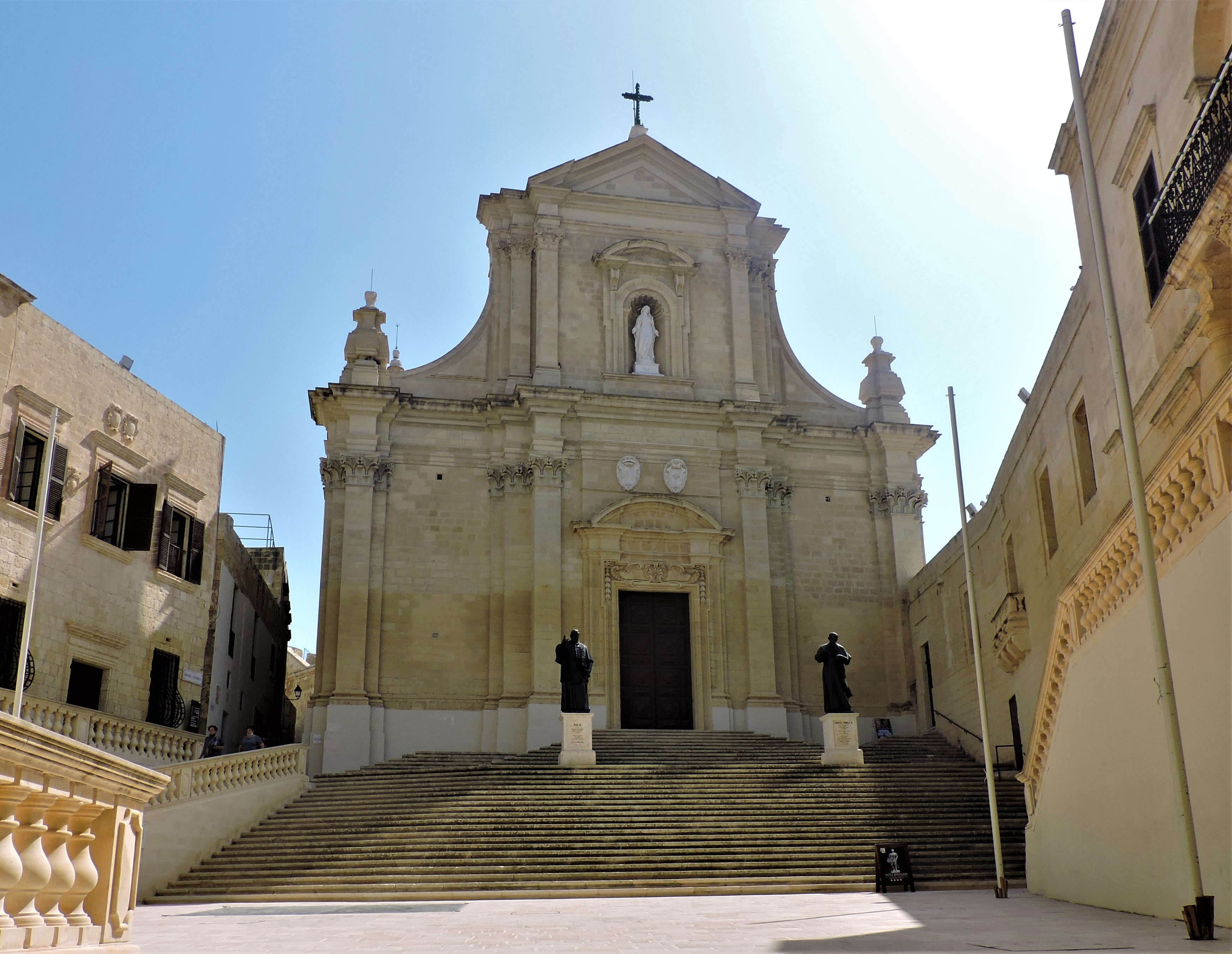
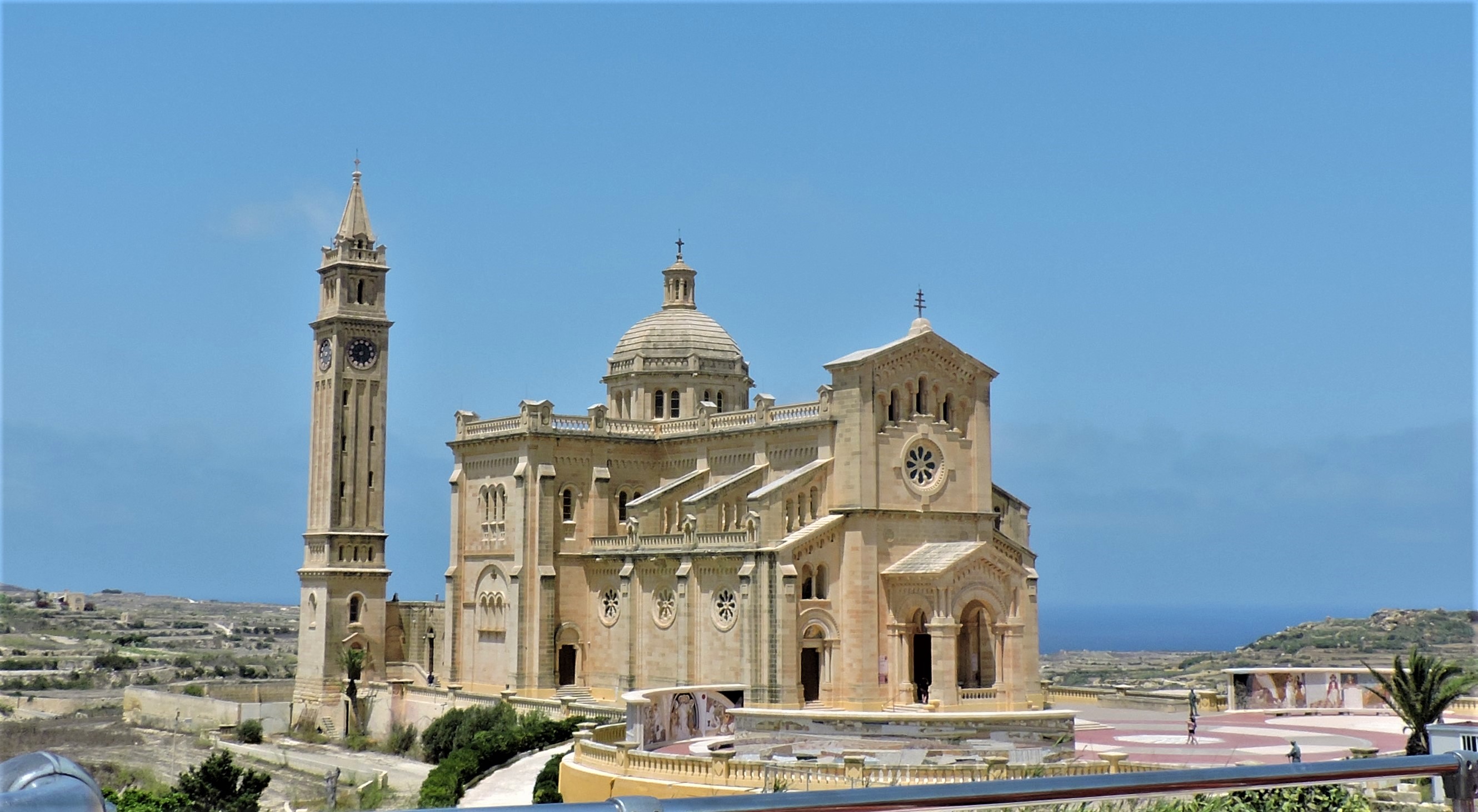
St Paul’s Cathedral, Mdina; St Paul’s church, Rabat with the marble sphere in front; underneath Church of St Paul’s Shipwreck in Valletta; bottom left: some church in Paola; middle: Cathedral of the Assumption in the Citadel of Victoria (Gozo island); and the rather new not baroque Basilica of Ta’Pinu which I’ll tell you about next time (on Gozo Island).

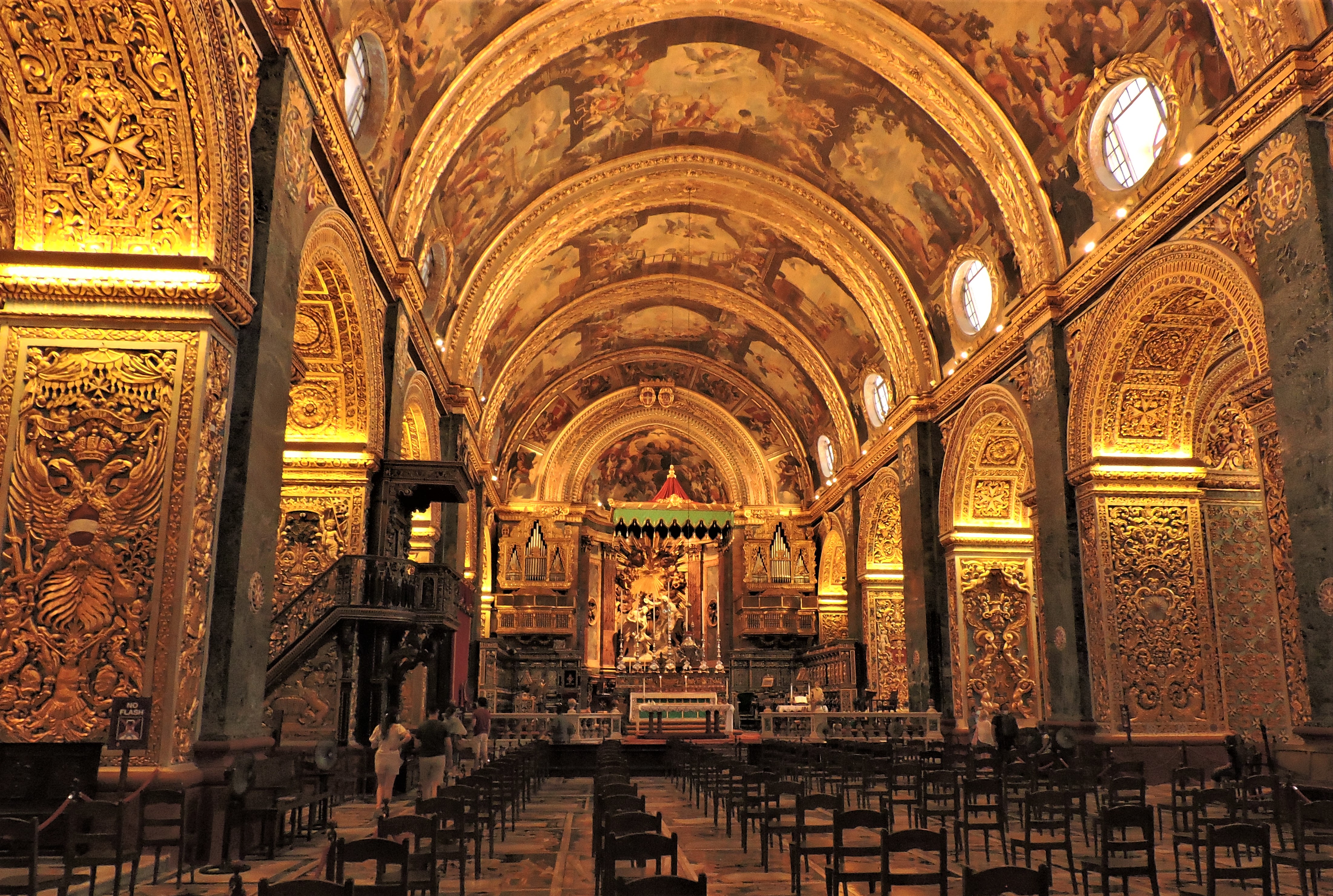
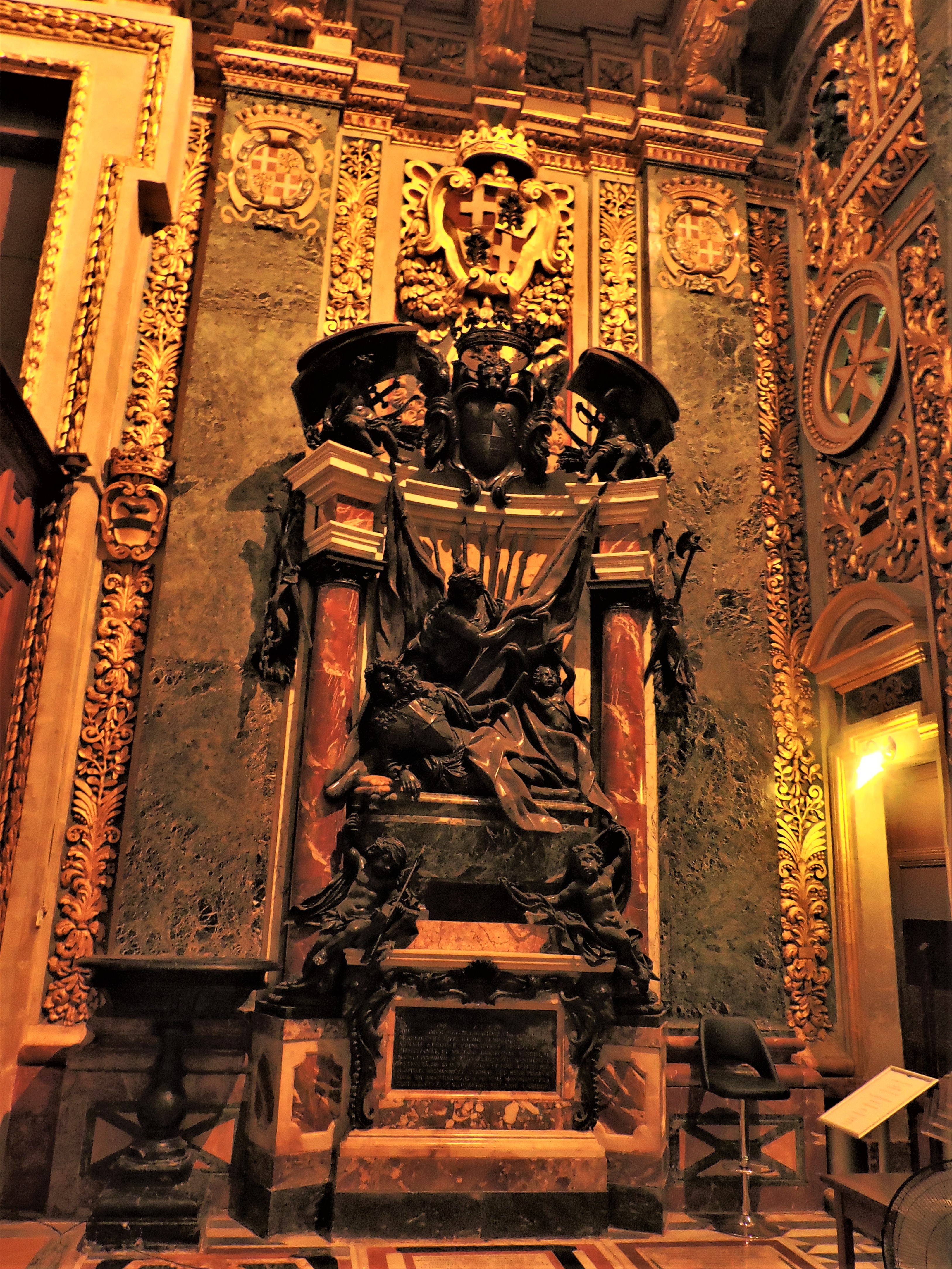
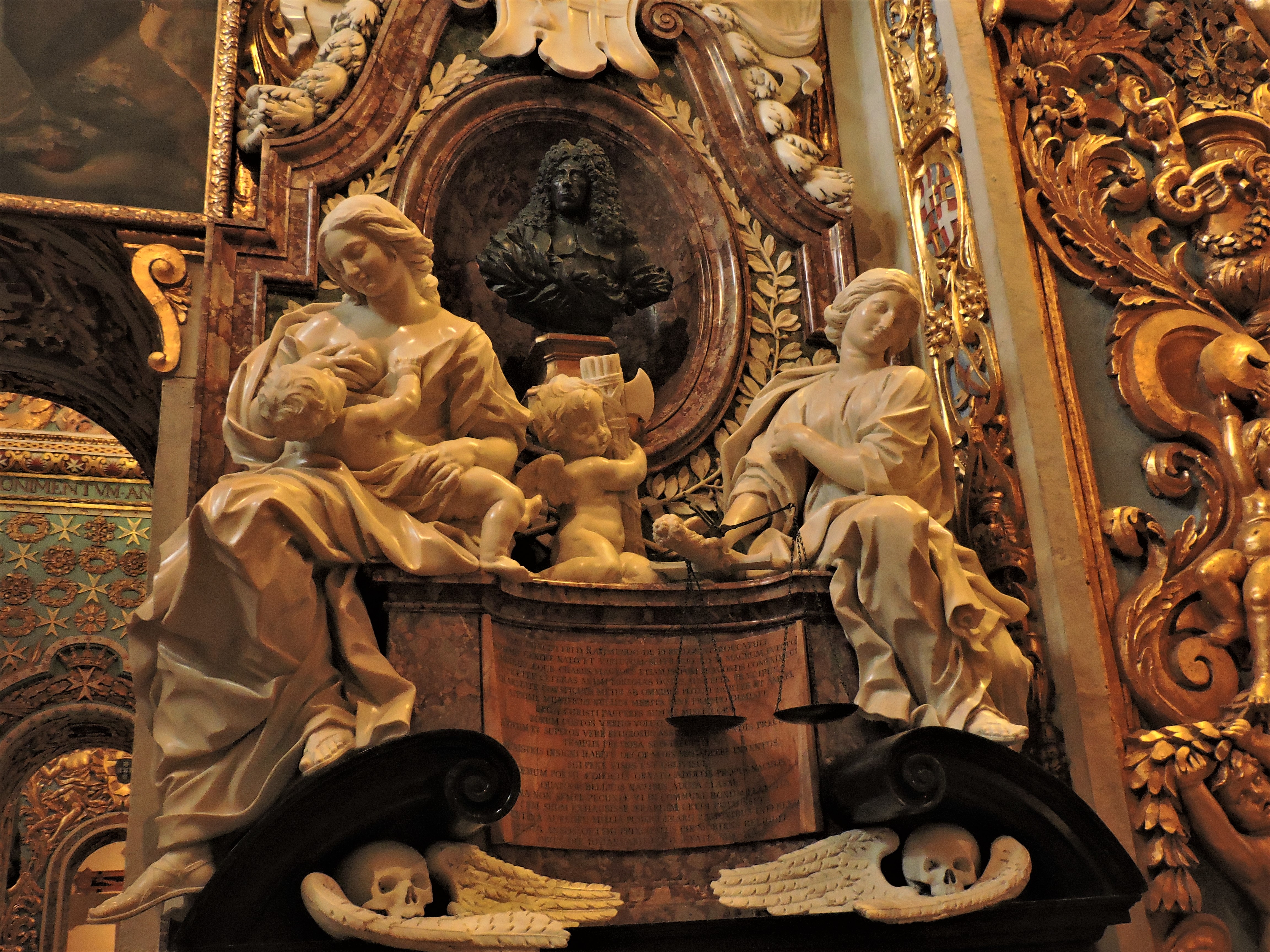
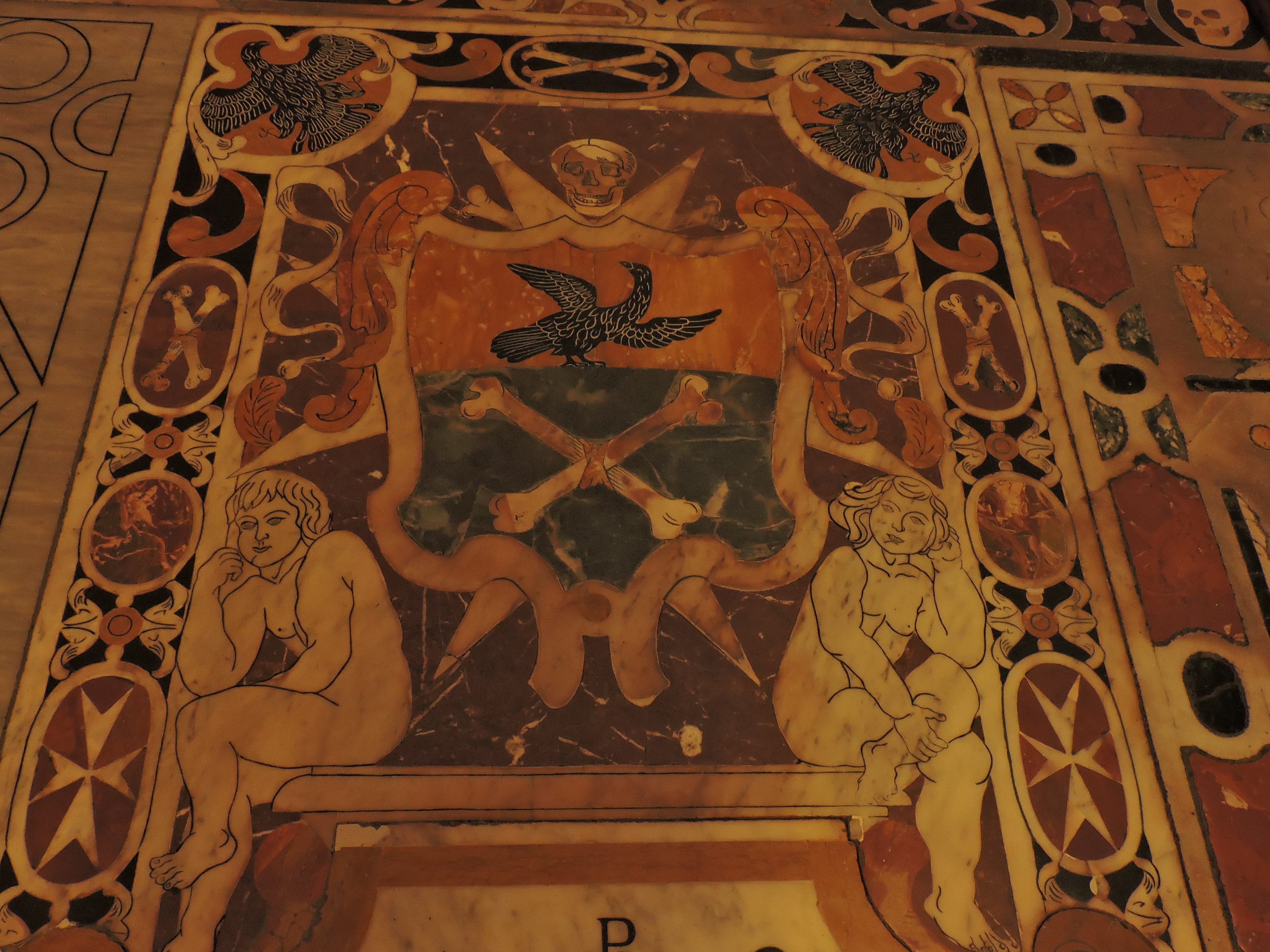
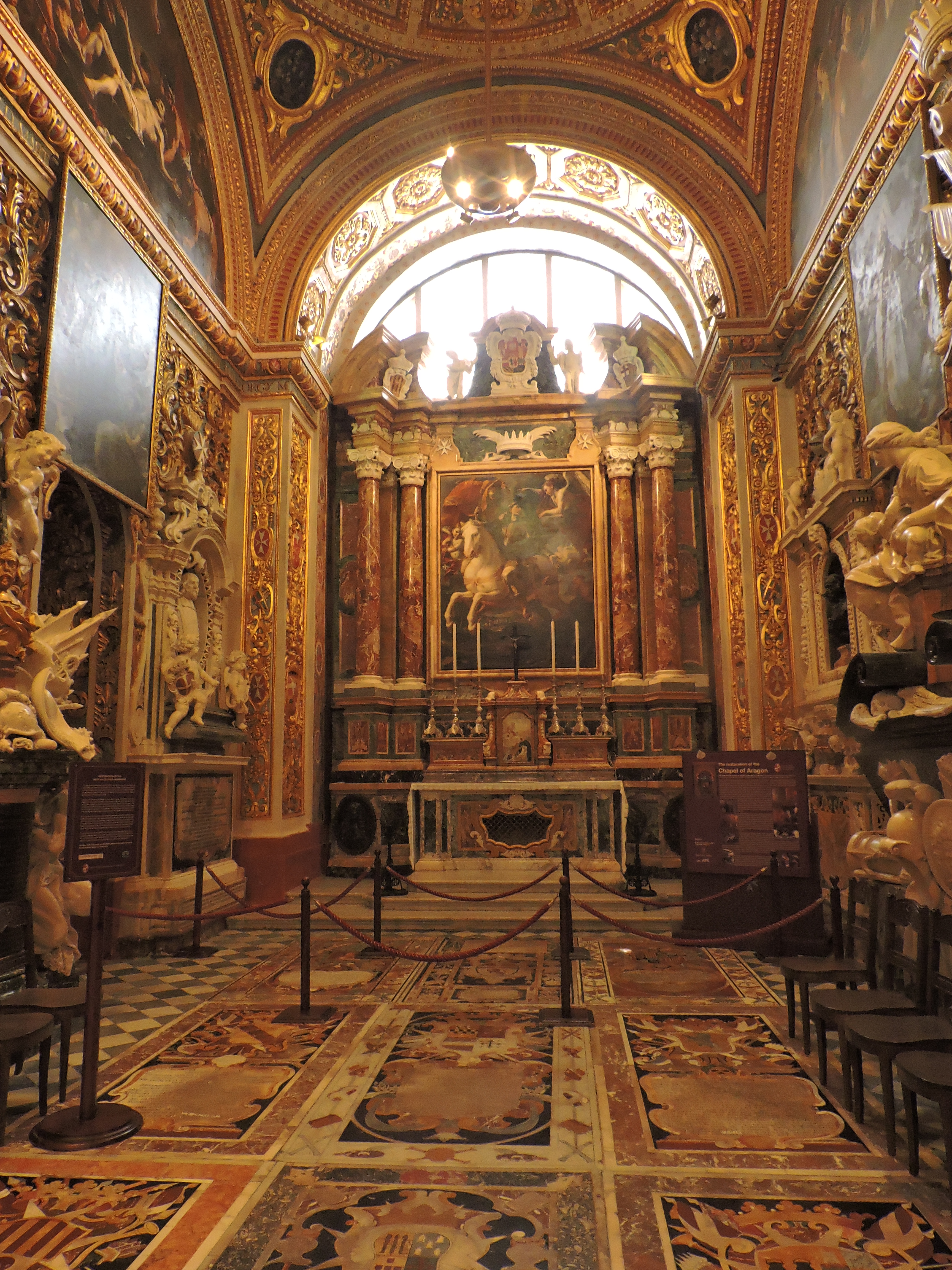
Overwhelming inside is St John’s Co-Cathedral in Valletta

My poor pictures – chosen with a great deal of ignorance and taken with superficial camera settings because the heat was wearing me down – my pictures can’t express the impact that the interior of the cathedral has on your eyes, on your senses.

Look at the floor, into the Chapels of the different “langues” of the Knights, look at the ceilings and look at the walls, and learn …

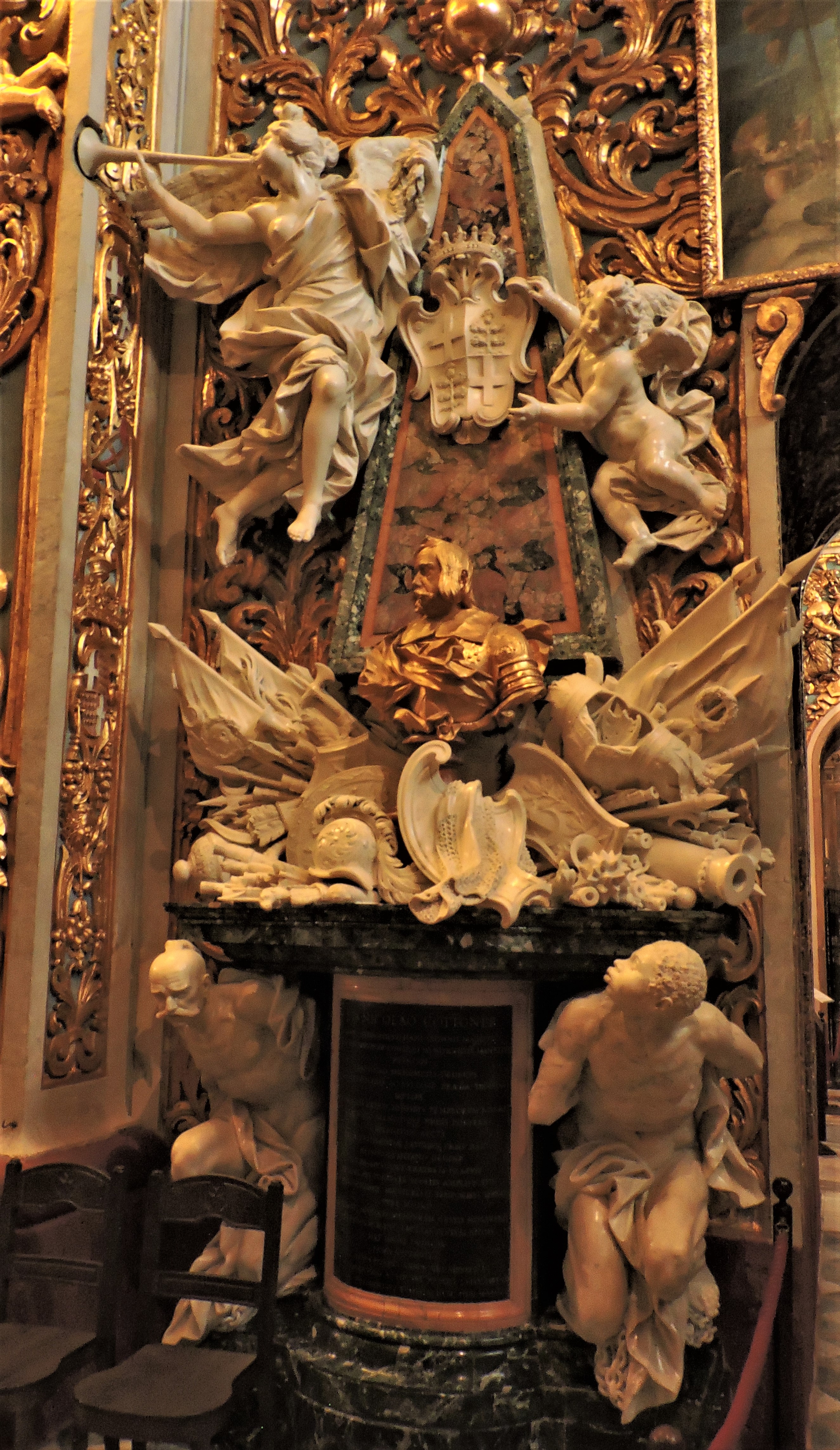
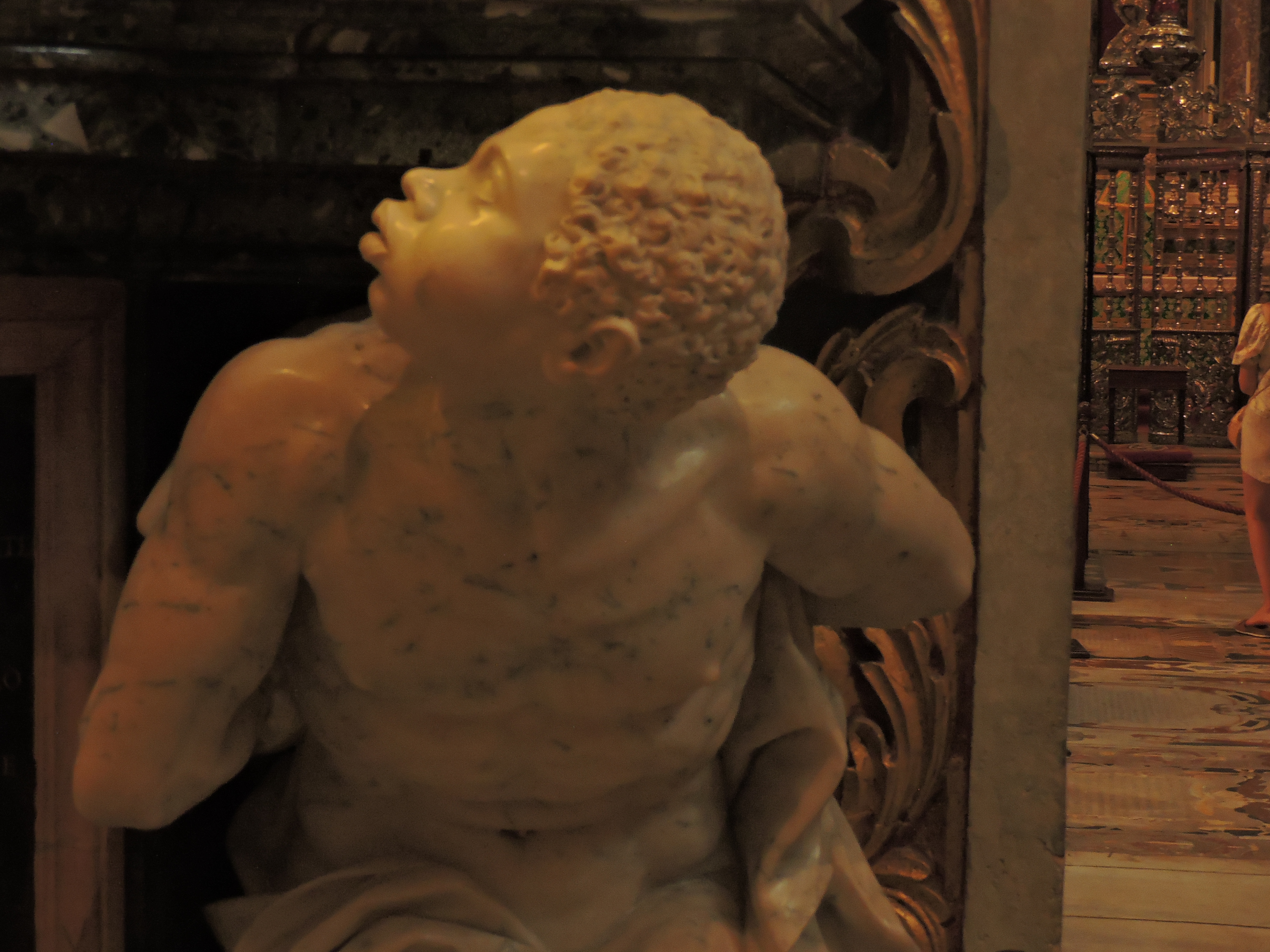
… and learn, for example, how salvation was brought to the poor souls of the slaves all over the world.

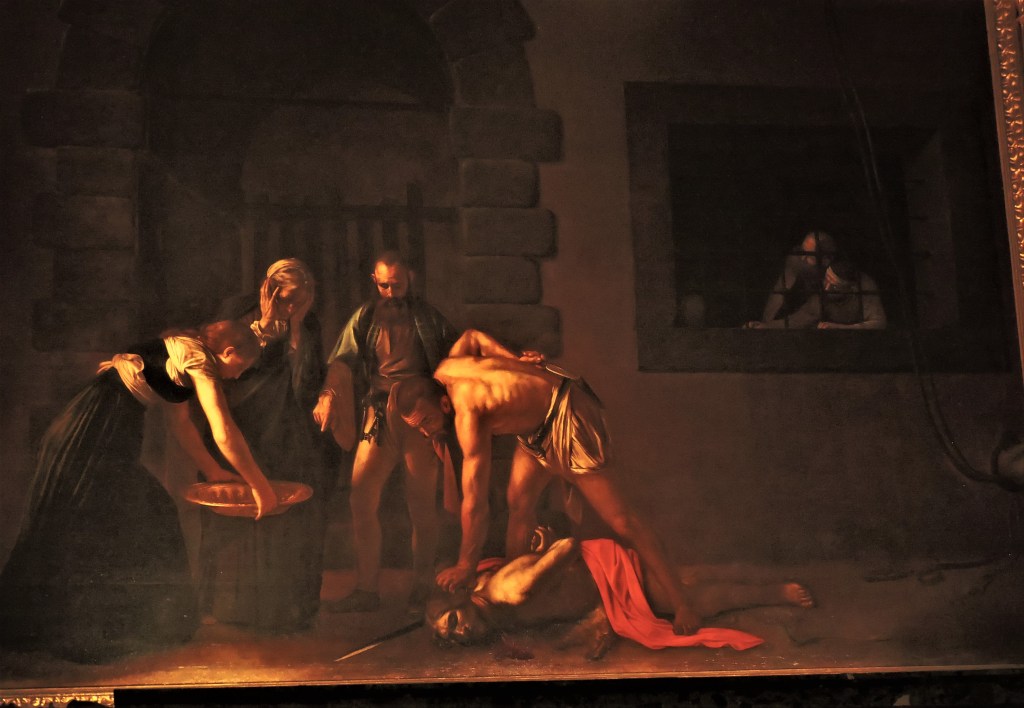
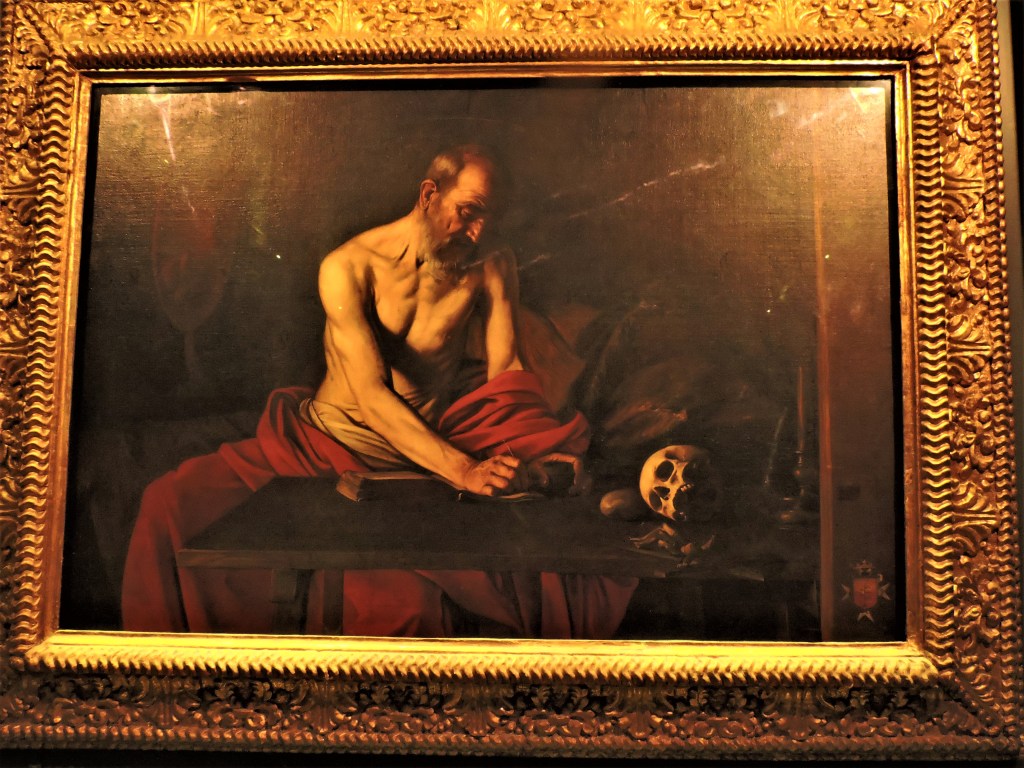
And if you have managed to steer clear of getting struck by the Stendhal syndrome, walk into the Oratory and get carried away by the highlight of the tour: the two Caravaggios. almost hidden in the oratory.

——————————————————————————————————————–

Saint Jerome writing (probably translating, probably the Bible, probably from Hebrew to Greek, the geek)

My roommate from Poland was awestruck by the red colour in the pictures and we wondered how it was produced in Caravaggio’s time. Flowers maybe, insects, who knows. In any case, they must have needed loads of them.

The end: Why hundreds of pictures by Mattia Preti and only two by Caravaggio? Clearly, the hotheaded genius didn’t last long in Malta, he got into a brawl with a knight of a superior rang and had to flee to Sicily.

Now if I got you interested in all that, look it up on the internet, the fotos are much much better. See you next time, I’ve got something mystical to tell you

Gerburg

Tiny great Malta 1

31 Aug

“Oh Island in the sun …” No, I’m not in the Carribean and Harry B. certainly didn’t think of Malta when he sang the song, but the tune is stuck in my head while sightseeing under the scorching sun at + 38 degrees centigrade. What’s there to see in the 10th smallest country in the world, you’ll wonder. A lot, a lot, from >4000 B.C. up to now … you’ll hardly have time to take a swim.

Little did I know about the tiny land right in the middle of the Mediterranean. From childhood I remember “Malteser” and “Johanniter”, the people that help others in need. Their ambulances wear a white (eight -pointed) cross on red ground, (the others are: the Red Cross on white ground).

download

Had I grown up as a boy I would have seen the connection of our ambulances with the Knights Hospitallers or the Order of Saint John. Boys like knights and they know all about them.

These particular knights struck with one hand and healed with the other. In fact, they were called hospitallers. One of the first things they did when they arrived in Malta, they established hospitals there.

In the Sacra Infermeria (in Valletta): two wards, the Old Ward (left, 16th century) and the Great Ward (right, 17th century, 155m long). The arched openings right and left had curtains and lead to the toilets. The sick were served their food on silver plates with silver cutlery, not to be posh – even slaves were treated here – but because of the antibacterial activity of silver. The curator of the museum told me he was working on a project to refurbish the hospital with beds and manikins to give visitors a better idea of what the Holy Infirmery looked like.

The knights left their mark in many ways on Malta. They ruled the country for 268 years, but didn’t exactly make the population love them for their arrogance and their tendency of molesting their women.

However, turism today owes them almost everything. They constructed fortresses, important edifices, watchtowers and, of course, churches churches churches and they protected the island from the Ottomans in the Great Siege in 1565.

DSCN8215 (3)DSCN8353 (2)

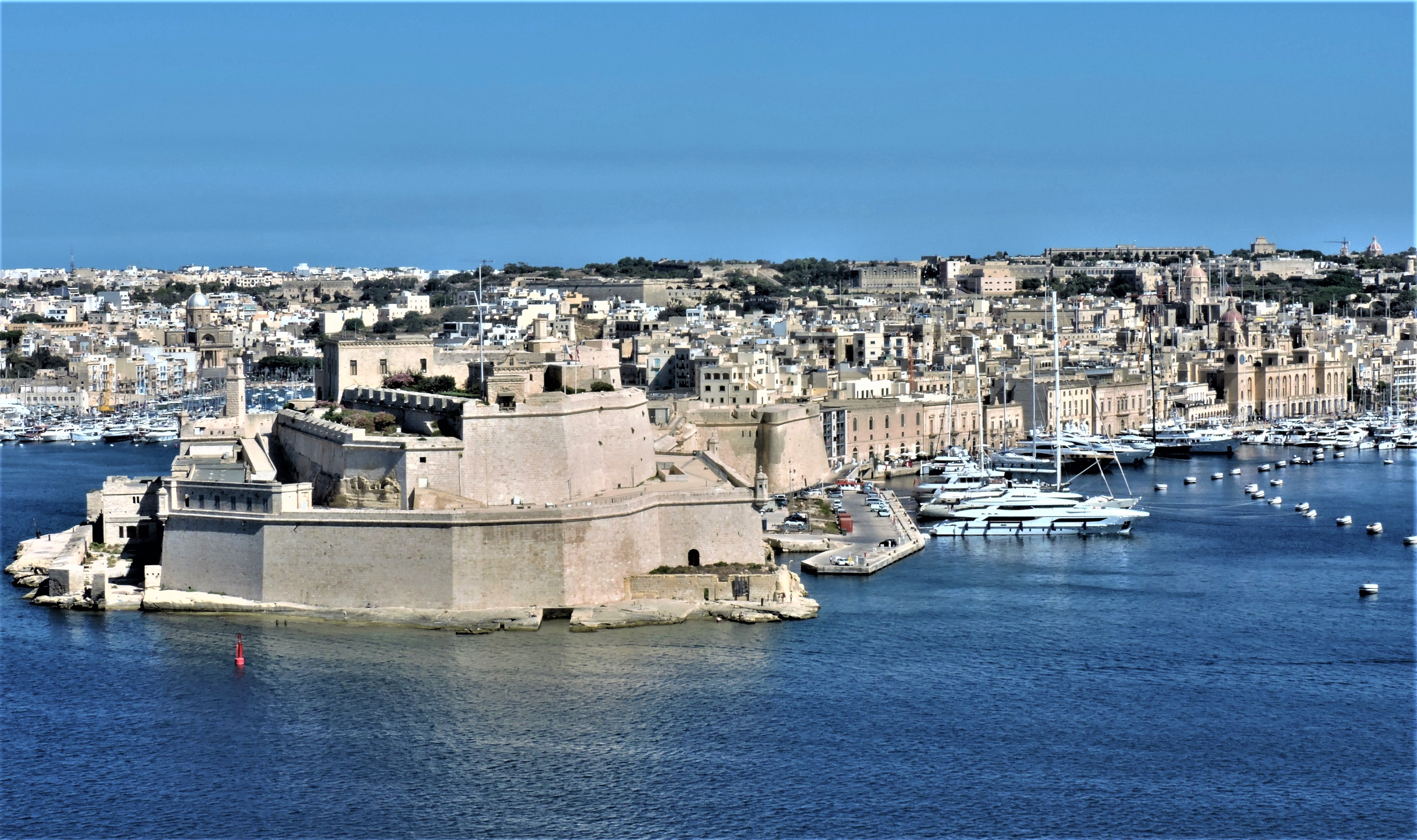
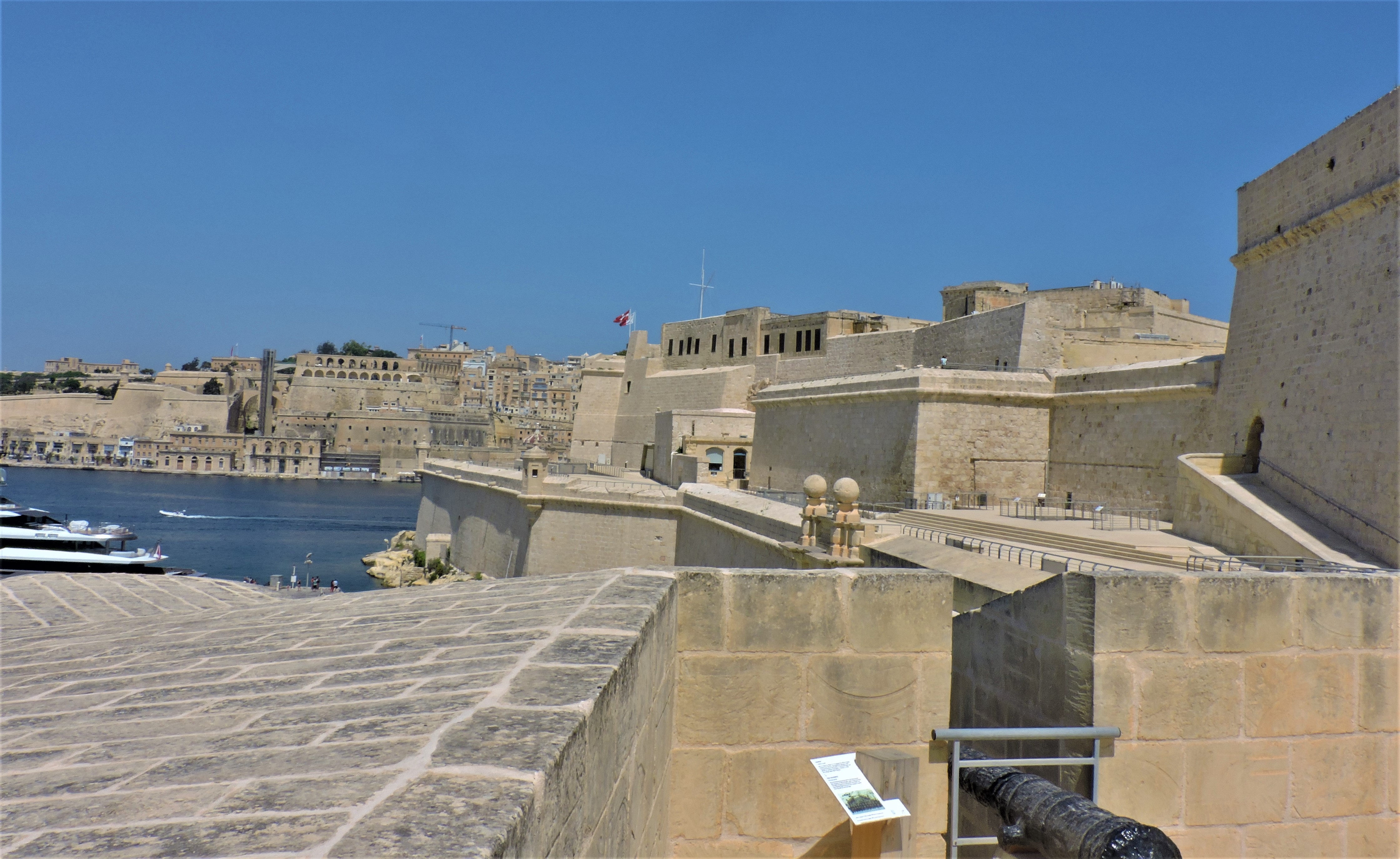
Fort St Angelo: an old fortification reinforced and renovated by the knights, became the main fortress, seat of the Grand Master, bastion against the Ottomans, prison for unruly knights, garrison, and later Royal Navy base.


The elements: worship and battle

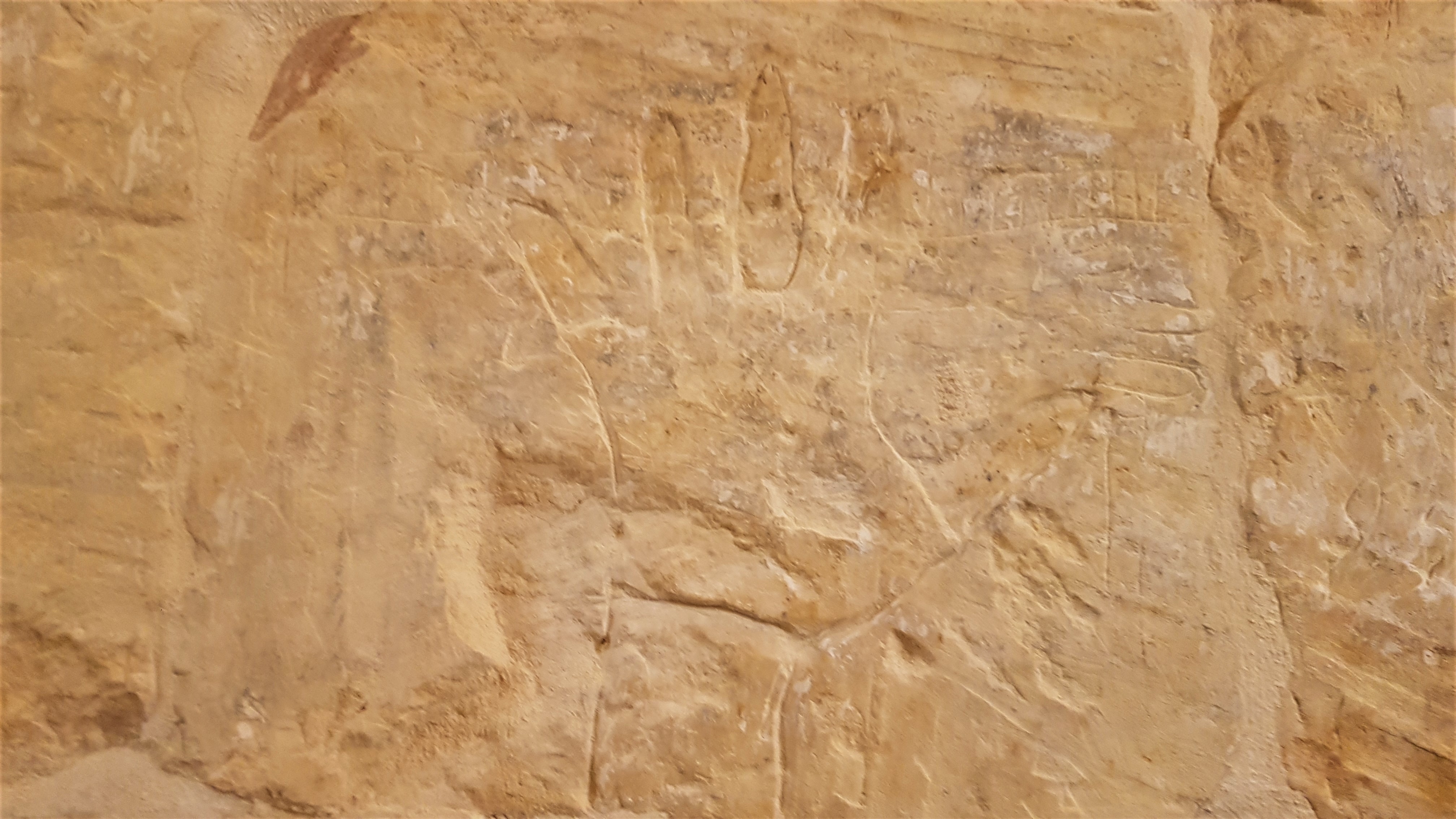
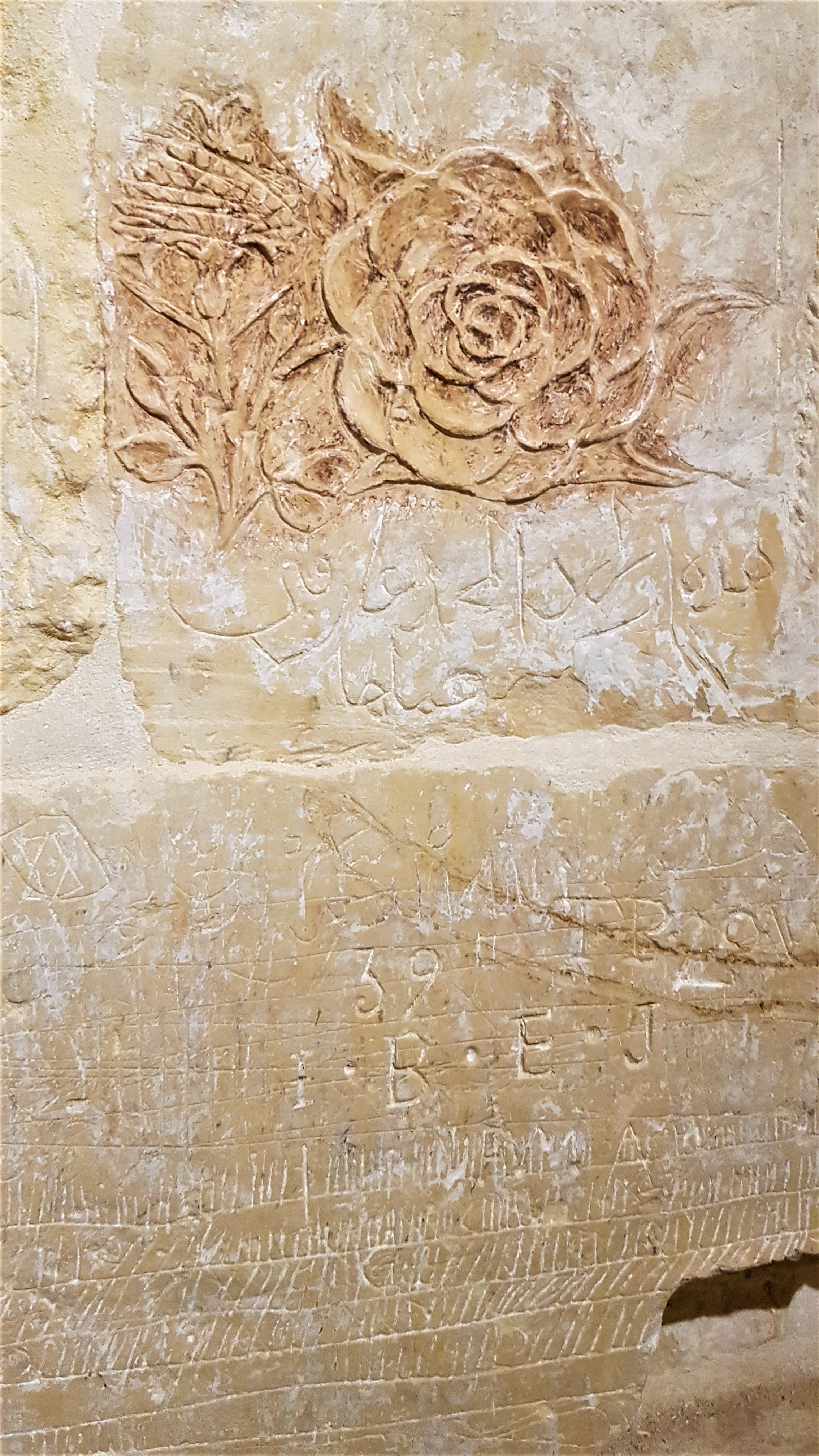
Lookout point, Saint Anne’s Chapel and graffitti carved by an imprisoned knight in an underground cell that had been hollowed out to be a cistern. The knight had killed another knight who was actively envolved in the enquisition. After spending time in the black pit and carving the last traces of his existence into the rock he was finally hanged, poor chap.

Fort St Angelo withstood the attack by the Ottomans who had captured Fort St. Elmo on the other side on the tip of the Valetta Island. It wasn’t conquered and that was the end of the Great Siege.

DSCN8349 (2)

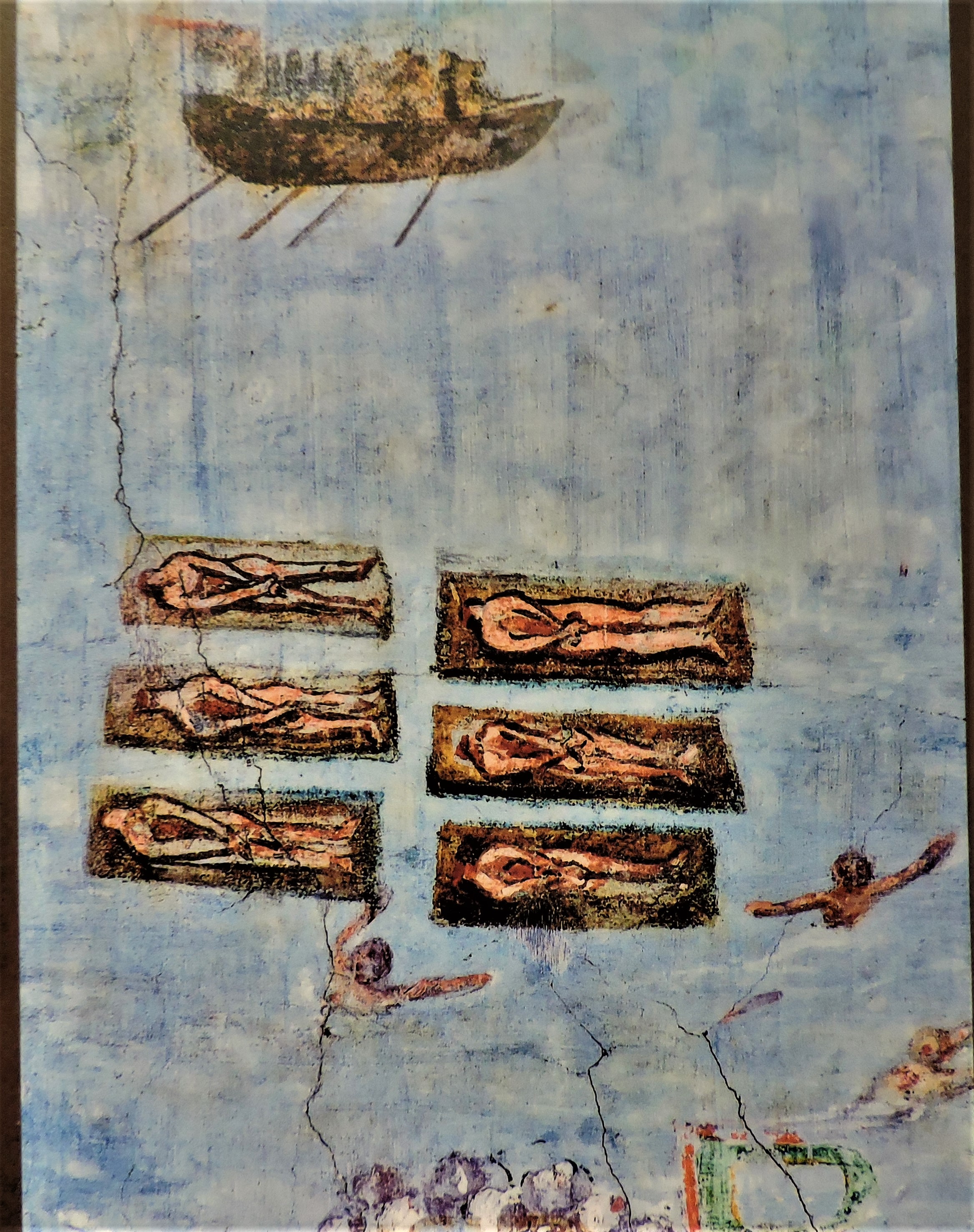
Following the fall of St. Elmo the Ottomans executed the knights and Maltese defenders, and nailed their beheaded bodies on wooden bars which they sent floating across the harbour. It is said that, in retaliation, the Grand Master Jean de Vallette ordered the beheading of all Ottoman prisoners of war and fired their heads in the direction of the Ottomans still celebrating the capture of Fort St. Elmo. Tough!!

DSCN8351 (2)


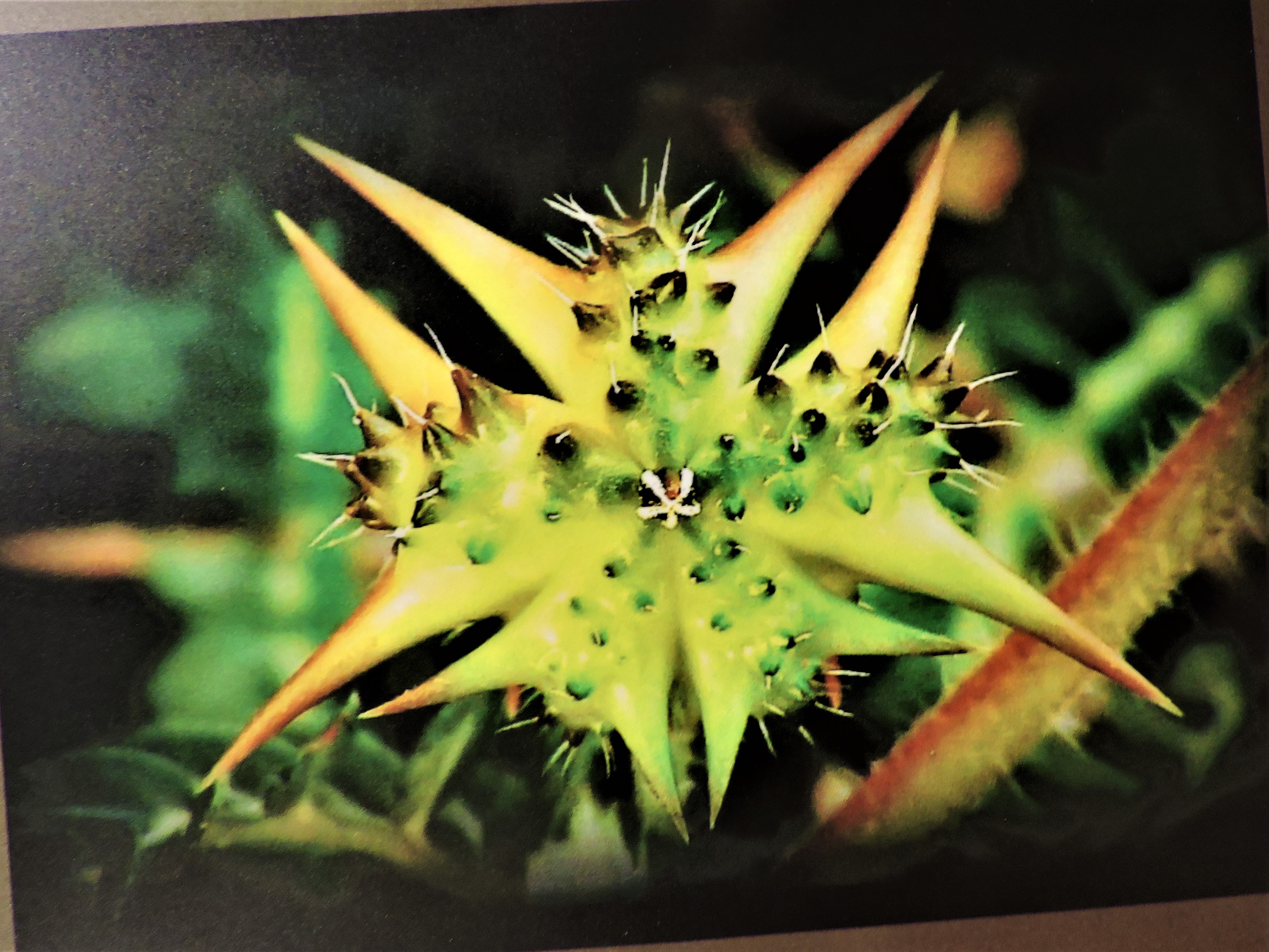
Legend has it that the yellow flower the ‘Knights’ Rose’ (Tribulus terrestris) grows exclusively at Fort St. Angelo as a tribute to the martyrdom of the knights whose blood watered the plant. In fact, what does the shape of the blossom remined you of?


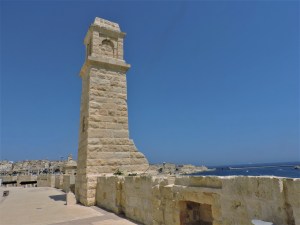
DSCN8357This monument was erected more than two hundred years after the Great Siege to commemorate the fallen knights and the victims of the plague outbreak in 1676.


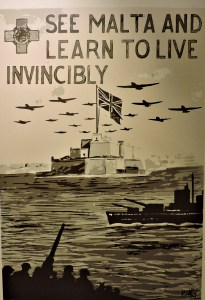
The last siege of Malta from 1940 – 1942 was also unsuccessful. The rogue states of the time bombed the British Crown Colony of Malta to ashes and rubble. The human cost was high but in the end the Axis broke and the people of Malta were awarded the George Cross.

DSCN8346 (3)

A poster of the invincible unsinkable stone frigate HMS St Angelo

DSCN8076 (2)

By Anton Agius, Malta’s ‘National Sculptor’: a group of 4 people standing near to the fuselage of a downed Nazi fighter plane.
One man is holding his head, whilst the three other people are lying on the ground, either dead or wounded.


DSCN8200 (2)

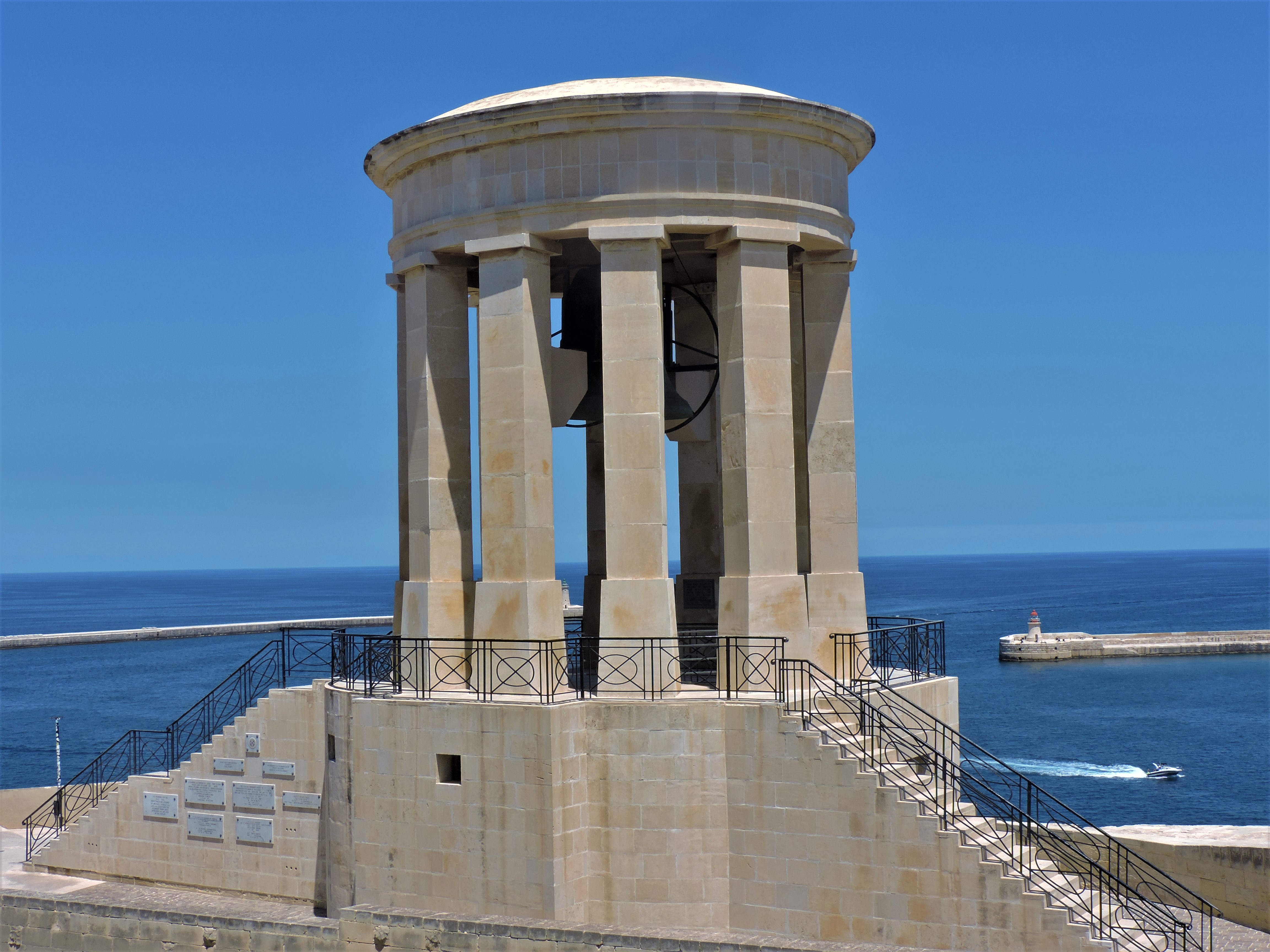
The Siege Bell Memorial, strangely enough I passed by it twice with someone from Malta (Oh, what’s that?) but wasn’t enlightened.

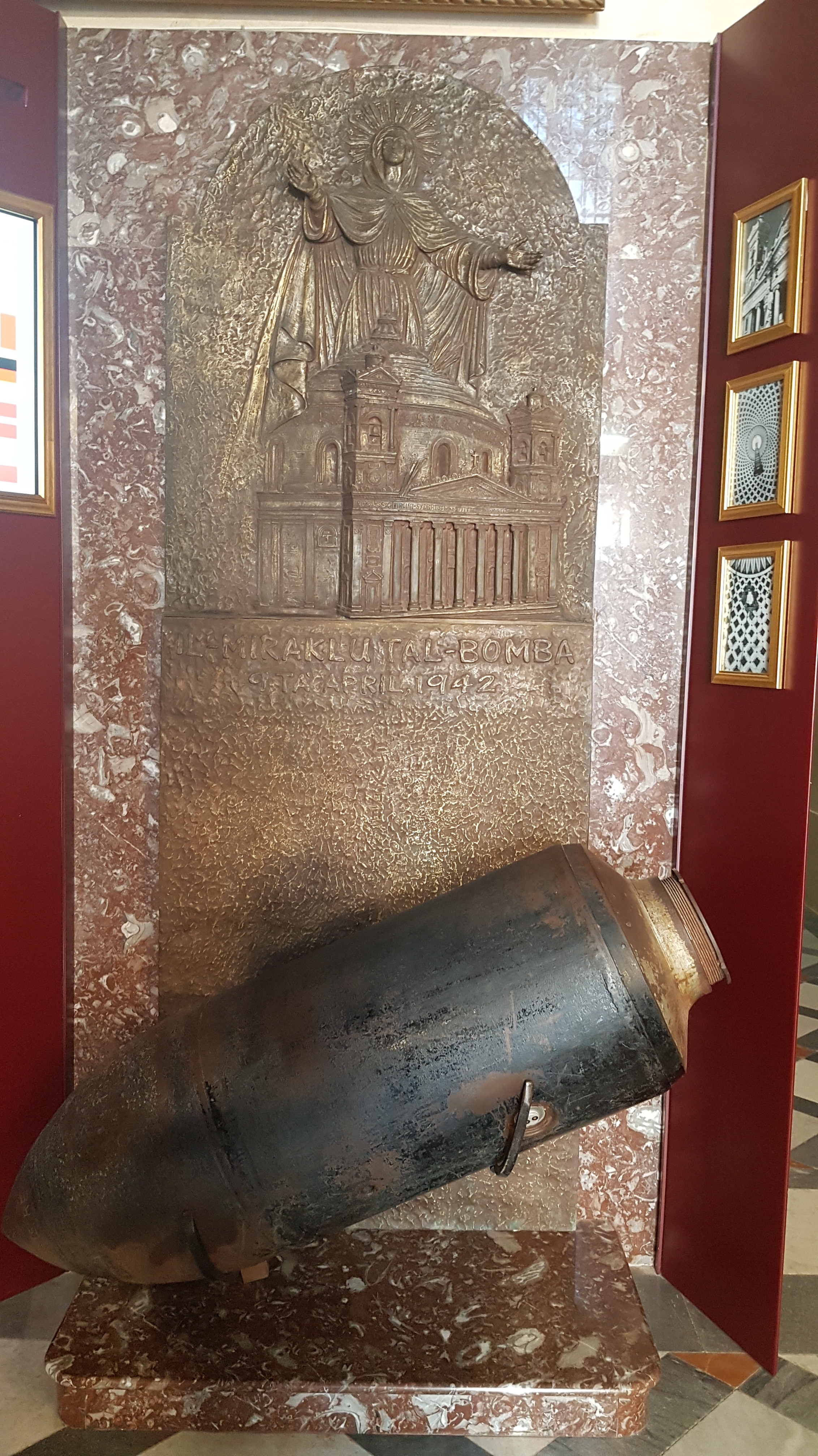
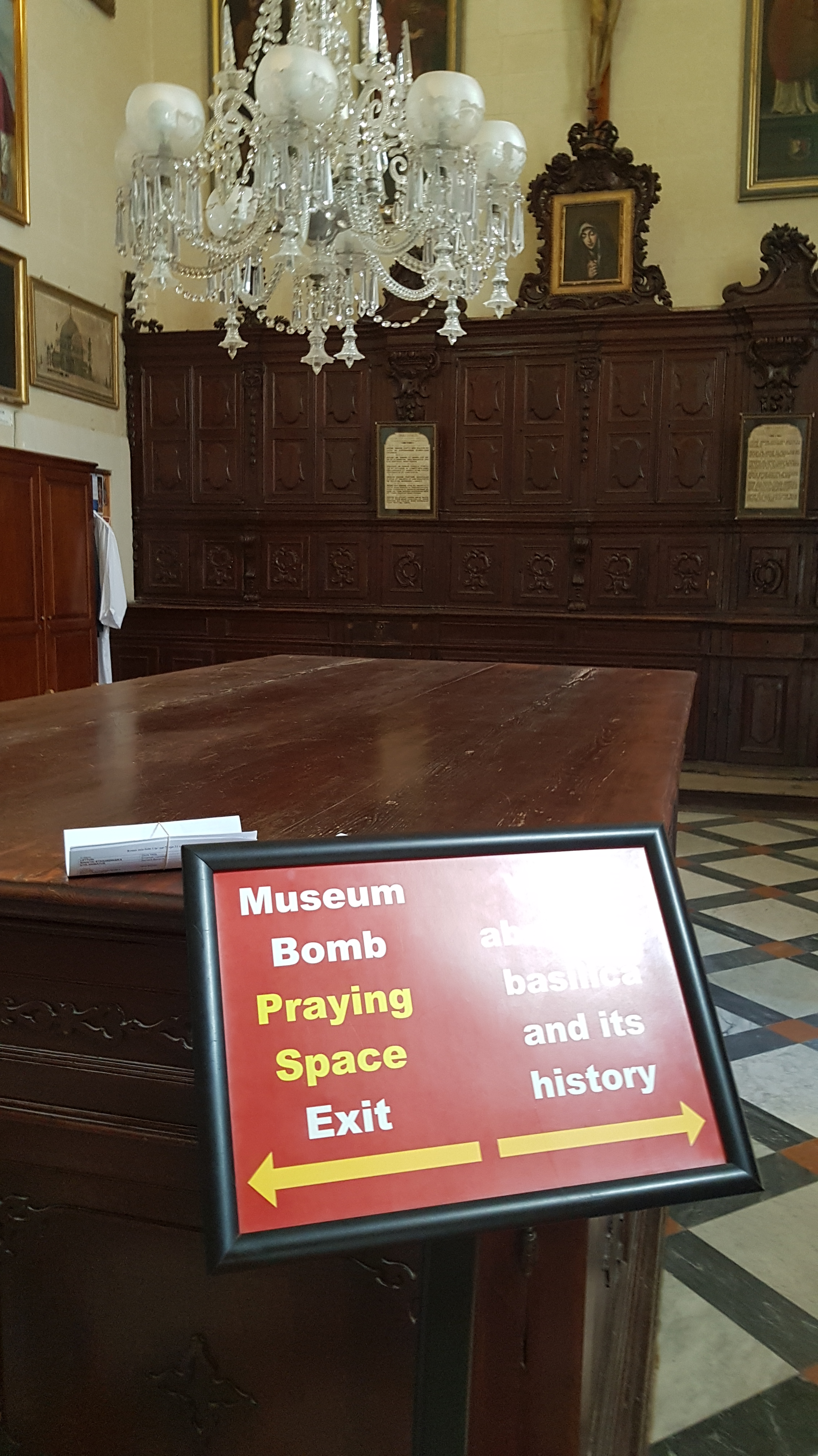
You find traces of WWII everywhere you go on Malta. The Dome in Mosta exhibits the bomb that struck it in 1942 when 300 worshippers had assembled for mass. Thank God, it didn’t detonate and what you see today is a replica, of course.

20200729_10295320200729_102143

And you can visit underground bomb shelters where you see how the population managed to get by during the heinous attacks by the infamous Luftwaffe and Regia Aeronautica.

They even managed to have a PARRUKKIER (hairdresser)!!!

To be continued

cheers Gerburg

From Italy to Iran with love (1)

22 Mar

Iran Summer 2019: a memorable experience in culture and humanity.

Greetings from our mandatory home retreat where memories travel wherever they like: roughly 2000 pictures show breathtaking architecture: mosques, bridges, badgirs, and the Azadi Tower, buzzling bazaars and squares, bridges, fairytale palaces, excavations older than antiquity, stunning art and charming poets’ tombs and memorials. No time and space can show all the wonders of our trip. This post is to say thank you for sharing all the beauty with us.

20190724_225600 (2)

Thank you for welcoming us in your splendid mosques and shrines.

Tehran: Imam Khomeini Mosque. The young woman put her baby in my arms. (It was a good omen: I’m going to be a granny in September!).

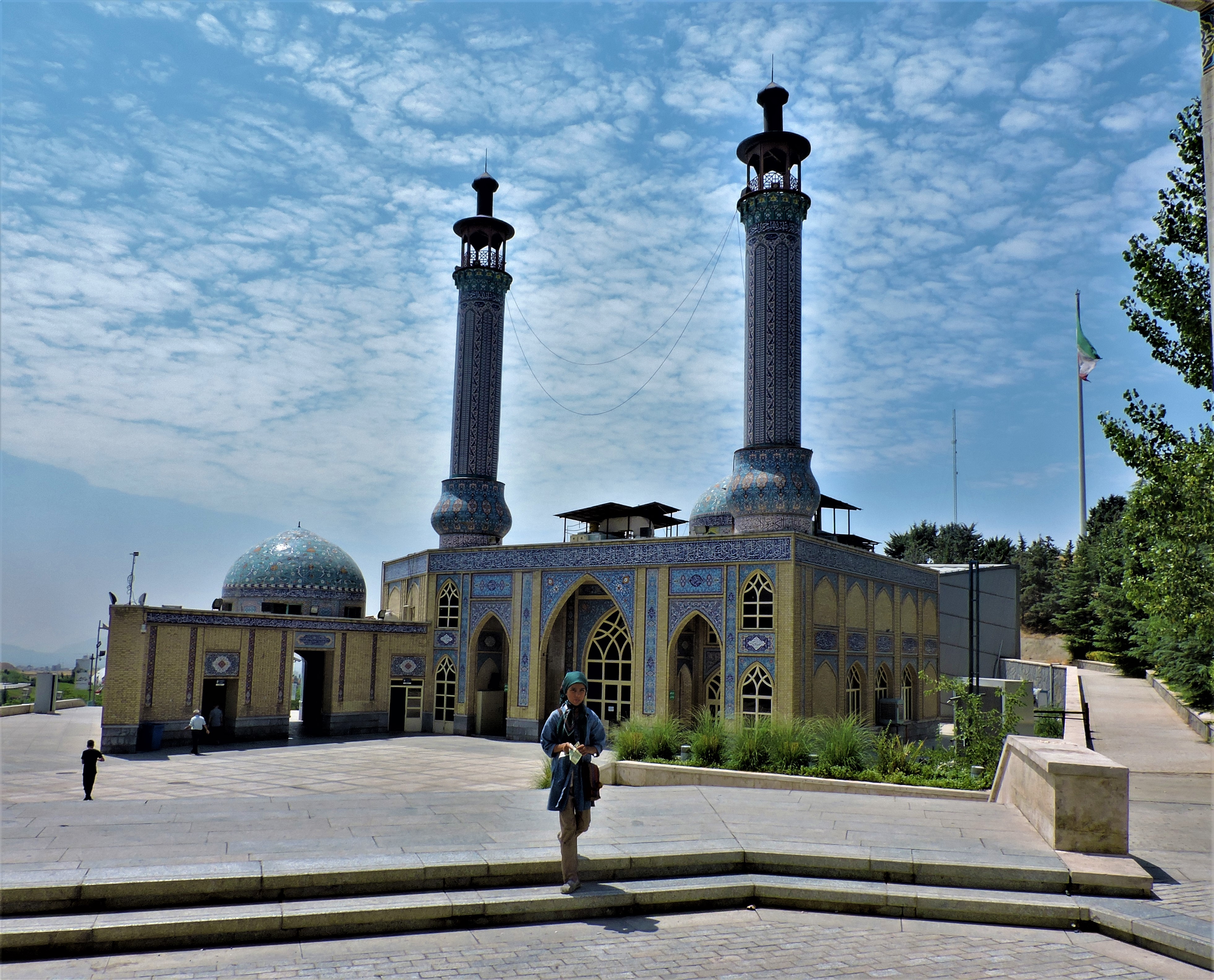
DSCN9978 (2)

nice small mosque in the North of Tehran

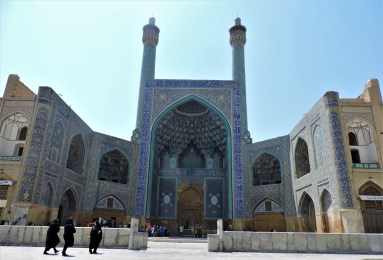
DSCN6642 - Copy (2)

Masjed-e Shah, Esfahan, refined decoration in blue tiles

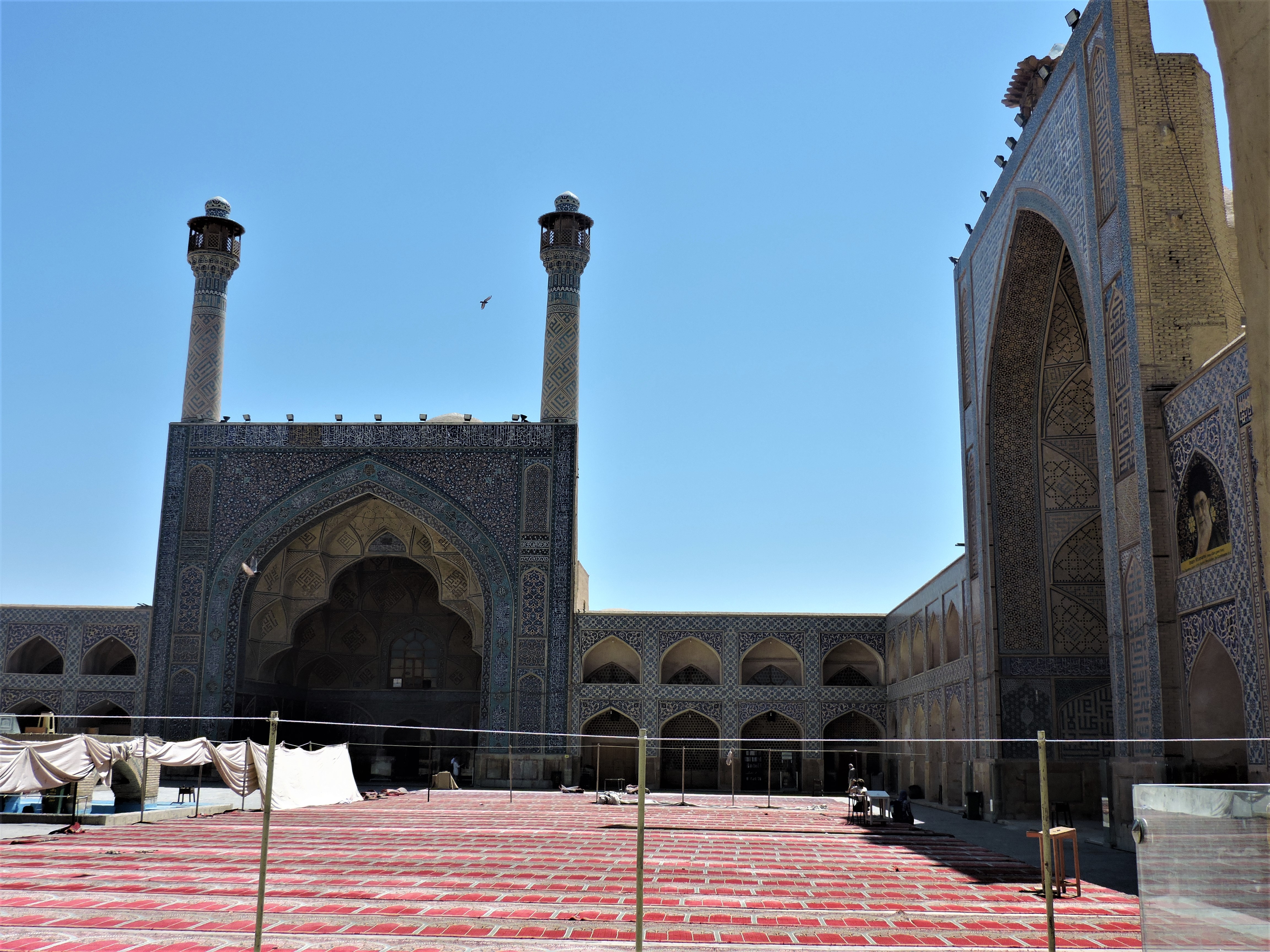
DSCN6742 (2)

Masjed-e Jameh, the Friday Mosque, Esfahan

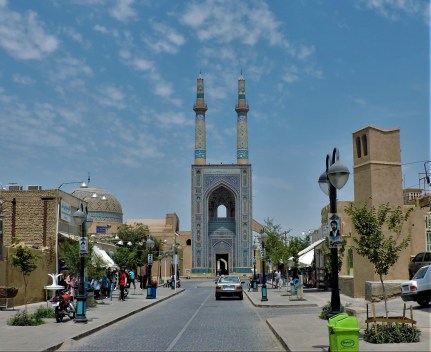
DSCN6833 (2)

Masjed-e Jameh, the Friday Mosque, Yazd with a badgir front right


DSCN6820 (4)

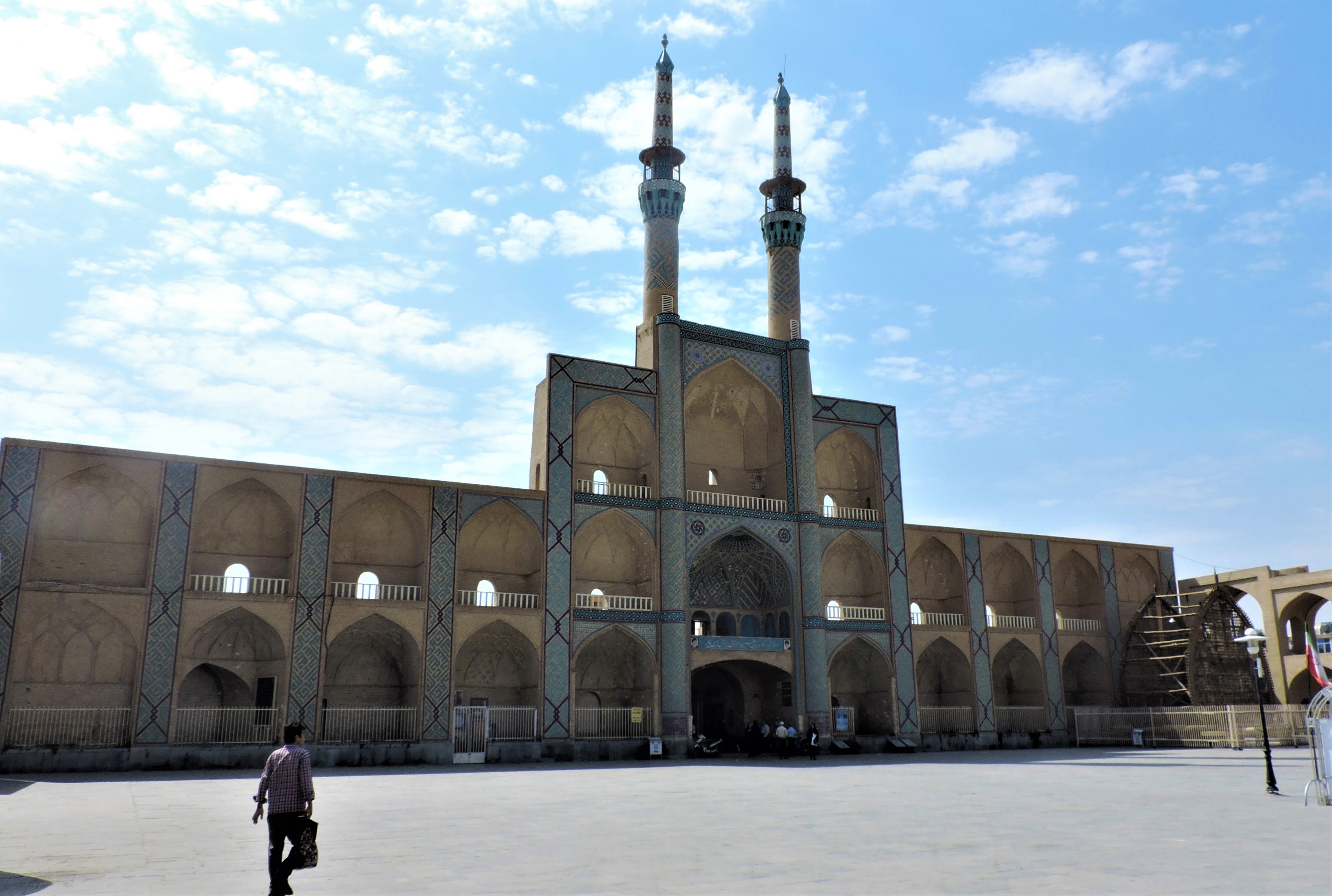
Amir Chakhmaq Mosque, Yazd, stunning facade


Thank you for offering us snacks and tea, for giving me a clean chador wherever it was necessary, for refreshing me with juicy apples in the afternoon heat when resting at the mosque entrance. It is quite common that people share what they have to eat with others, even more so in a mosque where many visitors offer something to other visitors.  (below: shrine Borgeh Sayd Rokknaddin, Yazd; Shah-e-Cheragh Mausoleum, Shiraz; Ayatollah Chomeini Mosque, Tehran).

After a warm welcome to the shrine Imamzadeh-ye Ali Ebn-e Hamze (Shiraz) with a cup of tea, some biscuits and a freshly starched and ironed chador the ladies tending to the shrine showed me around.

DSCN7235 (2)

With the smallest vocabulary imaginable the women from very young to almost elderly managed to quench their curiosity: “we Christians … me Protestant … husband Catholic … me German … husband Italian” (shining examples of cosmopolitanism and tolerance 😉 The ladies responded with enthusiasm: “Oh very good, very very good!” I tried to buy the chador from the shrine, just to have my own, they telephoned around but it wasn’t for sale ;-(

What is difficult to take photos of is the friendliness, gentleness, hospitality and generosity of the people. Thank you for making us feel at home and giving us a taste of your humour …

…thank you for helping us and taking good care of us: the two young chaps, one a taxi driver (safe driving!), one a soldier on leave even insisting on paying the taxi when we got to Rasht at night and didn’t find our way to the hotel. A family having a chat with us on a Sunday outing, oops Friday outing, to the gardens that once belonged to the Pahlevi family.

Making friends on every occasion: visiting an Armenian Museum, mosques and churches, and having coffee on the road (in Northern Iran, Naser Baini, thank you for getting us home safe!)

Proud parents send their kids ahead to talk to us and practice their English. They always get a whole beginners’ lesson: “What’s your name? Where are you from? How old are you?” Numbers are difficult and they go back to their parents. The older ones ask: “Do you like Iran? What is your religion?” And boys: “What is your favourite football team?”

The miniaturist Hussein Fallahi (Esfahan), a world-renowned artist, told us to pay on our own with our card at his card payment machine while wrapping up our souvenirs. How did he know we weren’t frauds? Do frauds not exist in Iran? Everybody pays by card and everybody tells his pin to the shopkeeper or the waiter. My first reaction at a juice vendor: “No, no, no! I digit the pin myself.” I looked at the card payment machine and couldn’t read the numbers. Everybody around me bent over laughing. Infact, you experience the opposite of cheating: you ask someone where you can buy, let’s say, washing detergent, he goes out of his way to show you the shop and before you realise what’s happening, he has payed for it and tells you, where you can find him in case you’re looking for anything else (That was in Tabriz). Or you meet a young man in the street (above) “collecting friends” taking pictures and exchanging a few words in English, or you take photos of the children posing dressed up in traditional clothing.

And thank you Mehri and your wonderful family for sharing your family life with us, for taking us on an adventure trip into the montains around Yazd and for inviting us to the best restaurant of the whole trip.!!!!

In gratitude to you Mehri and all the other people who helped us to get to know the country, the culture, and its people … and contributed to a wonderful and safe holiday.

DSCN9915

Sorry Rasool Zabihi, I haven’t got a picture of you and your guides, but I made TAP Persia  known to everybody!!! Thank you very much, you and your staff, too.

We are thinking of you all. May there be an overall change of heart to lift sanctions and shower your country with all the medicine and medical equipment you need in these difficult times.

Take care!!!

Never mind the Laamiido

3 Feb

DSCN9713

I have always wanted to see a lamido (laamiido), or at least his palace. One of my students had proudly chosen Ngaoundéré, his hometown, for the presentation he had to give in class of a nice place in Cameroon. I decided, I absolutely had to go there.

It takes 15 hours by train to go from Yaoundé to Ngaoundéré, (could be more, unlikely less), a night, a breakfast and a few hours of looking out of the window.

You have to have patience!

– when you buy the ticket at the well guarded train station in Yaoundé, where you queue under the vigilant gaze of security guards who don’t give special treatment to men in uniform (maybe a higher rank, but common soldiers queue like elderly ladies).

– when you board the train with the unasked for help of a porter. A tiny, tough chap all of a sudden grabbed my small backpack and started running through the crowd in front of the check-in barriers. Somehow I kept up with him and he placed me and my little backpack in a waiting room for VIP, i. e. the people with sleeping car tickets. He wanted money, I said no (getting grumpy inside).

“You cannot catch a train without a porter,” a lady patiently explained to me. Sure, all the other passengers had these huge checkered carrier bags full of all types of heavy goods (even cassava, Godknowswhy)

“I always do”, I stupidly told her.

It happened again at boarding, same guy, same haste. I got to my wagon-lit in less than two minutes (probably would have never found it myself), payed as much as others payed for 30 kg of luggage, but ok, it really wasn’t easy to find the carriage and get on the train with the crowds. Beds and sheets seemed clean with mosquito disinfestation toxin lingering in the air, sanitary facilities unhygienic, lights not working, I refrained from drinking.

In the morning the ladies that had boarded the train the evening before with big bags with baguettes and thermos arranged for breakfast. Good. After that: look out, count the stations and take pictures.

Arrive at Ngaoundéré station, take a taxi to the Maison d’Accueil diocesaine (Catholic mission run by Polish nuns), take a shower (the water is WARM!), go out and have yogurt with a cassava – maize mixture. This is lunch. The climate here is different from Yaoundé, almost Sahel, the rainy season is over, it’s warm and dry.

My taxi-driver is very good, calm, cautious, courteous. Next day I call him to take me to Tello Falls, about 50 km outside Ngaoundéré, the roads are such it seems twice as far.

Undulated plains, greenish from the rainy season, villages, cattle, where that delicious yogurt comes from, people telling us the way in Fulani, the lingua franca outside the city because in the countryside French isn’t spoken. The Fulbe or Fulani here are sedentary now but still essentially pastoralists.

Spectacular Tello Falls, the trip was worth it. The path that leads to the bottom of the falls is difficult to find. We met “the man with with the machete” who lead us down to where the falls plunge over a rocky cave into a pond.

Abdou, my taxi driver (picture: front), a devout Muslim, overawed by nature’s beauty couldn’t stop praising the Creator’s greatness, I took pictures and the man with the machete kept us company.

One last picture from the top of the waterfalls, don’t lean over, say good-bye to the man with the machete, give him a tip for being there and back we go. Except that driving on arid ground doesn’t mean that you might not end up in a swamp all of a sudden with the wheels spinning  and digging deeper and deeper in the mud.

Abdou ran back in the direction where we had come from. (I was worried, Abdou had had a serious disease in the past and wasn’t supposed to exert himself physically. I looked at the problem from all sides and figured if any wild animal appeared, I would just get into the car and close the door. But as usual, nothing really exciting ever happens to me. I had time to think of a feasible plan B: find a village, sleep in a hut … He came back with the man with the machete, who started cutting grass to be put under the wheels. Two motorcyclists literally coming out of the blue stopped and helped lift the car up onto the dry grass.

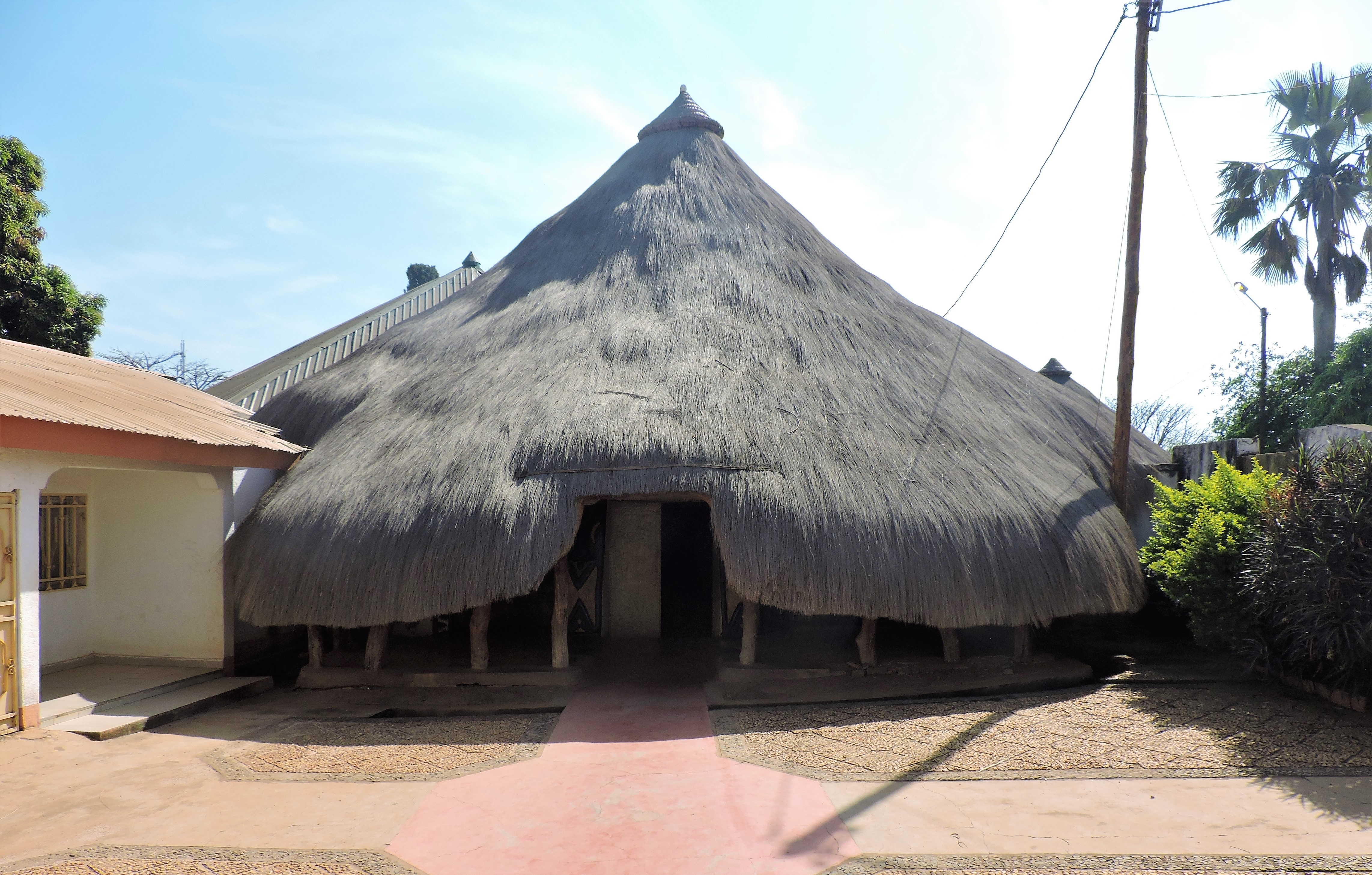
The visit to the Lamido’s Palace: book ahead just in case another tourist plans a visit on the same day.

DSCN9712

DSCN9714

DSCN9715

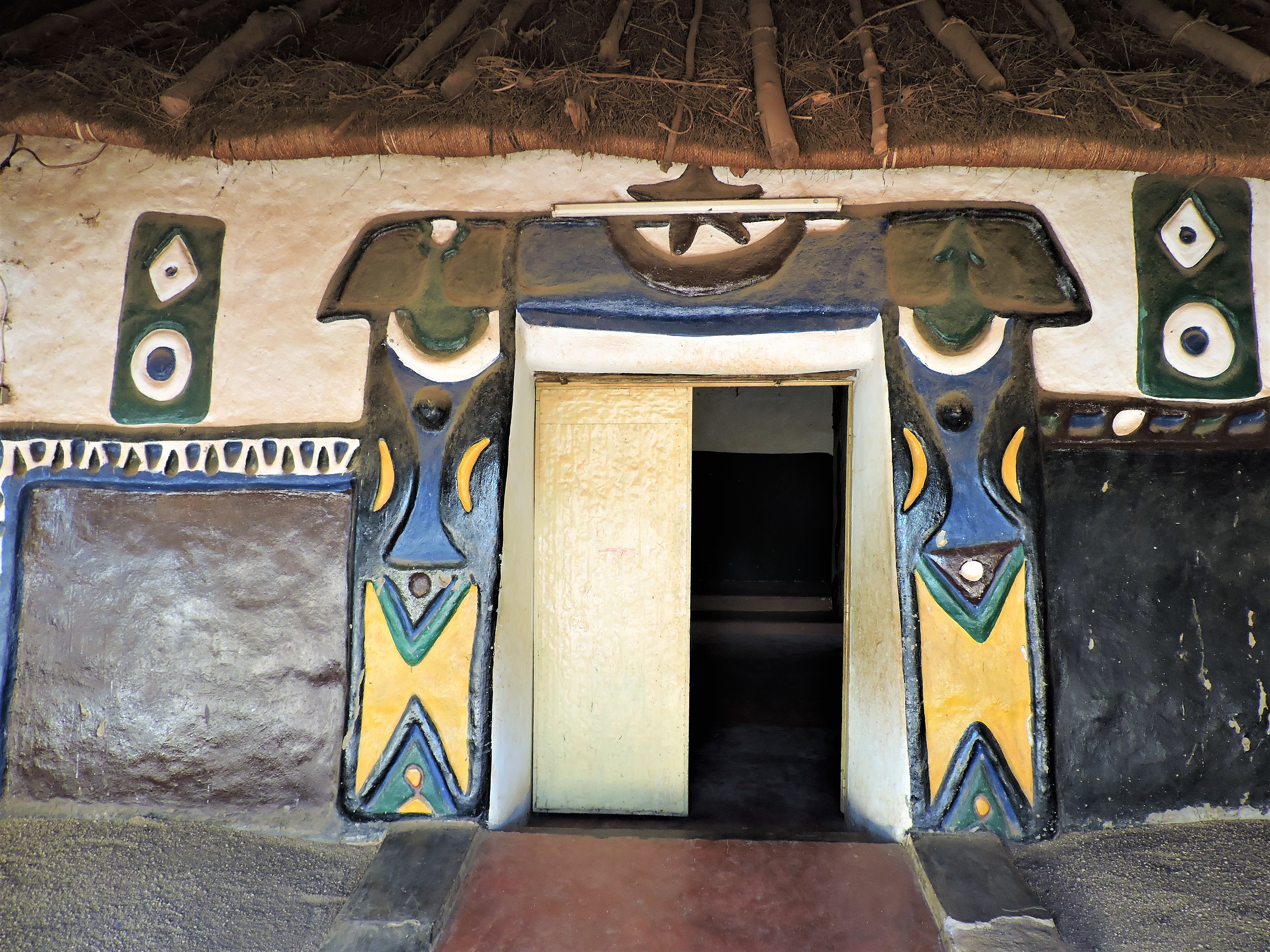
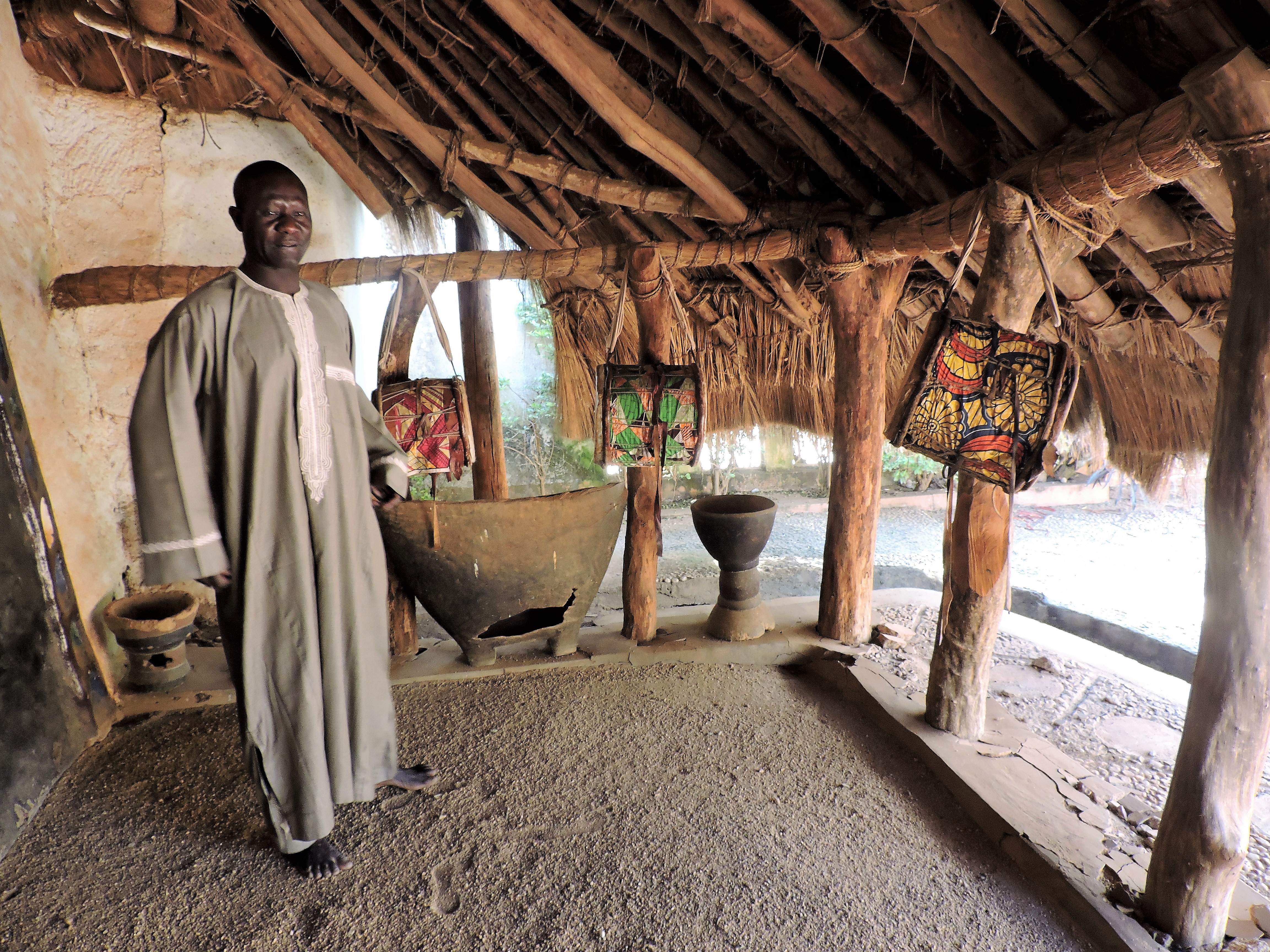
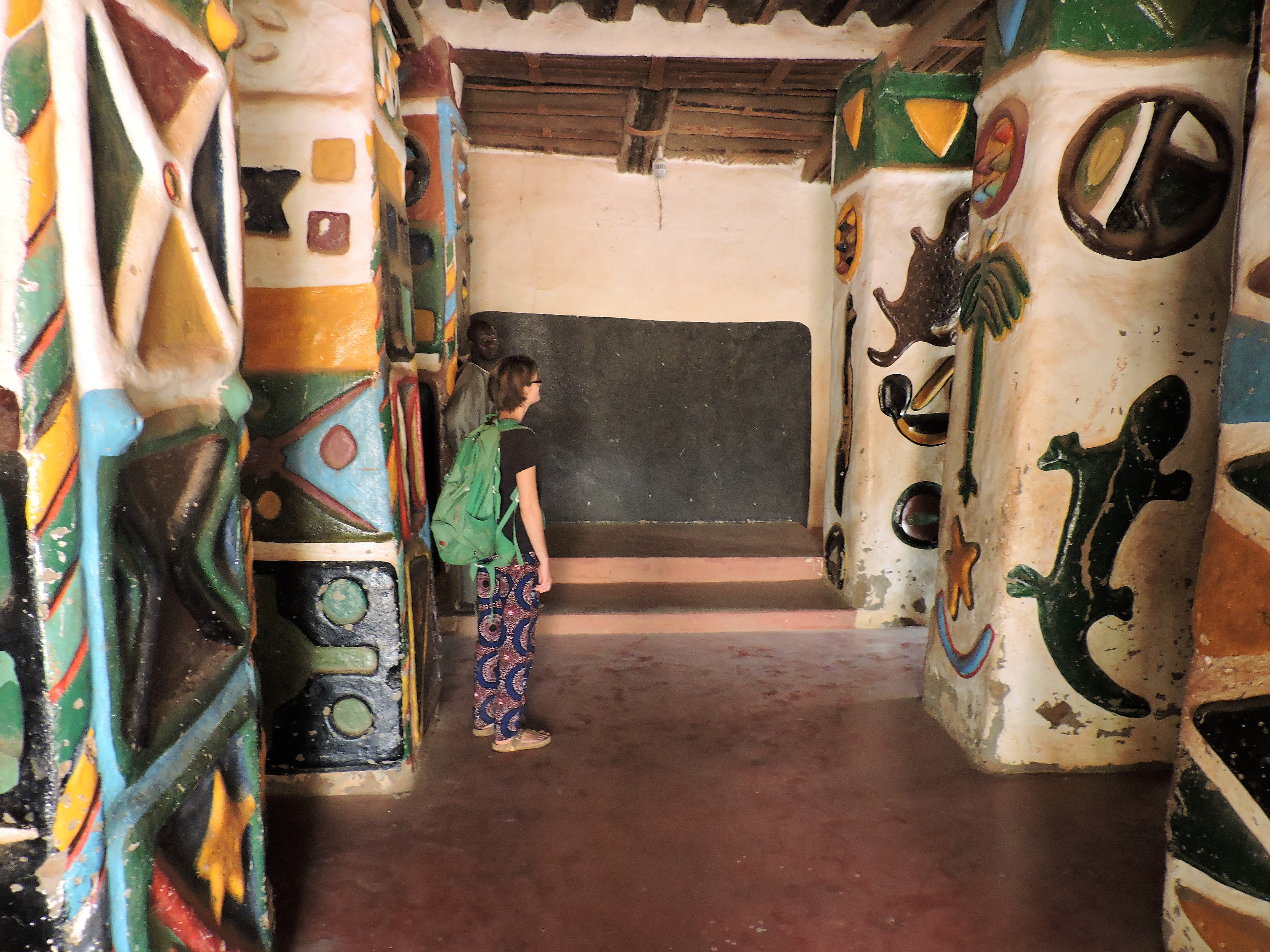
Traditional on the outside, decorated with colourful symbols on the inside

To enter or not to enter? Anyway, the Lamido isn’t home and won’t be back till the next week, too late for me. I heard contrasting news about this regional leader: someone local describes his education as inadequate like not being able to read and write, but that must have been some time ago. Our guide in the lamidat tells us about a mosque, a school and a hospital all public and part of the lamidat … and that’s what we expect a leader to provide, isn’t it?

Looking at the Lamido’s family tree I discover another repugnant act committed by my countrymen (I would have been surprised, if not). It seems poor Lamido Mohamadou Abbo Issa got killed while the Germans occupied Ngawndere.

A last look at the guest book: in 3 days: an Austrian, a Cameroonian, 2 Yemenites, a Syrian and two Germans (hi Laura!), with Austria and Germany being the only countries where there is peace. Greetings until my next and probably last letter from Cameroon Gerburg


Kribi 2: prawns, waterfall, lighthouse and goodbye

9 Dec

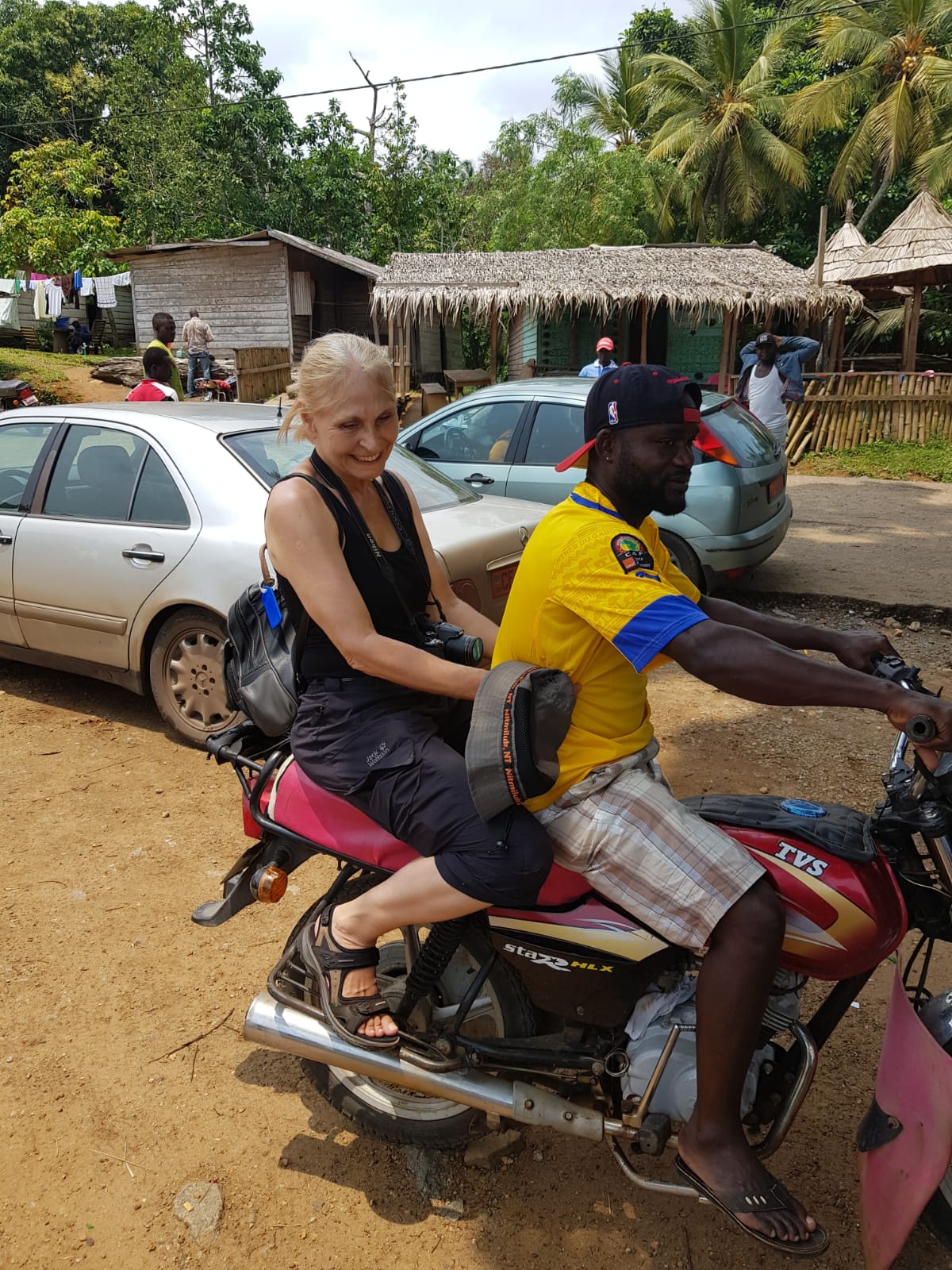
The real adventure starts when you can’t find even the most ramshackle taxi to take you where you want to go and you entrust your life and well being to a motor-taxi. While going over rough and tough I began to understand why you “ride” a motorcycle. I grabbed the poor driver by his sides, leaned forward toward his right ear and said in textbook French: “Veuillez conduir un peu plus lentement!” After which – to my dismay – he turned round at full speed and said something that I interpreted as “don’t worry!”.

IMG-20180818-WA0006Then I limited myself to short expressions like “doucement!” or “attention enfant!” “chien à droite!” “sable sur la route” … just in case …

A few young men with a rowing boat took us to where the Lobé river, the same one that leads to  the forest village, plunges directly into the Atlantic Ocean (Chutes de la Lobé). It’s a unique environment of great mythological and spiritual value to the autochthonous peoples as well as of naturalistic value for all of us, ideal habitat for prawns, too. World Heritage! (either nominated or already on the list).

Kribi Town sightseeing: The lighthouse, German legacy and still operative, from where the indigenous population was evacuated to Limbe after the outbreak of WW1 when the allied forces from France, Belgium and Britain invaded the German colony Cameroon. There is St. Joseph’s Church where by the end of the 19th century the newly arrived missionaries didn’t last longer than a year before being buried on its premises. There is a fantastic fish market with all kinds of fish that I had never seen or heard of before. Unfortunately I lost all my fish market pictures while I tried to transfer them to the computer.

You see huge modern adds right next to someone doing his laundry in a very traditional way.


You see an add for a clinic that offers general health care, and care during pregnancy, childbirth, vaccination, ultrasound, x-ray, gynecology, treatment for venereal diseases, family planning and the irresistibile offer of circumcisions for 5000 CFA roughly 7€.

I didn’t take pictures of what I would consider the best scenes, on a market, near a mosque, people started looking at me as if they didn’t appreciate someone walking around with a camera so I made do with a couple of unspectacular photos without running into trouble.

And then it was bye-bye Kribi. The bus ride to Yaoundé wasn’t without trouble with police harassing mini-buses in general and foreign passengers in particular.

Waiting for the bus someone falls asleep on top of his merchandise. A little boy befriends me and takes a picture of me.

It is not easy to take one of those buses. There is always a lot of confusion and in the end more people get on the bus than you would imagine. I never found out where they put the little pig in the basket.

The buses don’t stop for toileting but for police checks, yes. I always have a weird feeling when men are singled out and taken away …

… but all’s well that ends well.


Kribi 1: beaches, prawns, waterfall and forest

8 Dec

From Douala to Kribi: public transport again, a couple of hours, it’s raining, I don’t drink, near Edea there is an old German bridge over the Sanaga river, you see it through the window, amazing, it’s still operative (quality!).

On the way lots of trucks loaded with huge trunks of precious wood. Is Cameroon trying to do its best to destroy the rain forest? Cameroon or who? The wood is being shipped to China (huge amount), Belgium (a lot), Italy (3rd place), with Germany being in a modest “also ran category”.  The rest of the trip: apart from police and military roadblocks and checks, uneventful.

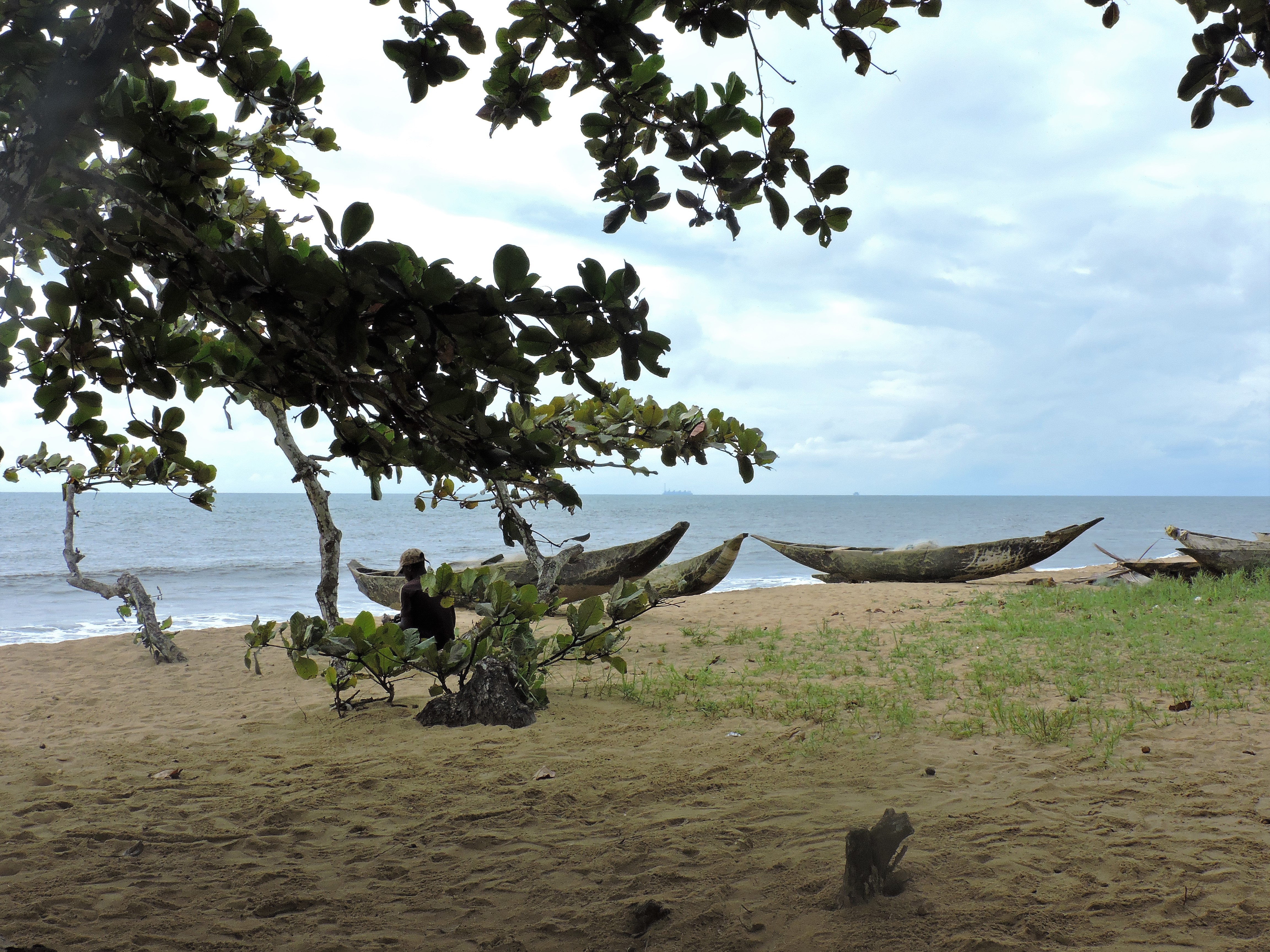
The beach is nice

DSCN9358

picturesque, even in the rainy season

Take a canoe ride up the Lobe river: silence, just the soft splashing of the oars dipping into the almost still water, an occasional chirping of a bird, no crocks, no snakes (maybe)

A walk through the forest and then you are there: a camp with huts made of natural building material and corrugated metal, plastic buckets, plastic sheets, iron pots. And people: if you respect them, you call them Baka, but if you want to be understood by a guide who takes you there, you call them Pygmies. And then Baka might not even be the correct name. In that area there are the Bagyeli people, but again, it’s difficult to know.

They are hunter-gatherers, nomads or semi-nomadic people, the forest provides everything they need.

What you get to see are poor, marginalized, showcase indigenous people that sit and wait for visitors in order to pose for money, to tell them stories about their supposed lifestyle. You see malnourished children with big bellies, skin diseases, faded hair and a disorderly village with huts in need of repair and plastic waste all over.

The father let me hold the baby!!!!!!! It feels the same as any other baby, they are all tiny.

DSCN9402

That’s when I would have liked to become a hunter-gatherer, when I saw dozens of these little plastic bags on the forest ground around the village.


Douala

29 Oct

Biggest city, biggest port, hot, humid, trafficky but…

… they have street signs and splendid views (top right our hotel from downhill)

Where to stay in Douala? Good idea, The German Seamen’s Mission, Foyer du Marin. It has a nice garden, a terrace overlooking the harbour and it has got a mission, it advertises the “German Monuments and African Cultures Association”

Go looking for old colonial buildings of what was once called Kamerunstadt. Not easy to find, not always well preserved but still in place and under protection.

Like in Yaoundé tourist attractions are not abounding. The Palace of King Manga Ndumbe Bell is in the city’s administrative center. It was built by the Germans and is commonly called “la Pagode”. (don’t ask me why they didn’t build one of those traditional timber-framed houses). Through the front door you enter an air conditioned French style bistro and in the back there is doual’art, a gallery and exhibition space where you can have a cup of coffee together with artists and magistrates from the court nearby in the shade of big trees.

La Pagode, Place du Government,

Doual’art: modern art, ideas based on cultural heritage and religion

I wanted to visit the tomb of Rudolph Douala Manga Bell another name on the long list of crimes committed by my forbears. Strictly, Rudolph Manga Bell wasn’t even a freedom fighter, he (Rudolph!) came from a Germanophile family, knew and believed in German “Justiz” and had merely dared insist that the promise given by the Germans not to expropriate his people’s land be respected. Tragically, he was “betrayed” by Ibrahim Njoya, the grandfather of the actual Sultan Njoya – the Sultan we “got to know” in Foumban. Bell was accused of treason, and hanged after a quick and superficial trial. Seven weeks later, in September 1914 the Allies captured Douala. Treason wouldn’t have been necessary to make Germany lose Cameroon.


While I was wandering around looking for the tomb an elderly man passing by pointed backwards and said to my surprise:

“It’s over there what you are looking for.”

A few steps around the corner and there they were, the tombs of Rudolph Manga Bell and his son.

Truth is, there are a couple of brave and just men who were made heroes (Héros de la Résistence et Indépendance) at the hands of other European colonialists (for example Ruben Um Nyobé assassinated by the French army shortly before independence was won).

Interesting to visit is the maritime museum, with some technical seafaring equipment, a traditional painting, a few models of ships and some information about the world’s contemporary human tragedy. At the end of your guided tour you get 15 minutes of an animated simulation of the deportation of slaves in a small rocking boat with real water being sprayed in your face (so you see what it was like!)

All this brought into being by the Italian Genius! That’s why with a certain hint of pride I took this foto (and later on I realized that Gènes means actually Genova).

Cheers dears

Gerburg

Bafoussam

29 Aug

Bye bye Foumban, art and culture jewel of Cameroon! Take care of your heritage and make your treasures more easily accessible to travelers. The 80 km trip from Foumban could be called uneventful, if you don’t consider the habit of adding another passenger per row when the bus is already full.

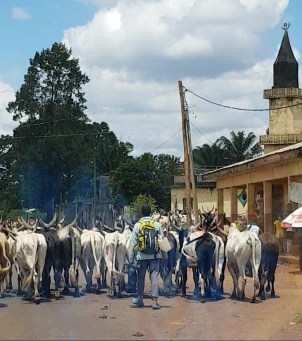
I was placed next to the driver and filmed some of the trip with music in the background. See FB! Picturesque cattle herds share the road with the traffic.

20180811_113003_Moment(2)

On the taxi ride all over Bafoussam it turns out that the hotel we booked is not where google maps shows it but some 60 km further out of town where nobody goes. Our taxi driver takes us to several not really recommendable looking hotels and then drops us off in a really fancy one.

You go to Bafoussam to see the historical Bamiléké Chefferies (chief’s compounds) in the area …

… and when they happen to be closed your taxi “chauffeur” helps you find a really good guide to make up for that. We are told about the fon (King), the father of his people, with supernatural powers that enable him to turn into an elephant, a lion, a leopard … about his 150 queens and several hundred children, about his eight nobles, his advisers, about secret police and secret societies, about long and complicated funerary rites according to which two years after a person’s death his skull is exhumed and buried in the house of his family. Although the Bamiléké are mainly Catholic now, witch doctors and sorcerers are still sought after by the people. Later that day we unexpectedly come across  a live example of that. It’s probably quite enough to see one or two chefferies: the one in Baffoussam

… and the one in Bandjoun:                                    oh no, not tourists again

talking drum, playing music and I love my calabash

dressing up European style, my little handbag, le chef c’è moi

Relax from all the culture talk and watch a soccer game in the village or go and see the Métchie waterfalls.

All along the walk down to the waterfall you come across sacrificial offerings like salt, sauce, beans and biscuits and right on top of the waterfalls there is a spiritual healing place.

A naked woman, her body covered with mud, is sitting on a very low stool calmly looking over the flowing water. A man and a woman take her, slowly lead her into the river where the current is not too strong and start washing off the mud. At the same time two  men bring two sacrificial animals, a rooster which is already dead and a little goat that seems to be sensing what is in store for it and bleats and struggles in desperation. We are asked to leave and not take any pictures because otherwise the ritual wouldn’t work.

Leaving Bafoussam, by the way the only place where I wouldn’t have minded to have a cardigan to put on,

leaving the town by bus … means you have to go through a seven hour limbo, waiting for a coach with the letter H not written anywhere. Experience tells you not to drink because the driver won’t stop on his (as it turns out 5 hour!) run to Douala. The trip is further delayed by someone who gets on the bus trying – and succeeding – to sell a remedy that cures everything from a mere cold to Aids and cancer and I am seriously tempted …

20180813_163822

… to report

And you are forced to do things you never wanted to, i.e. travel after darkness, during rain, on one of the most dangerous roads with the bus almost tipping over twice because of the enormous wholes in the narrow road. The driver goes too fast with equally reckless trucks oncoming and the bus is not in good condition. I’m not complaining but I won’t do it again.

You leave the hotel at 9.30 in the morning and you geht to your hotel in Douala at 23.30 at night with the hotel kitchen closed and a merciful barman pouring his last peanuts from a bottle for you. But the room has all the services …

Cheers Gerburg  (63 since April)


“Your Excellency” I would have started …

28 Aug
… but he was really busy with his subjects …

… who stopped by in busloads to greet him on their way to Mecca.

may my humble self – as a culture-keen tourist  passing through Foumban, your splendid ancient capital – give you some valuable pointers on how to enhance tourism in your Majesty’s renowned culture-rich Sultanate of Bamoun?

Of course I wouldn’t … but in the pictures above His Excellency seems to be quite available and willing to lend an ear to commoners. And I have lots of practical ideas about how to make it easier for tourists to come and see the kingdom’s treasures.

DSCN9098

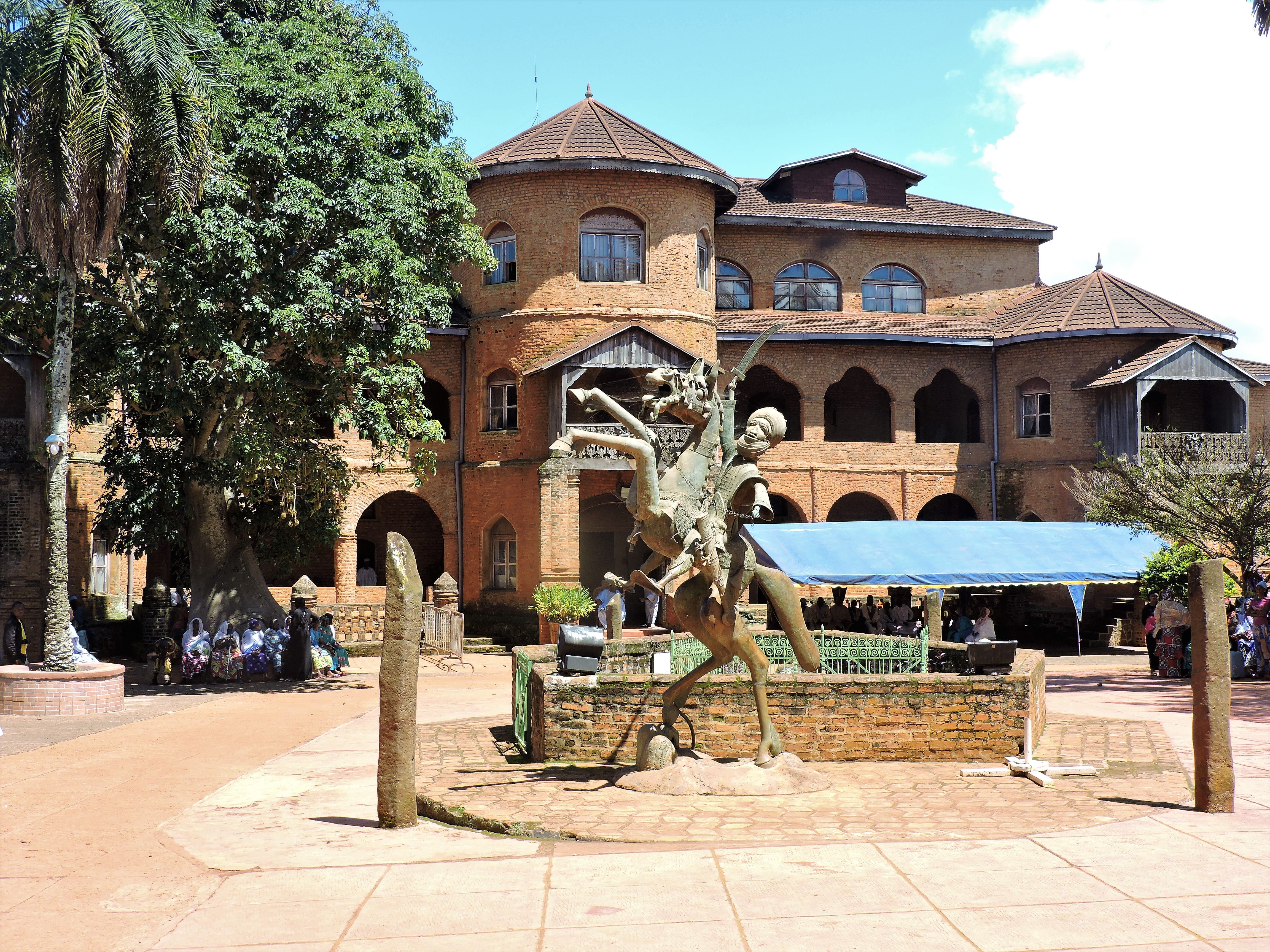
the Sultan’s Palace

The inside of the palace and what is left of the museum being transferred to the snake building: not all pieces are exceptional and most of them are covered with dust. The guide is exhaustive so you don’t mind that many pieces are missing. He can take his time for we are the only tourists here. Much later a group shows up and is quickly guided through.

ET’s African ancestors

The “palace” of the former sultans was more of a traditional Chefferie building but when Sultan Njoya, the grandfather of the actual Sultan Njoya, saw the new housing construction techniques of the Germans, he wanted a brick building for himself.

Massimo befriending some very classy looking ladies in the sultan’s courtyard. People are usually reluctant to hostile about having their pictures taken. The ladies seem to be enjoying it. Grandfather Njoya invented also some kind of syllabic writing. The Njoya dynasty.

DSCN9087

The visit of the palace ends with a demonstration of traditional musical instruments and a little concert (see Facebook for that)

A visit to the market, a look at the mosque and the huge tam tam, and a tour around the workshops, where bronze sculptures are still being made the traditional way, are a must.

The market with the mosque, fish and cassava drying in the sun.

Playing the talking drum

Finest metal and wooden artisanry to buy and take away if you can store it somewhere (nobody wants to believe we are travelling just with a small backpack), the cheetahs and the warriors will probably decorate hotels or public buildings.

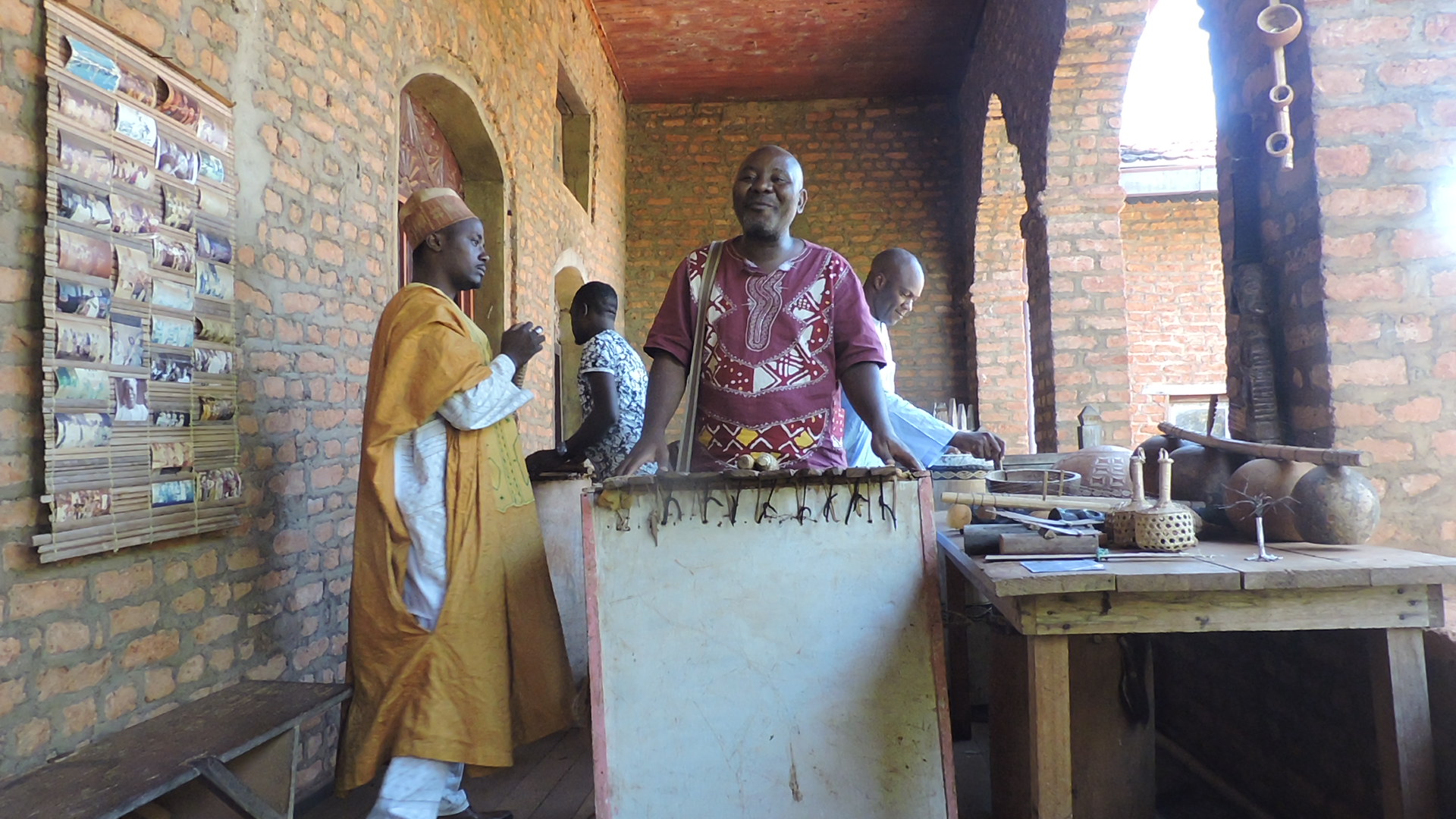
And when you think you have finished your cultural tour, you find out from the English speaking hotel staff there is still another museum, bigger, more complete and extraordinary just a kilometer and a half away …

… with a lovely guide conveying her encyclopedic knowledge in English with a Bamoun accent. And you find out, you don’t have to carry the whole scull of your adversary around to show that you’re the winner, the jaw is quite enough.
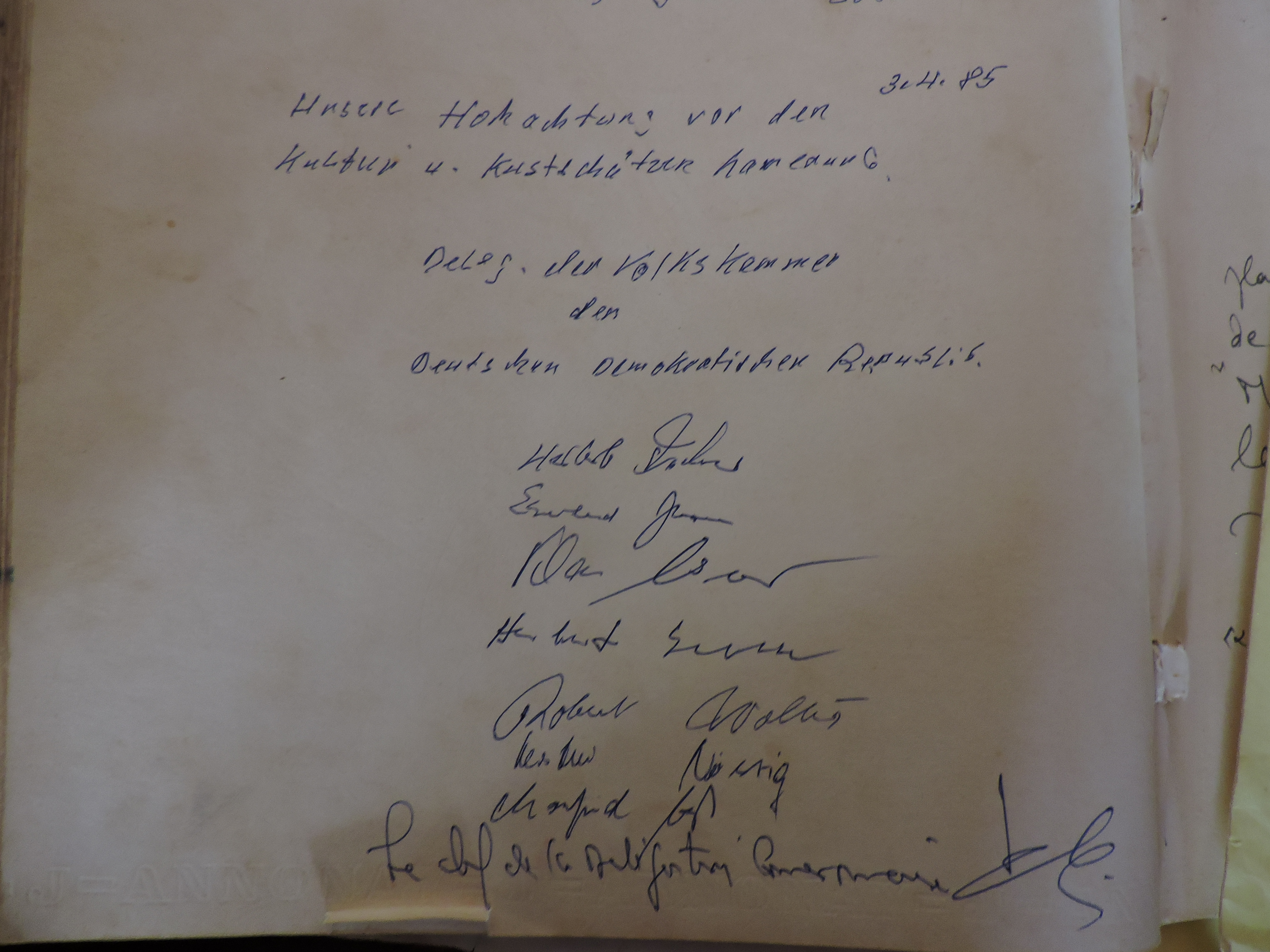
And in the end when browsing the guest book you come across this record of old times, scrawled down by Delegation der Volkskammer der Deutschen Demokratischen Republik, expressing their high regard of the cultural and artistic treasures of Kamerun.

DSCN9224

(and don’t say they weren’t allowed to travel)

cheers Gerburg