“Oh Island in the sun …” No, I’m not in the Carribean and Harry B. certainly didn’t think of Malta when he sang the song, but the tune is stuck in my head while sightseeing under the scorching sun at + 38 degrees centigrade. What’s there to see in the 10th smallest country in the world, you’ll wonder. A lot, a lot, from >4000 B.C. up to now … you’ll hardly have time to take a swim.
Little did I know about the tiny land right in the middle of the Mediterranean. From childhood I remember “Malteser” and “Johanniter”, the people that help others in need. Their ambulances wear a white (eight -pointed) cross on red ground, (the others are: the Red Cross on white ground).

Had I grown up as a boy I would have seen the connection of our ambulances with the Knights Hospitallers or the Order of Saint John. Boys like knights and they know all about them.


These particular knights struck with one hand and healed with the other. In fact, they were called hospitallers. One of the first things they did when they arrived in Malta, they established hospitals there.


In the Sacra Infermeria (in Valletta): two wards, the Old Ward (left, 16th century) and the Great Ward (right, 17th century, 155m long). The arched openings right and left had curtains and lead to the toilets. The sick were served their food on silver plates with silver cutlery, not to be posh – even slaves were treated here – but because of the antibacterial activity of silver. The curator of the museum told me he was working on a project to refurbish the hospital with beds and manikins to give visitors a better idea of what the Holy Infirmery looked like.
The knights left their mark in many ways on Malta. They ruled the country for 268 years, but didn’t exactly make the population love them for their arrogance and their tendency of molesting their women.
However, turism today owes them almost everything. They constructed fortresses, important edifices, watchtowers and, of course, churches churches churches and they protected the island from the Ottomans in the Great Siege in 1565.
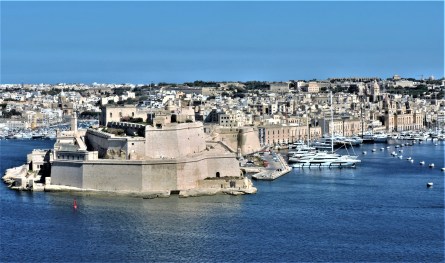
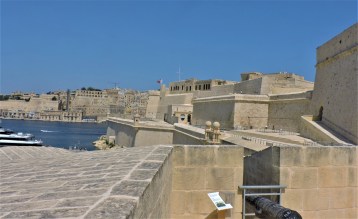
Fort St Angelo: an old fortification reinforced and renovated by the knights, became the main fortress, seat of the Grand Master, bastion against the Ottomans, prison for unruly knights, garrison, and later Royal Navy base.
The elements: worship and battle


Lookout point, Saint Anne’s Chapel and graffitti carved by an imprisoned knight in an underground cell that had been hollowed out to be a cistern. The knight had killed another knight who was actively envolved in the enquisition. After spending time in the black pit and carving the last traces of his existence into the rock he was finally hanged, poor chap.
Fort St Angelo withstood the attack by the Ottomans who had captured Fort St. Elmo on the other side on the tip of the Valetta Island. It wasn’t conquered and that was the end of the Great Siege.

Following the fall of St. Elmo the Ottomans executed the knights and Maltese defenders, and nailed their beheaded bodies on wooden bars which they sent floating across the harbour. It is said that, in retaliation, the Grand Master Jean de Vallette ordered the beheading of all Ottoman prisoners of war and fired their heads in the direction of the Ottomans still celebrating the capture of Fort St. Elmo. Tough!!
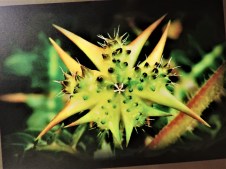
Legend has it that the yellow flower the ‘Knights’ Rose’ (Tribulus terrestris) grows exclusively at Fort St. Angelo as a tribute to the martyrdom of the knights whose blood watered the plant. In fact, what does the shape of the blossom remined you of?
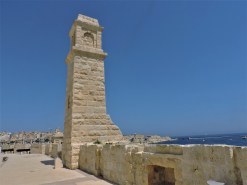 This monument was erected more than two hundred years after the Great Siege to commemorate the fallen knights and the victims of the plague outbreak in 1676.
The last siege of Malta from 1940 – 1942 was also unsuccessful. The rogue states of the time bombed the British Crown Colony of Malta to ashes and rubble. The human cost was high but in the end the Axis broke and the people of Malta were awarded the George Cross.

A poster of the invincible unsinkable stone frigate HMS St Angelo
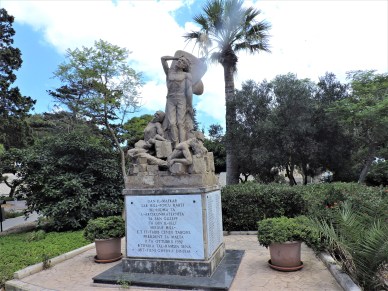
By Anton Agius, Malta’s ‘National Sculptor’: a group of 4 people standing near to the fuselage of a downed Nazi fighter plane.
One man is holding his head, whilst the three other people are lying on the ground, either dead or wounded.
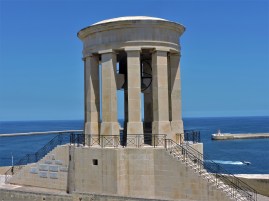
The Siege Bell Memorial, strangely enough I passed by it twice with someone from Malta (Oh, what’s that?) but wasn’t enlightened.
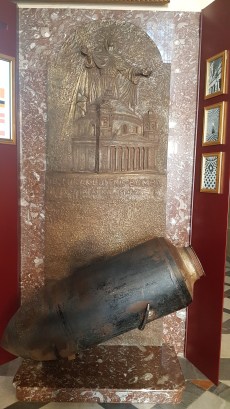
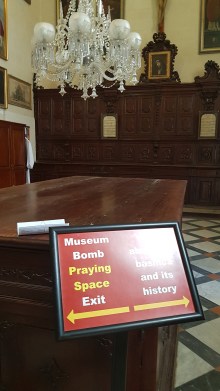
You find traces of WWII everywhere you go on Malta. The Dome in Mosta exhibits the bomb that struck it in 1942 when 300 worshippers had assembled for mass. Thank God, it didn’t detonate and what you see today is a replica, of course.
And you can visit underground bomb shelters where you see how the population managed to get by during the heinous attacks by the infamous Luftwaffe and Regia Aeronautica.


They even managed to have a PARRUKKIER (hairdresser)!!!
To be continued
cheers Gerburg
 gerburgkamm