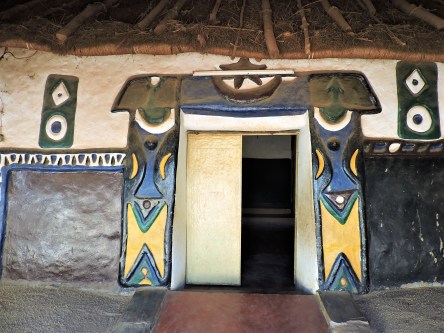
I have always wanted to see a lamido (laamiido), or at least his palace. One of my students had proudly chosen Ngaoundéré, his hometown, for the presentation he had to give in class of a nice place in Cameroon. I decided, I absolutely had to go there.
It takes 15 hours by train to go from Yaoundé to Ngaoundéré, (could be more, unlikely less), a night, a breakfast and a few hours of looking out of the window.


You have to have patience!
– when you buy the ticket at the well guarded train station in Yaoundé, where you queue under the vigilant gaze of security guards who don’t give special treatment to men in uniform (maybe a higher rank, but common soldiers queue like elderly ladies).
– when you board the train with the unasked for help of a porter. A tiny, tough chap all of a sudden grabbed my small backpack and started running through the crowd in front of the check-in barriers. Somehow I kept up with him and he placed me and my little backpack in a waiting room for VIP, i. e. the people with sleeping car tickets. He wanted money, I said no (getting grumpy inside).
“You cannot catch a train without a porter,” a lady patiently explained to me. Sure, all the other passengers had these huge checkered carrier bags full of all types of heavy goods (even cassava, Godknowswhy)
“I always do”, I stupidly told her.
It happened again at boarding, same guy, same haste. I got to my wagon-lit in less than two minutes (probably would have never found it myself), payed as much as others payed for 30 kg of luggage, but ok, it really wasn’t easy to find the carriage and get on the train with the crowds. Beds and sheets seemed clean with mosquito disinfestation toxin lingering in the air, sanitary facilities unhygienic, lights not working, I refrained from drinking.
In the morning the ladies that had boarded the train the evening before with big bags with baguettes and thermos arranged for breakfast. Good. After that: look out, count the stations and take pictures.


Arrive at Ngaoundéré station, take a taxi to the Maison d’Accueil diocesaine (Catholic mission run by Polish nuns), take a shower (the water is WARM!), go out and have yogurt with a cassava – maize mixture. This is lunch. The climate here is different from Yaoundé, almost Sahel, the rainy season is over, it’s warm and dry.


My taxi-driver is very good, calm, cautious, courteous. Next day I call him to take me to Tello Falls, about 50 km outside Ngaoundéré, the roads are such it seems twice as far.


Undulated plains, greenish from the rainy season, villages, cattle, where that delicious yogurt comes from, people telling us the way in Fulani, the lingua franca outside the city because in the countryside French isn’t spoken. The Fulbe or Fulani here are sedentary now but still essentially pastoralists.
Spectacular Tello Falls, the trip was worth it. The path that leads to the bottom of the falls is difficult to find. We met “the man with with the machete” who lead us down to where the falls plunge over a rocky cave into a pond.


Abdou, my taxi driver (picture: front), a devout Muslim, overawed by nature’s beauty couldn’t stop praising the Creator’s greatness, I took pictures and the man with the machete kept us company.
One last picture from the top of the waterfalls, don’t lean over, say good-bye to the man with the machete, give him a tip for being there and back we go. Except that driving on arid ground doesn’t mean that you might not end up in a swamp all of a sudden with the wheels spinning and digging deeper and deeper in the mud.


Abdou ran back in the direction where we had come from. (I was worried, Abdou had had a serious disease in the past and wasn’t supposed to exert himself physically. I looked at the problem from all sides and figured if any wild animal appeared, I would just get into the car and close the door. But as usual, nothing really exciting ever happens to me. I had time to think of a feasible plan B: find a village, sleep in a hut … He came back with the man with the machete, who started cutting grass to be put under the wheels. Two motorcyclists literally coming out of the blue stopped and helped lift the car up onto the dry grass.
The visit to the Lamido’s Palace: book ahead just in case another tourist plans a visit on the same day.
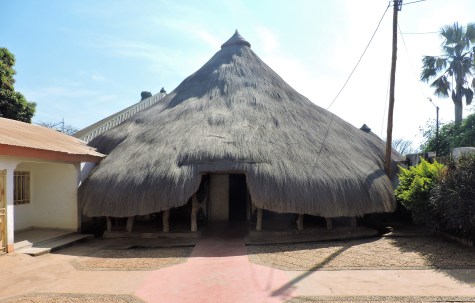
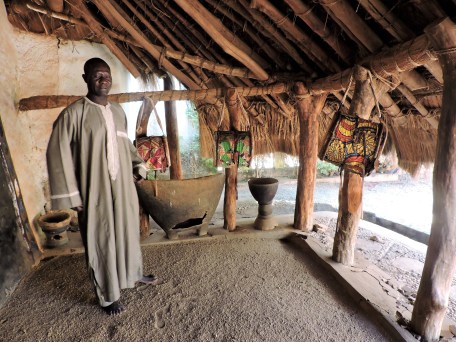
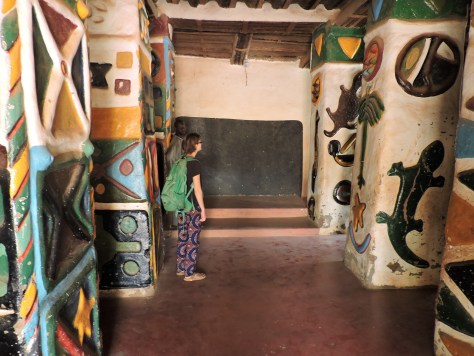
Traditional on the outside, decorated with colourful symbols on the inside


To enter or not to enter? Anyway, the Lamido isn’t home and won’t be back till the next week, too late for me. I heard contrasting news about this regional leader: someone local describes his education as inadequate like not being able to read and write, but that must have been some time ago. Our guide in the lamidat tells us about a mosque, a school and a hospital all public and part of the lamidat … and that’s what we expect a leader to provide, isn’t it?


Looking at the Lamido’s family tree I discover another repugnant act committed by my countrymen (I would have been surprised, if not). It seems poor Lamido Mohamadou Abbo Issa got killed while the Germans occupied Ngawndere.


A last look at the guest book: in 3 days: an Austrian, a Cameroonian, 2 Yemenites, a Syrian and two Germans (hi Laura!), with Austria and Germany being the only countries where there is peace. Greetings until my next and probably last letter from Cameroon Gerburg
 gerburgkamm
Leave a comment