The real adventure starts when you can’t find even the most ramshackle taxi to take you where you want to go and you entrust your life and well being to a motor-taxi. While going over rough and tough I began to understand why you “ride” a motorcycle. I grabbed the poor driver by his sides, leaned forward toward his right ear and said in textbook French: “Veuillez conduir un peu plus lentement!” After which – to my dismay – he turned round at full speed and said something that I interpreted as “don’t worry!”.
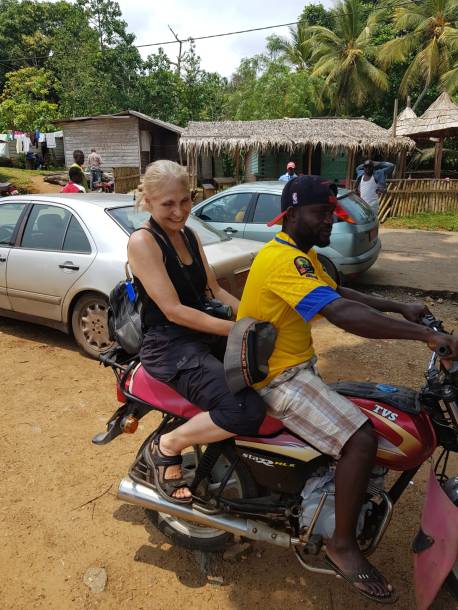 Then I limited myself to short expressions like “doucement!” or “attention enfant!” “chien à droite!” “sable sur la route” … just in case …


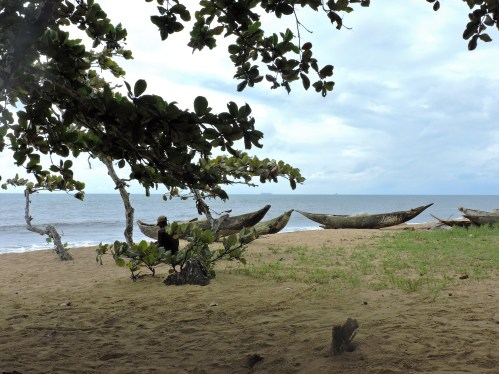
A few young men with a rowing boat took us to where the Lobé river, the same one that leads to the forest village, plunges directly into the Atlantic Ocean (Chutes de la Lobé). It’s a unique environment of great mythological and spiritual value to the autochthonous peoples as well as of naturalistic value for all of us, ideal habitat for prawns, too. World Heritage! (either nominated or already on the list).
Kribi Town sightseeing: The lighthouse, German legacy and still operative, from where the indigenous population was evacuated to Limbe after the outbreak of WW1 when the allied forces from France, Belgium and Britain invaded the German colony Cameroon. There is St. Joseph’s Church where by the end of the 19th century the newly arrived missionaries didn’t last longer than a year before being buried on its premises. There is a fantastic fish market with all kinds of fish that I had never seen or heard of before. Unfortunately I lost all my fish market pictures while I tried to transfer them to the computer.


You see huge modern adds right next to someone doing his laundry in a very traditional way.


You see an add for a clinic that offers general health care, and care during pregnancy, childbirth, vaccination, ultrasound, x-ray, gynecology, treatment for venereal diseases, family planning and the irresistibile offer of circumcisions for 5000 CFA roughly 7€.


I didn’t take pictures of what I would consider the best scenes, on a market, near a mosque, people started looking at me as if they didn’t appreciate someone walking around with a camera so I made do with a couple of unspectacular photos without running into trouble.


And then it was bye-bye Kribi. The bus ride to Yaoundé wasn’t without trouble with police harassing mini-buses in general and foreign passengers in particular.
Waiting for the bus someone falls asleep on top of his merchandise. A little boy befriends me and takes a picture of me.


It is not easy to take one of those buses. There is always a lot of confusion and in the end more people get on the bus than you would imagine. I never found out where they put the little pig in the basket.


The buses don’t stop for toileting but for police checks, yes. I always have a weird feeling when men are singled out and taken away …
… but all’s well that ends well.




 gerburgkamm