Archive | August, 2018

Bafoussam

29 Aug

Bye bye Foumban, art and culture jewel of Cameroon! Take care of your heritage and make your treasures more easily accessible to travelers. The 80 km trip from Foumban could be called uneventful, if you don’t consider the habit of adding another passenger per row when the bus is already full.

I was placed next to the driver and filmed some of the trip with music in the background. See FB! Picturesque cattle herds share the road with the traffic.
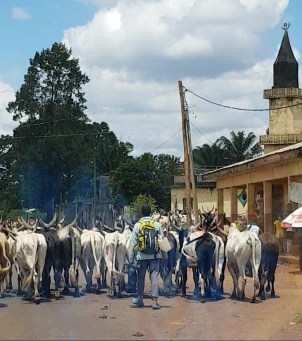
20180811_113003_Moment(2)

On the taxi ride all over Bafoussam it turns out that the hotel we booked is not where google maps shows it but some 60 km further out of town where nobody goes. Our taxi driver takes us to several not really recommendable looking hotels and then drops us off in a really fancy one.

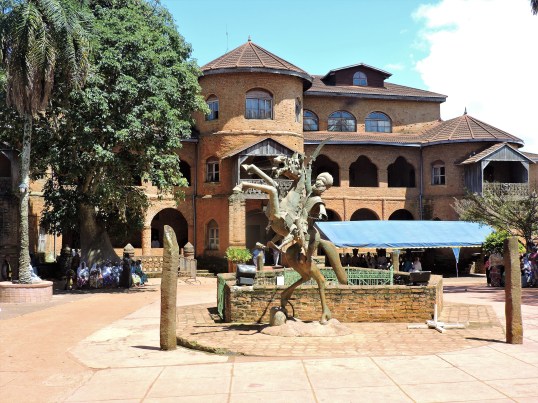
You go to Bafoussam to see the historical Bamiléké Chefferies (chief’s compounds) in the area …

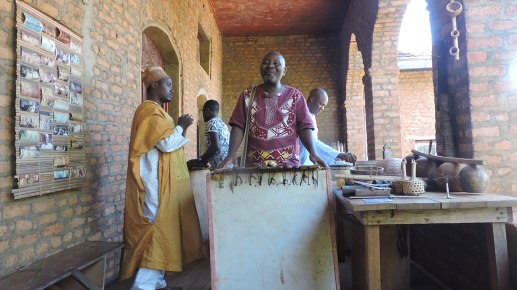
… and when they happen to be closed your taxi “chauffeur” helps you find a really good guide to make up for that. We are told about the fon (King), the father of his people, with supernatural powers that enable him to turn into an elephant, a lion, a leopard … about his 150 queens and several hundred children, about his eight nobles, his advisers, about secret police and secret societies, about long and complicated funerary rites according to which two years after a person’s death his skull is exhumed and buried in the house of his family. Although the Bamiléké are mainly Catholic now, witch doctors and sorcerers are still sought after by the people. Later that day we unexpectedly come across  a live example of that. It’s probably quite enough to see one or two chefferies: the one in Baffoussam

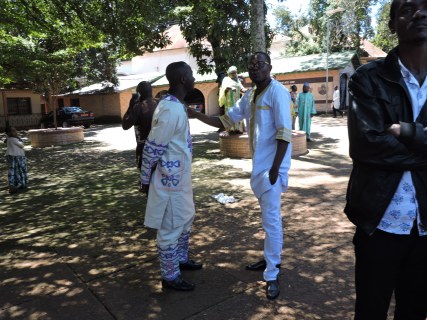
… and the one in Bandjoun:                                    oh no, not tourists again

talking drum, playing music and I love my calabash

dressing up European style, my little handbag, le chef c’è moi

Relax from all the culture talk and watch a soccer game in the village or go and see the Métchie waterfalls.

All along the walk down to the waterfall you come across sacrificial offerings like salt, sauce, beans and biscuits and right on top of the waterfalls there is a spiritual healing place.

A naked woman, her body covered with mud, is sitting on a very low stool calmly looking over the flowing water. A man and a woman take her, slowly lead her into the river where the current is not too strong and start washing off the mud. At the same time two  men bring two sacrificial animals, a rooster which is already dead and a little goat that seems to be sensing what is in store for it and bleats and struggles in desperation. We are asked to leave and not take any pictures because otherwise the ritual wouldn’t work.

Leaving Bafoussam, by the way the only place where I wouldn’t have minded to have a cardigan to put on,

leaving the town by bus … means you have to go through a seven hour limbo, waiting for a coach with the letter H not written anywhere. Experience tells you not to drink because the driver won’t stop on his (as it turns out 5 hour!) run to Douala. The trip is further delayed by someone who gets on the bus trying – and succeeding – to sell a remedy that cures everything from a mere cold to Aids and cancer and I am seriously tempted …

20180813_163822

… to report

And you are forced to do things you never wanted to, i.e. travel after darkness, during rain, on one of the most dangerous roads with the bus almost tipping over twice because of the enormous wholes in the narrow road. The driver goes too fast with equally reckless trucks oncoming and the bus is not in good condition. I’m not complaining but I won’t do it again.

You leave the hotel at 9.30 in the morning and you geht to your hotel in Douala at 23.30 at night with the hotel kitchen closed and a merciful barman pouring his last peanuts from a bottle for you. But the room has all the services …

Cheers Gerburg  (63 since April)


“Your Excellency” I would have started …

28 Aug

… but he was really busy with his subjects …

… who stopped by in busloads to greet him on their way to Mecca.

may my humble self – as a culture-keen tourist  passing through Foumban, your splendid ancient capital – give you some valuable pointers on how to enhance tourism in your Majesty’s renowned culture-rich Sultanate of Bamoun?

Of course I wouldn’t … but in the pictures above His Excellency seems to be quite available and willing to lend an ear to commoners. And I have lots of practical ideas about how to make it easier for tourists to come and see the kingdom’s treasures.

DSCN9098

the Sultan’s Palace

The inside of the palace and what is left of the museum being transferred to the snake building: not all pieces are exceptional and most of them are covered with dust. The guide is exhaustive so you don’t mind that many pieces are missing. He can take his time for we are the only tourists here. Much later a group shows up and is quickly guided through.

ET’s African ancestors

The “palace” of the former sultans was more of a traditional Chefferie building but when Sultan Njoya, the grandfather of the actual Sultan Njoya, saw the new housing construction techniques of the Germans, he wanted a brick building for himself.

Massimo befriending some very classy looking ladies in the sultan’s courtyard. People are usually reluctant to hostile about having their pictures taken. The ladies seem to be enjoying it. Grandfather Njoya invented also some kind of syllabic writing. The Njoya dynasty.

DSCN9087

The visit of the palace ends with a demonstration of traditional musical instruments and a little concert (see Facebook for that)

A visit to the market, a look at the mosque and the huge tam tam, and a tour around the workshops, where bronze sculptures are still being made the traditional way, are a must.

The market with the mosque, fish and cassava drying in the sun.

Playing the talking drum

Finest metal and wooden artisanry to buy and take away if you can store it somewhere (nobody wants to believe we are travelling just with a small backpack), the cheetahs and the warriors will probably decorate hotels or public buildings.

And when you think you have finished your cultural tour, you find out from the English speaking hotel staff there is still another museum, bigger, more complete and extraordinary just a kilometer and a half away …

… with a lovely guide conveying her encyclopedic knowledge in English with a Bamoun accent. And you find out, you don’t have to carry the whole scull of your adversary around to show that you’re the winner, the jaw is quite enough.

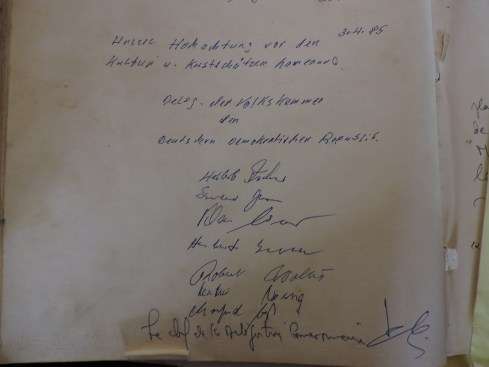
And in the end when browsing the guest book you come across this record of old times, scrawled down by Delegation der Volkskammer der Deutschen Demokratischen Republik, expressing their high regard of the cultural and artistic treasures of Kamerun.

DSCN9224

(and don’t say they weren’t allowed to travel)

cheers Gerburg

Travelling in Cameroon?

27 Aug

To travel in Cameroon either:

  • be well-to-do enough to have a car or hire one together with the driver
  • be under 63, better in your 30s
  • be patient, resilient, intrepid, in excellent health, water-proof, malaria-proof,
  • be prepared …
  • be a Cameroonian, they know what to expect and don’t travel for FUN

No, it’s not an adventure, it’s a challenge. Massimo calls it “something in between nightmare and incubus”.

Cameroon’s pride is its diversity: peoples and cultures, terrain and landscapes, flora and fauna. Africa in miniature!  See as much as you can in 3 weeks holiday!

Take away the no-go zones:

  • the North! (Not that I’d have any appeal to Boko Haram)
  • the West! Unrest among the English-speaking population demanding autonomy or fighting for secession to keep the revenue from their oil reserves to themselves
  • the East, rain forest region, impassable during the rainy season which ends in November

So this is the plan: buy a ticket, take a bus and go on a cultural sightseeing trip ending with a couple of days of relax on Kribi’s beaches on the Gulf of Guinea before going back to Yaoundé.

Start with Foumban:

only 250 km away, history- and culture-rich capital of the Bamoun Kingdom, one of the oldest towns in Cameroon, see the Royal Palace, watch the Sultan visit the mosque on Friday, visit the colourful, bustling market, see the biggest tam tam (talking drum) you can imagine, visit the art museums with most wonderfully carved thrones, masks, sculptures … Exciting place to visit.

Practical problems: which bus? where to leave from? (bus station: gare routière, which one?), what time, how to book ahead … ?????

… all your preconceptions become misconceptions starting with the non-existent Tourist Information Centre. Information on the internet? Zero! You just keep chatting with everybody you encounter about your travel plans and some museum guide (in this case the multi-laureate from le Musée de Blackitude I mentioned on Facebook who is actually from the Foumban region) sends you to Confort Voyages at some far away carrefour the name of which he mispronounces (instead of Manguier, he said and wrote Mangier), so you mispronounce it to the taxi driver and wonder why it is so difficult to convince anyone to take you there.

The minibus is scheduled to leave at six in the morning, so you better be there at half past five to comfortably conquer a seat on the bus, which chronically has a problem of high demand and low supply and leaves a couple of protesting customers standing in the mud. You are allowed one piece of luggage small enough to fit under the seat.

For three weeks!? A sheet bag against possible bed bugs or a nice dress for going out in the evening? Forget it! Underwear, malaria pills, toothbrush, be a good sport! I’m so overwhelmed by the frenzy at the bus station, I forget to take pictures. It’s still dark, anyway. The bus leaves 40 minutes late and the driver seems to be trying to make up for the delay: no limit, no rule, no road construction, no hole in the road would convince him to slow down. He succeeds … in making the car go haywire. He had ignored various requests for a physiological stop by some passengers, now the physiology of the car gives in and the stop is inevitable. Everybody out, no prudery, ladies and gentlemen, messieurs-dames, there’s no “men to the left and women to the right”, there’s only standing or squatting, maybe the women go a bit further away. Who cares! No pictures here.

The trip takes more than six hours. Vendors hand in homemade snacks like fried bananas, cola nuts, roasted peanuts and some brownish round balls that the ladies around me make me try. A boy carefully gives me one of those balls, not touching it with his bare hands but with a piece of writing paper. They  are made of ground peanuts and banana flower and … the ladies had forgotten to tell me … “Ah that was hot” … “le piment”.

At the arrival in Foumban the other ladies and I congratulated each other.

Hotel Pekassa de Karche: outside two bronze cheetahs, inside wooden sculptures and masques like a museum, looks clean, very nice staff, three elderly men presumably cook and waiters, two of them speak English because they are from Bamenda, West of Foumban, but advise us not to go there. “Too many problems”.

What to do? Go and see the Palace which is supposed to host the museum and to your surprise, right next to it is an enormous two-headed snake with a spider on top. In his notorious ignorance the European visitor thinks of a kind of African Disneyland.

Try to go and buy a ticket to see the Royal Palace and museum, there’s no sign, no list, no cashier. Wait for a guide, you’ll find out the price. There are more guides than visitors and you can’t walk around on your own. Never, ever in any museum, it’s been like that in Yaoundé and will be like that everywhere else.

DSCN9125

guides guides guides

The Museum is being transferred from the palace to the new building, the big two-headed snake with the spider on top, so we can’t see all the artifacts but our guide is making up for the lack with his very detailed explanations about Bamoun history. The two-headed snake and spider are the emblems of the Bamoun dynasty  which dates back to the 14th century. It’s a long story, a long history. Only so much: the snake goes back two the Bamoun people fighting on two front lines and the spider is a symbol for wisdom and patience.

The Sultan, Ibrahim Mbombo Njoya, is sitting at the entrance to his palace giving his benediction to buses full of Hadj pilgrims leaving for Mecca. Being also a senator he is actually a kind of mediator referring the people’s grievances and wishes to the country’s government. He seems to be close to his people and well-liked by both, the Muslim majority (85%) and the Christians.

It wasn’t easy to get to Foumban but it was worth the effort as I will show you in my next letter.

Cheers Gerburg


Where exactly is Cameroon?

4 Aug

It is sometimes referred to as the armpit of Africa, it’s in the bent of West-Africa a bit north of the equator.

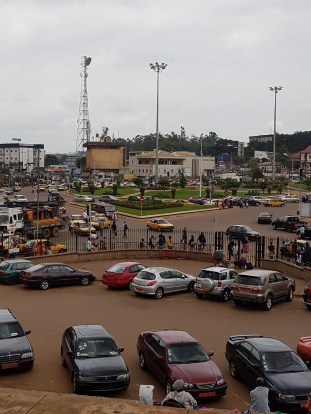
Yaoundé, the capital with 3,5 million inhabitants, is spreading over 7 hills (could be more) and – ever heard of a city like that before? – could 7 hills be a bad omen? Chaos and confusion, traffic and pollution, inscrutable urban planning, bad waste management …


20180731_121257

view from the Cathedral steps, Cathédrale de Notre Dame des Victoire

Most difficult city to get around: the streets have names or four-digit numbers, but you will hardly find any street signs. Even citizens confuse the streets: “Avenue de l’Indépendance”, or “Avenue Monseigneur Vogt”, who cares, the only person who really needs to know is me. My GPS is going wild, doesn’t know in which direction to point with me going round in circles. I’m concentrating on it so hard, I risk getting pickpocketed if it weren’t for two young ladies who start yelling and jumping in my direction slapping the wrong-doer’s hand off my backpack.

Early morning ride to learn my way to the Goethe-Institut.

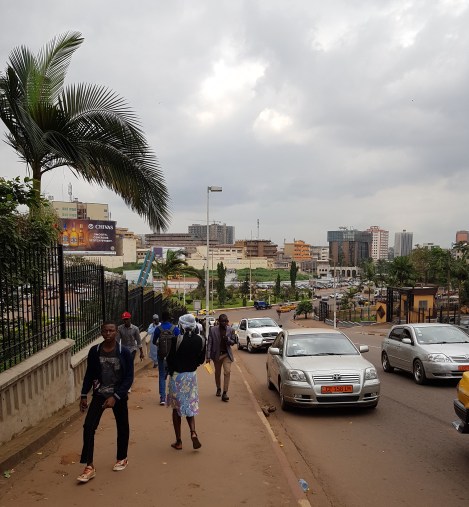
It’s been here since 1961, a bit longer than the University of Cameroon. Later in the day traffic chaos breaks out and even sidewalks aren’t safe.

20180731_112305.jpg

Walking down one of the >7 hills.

Public transport is NOT buses that run along certain routes, it’s yellow taxis, so old you wouldn’t even think Toyota (or whatever) has existed for so long, their parts being held together by the grace of providence, many of them with an alarming roundish crack where the front-seat passenger’s head would knock on in case of a hard stop. Seat belts, no, be happy if there is a handle to hold on to.  You have to use the taxi a lot to get a feeling for the (fair) fare. Wait at the side of the street, the taxi slows down, you say where you ‘re going and they take you or they just drive on. That is stressful and unpredictable. Don’t be too precise with your destination and neither too vague. I usually say “centre ville”, and then something like “ministère de …”. I walk a lot. If you agree on going “depot” they take you where you want to go, mostly without other passengers and you pay 5 – 10 times the “collective” fare. Make it clear from the start.

You go downtown mainly to shop for things you don’t find where you live. As to sightseeing, you’d be through in a day. There is a National Museum, you can’t take pictures in it, you can’t walk around it by yourself, and the second floor is history, which is basically when the President Mr. Paul Biya was young. He’s been president for about 36 years now.

There isn’t a “Musée Ethnographique des Peuples de la Forêt” but it would have been a good idea to have one instead of just advertising it on the internet and sending me around town through places where I didn’t dare take my camera or cell phone out.

Some days later, I was more successful

thumbnail

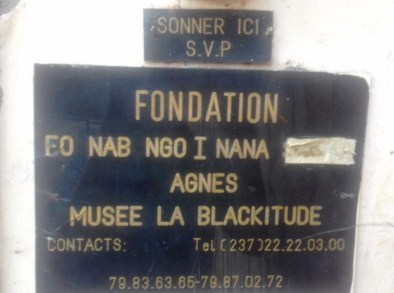
I found the “Musée de la Blackitude”, hidden in a corner of a nameless side street where no one goes

It was just one room, the entrance fee was 3 Goethe-Institut meals, I wasn’t allowed to take pictures but I had a warden, a museology student, a young man with couple of university degrees and a princess to guide me through the room explaining the artifacts  in fluent to fast french. That’s 4 to 1, guides to visitors. They made me feel like a star.

I also found the “Centre d’Artisanat” …

… which left me with a slight sense of inadequacy.

Now and then I enjoy something that could be considered a safe haven amidst big city frenzy: The sanctuary at Mont Fébé, where I heard the most wonderful polyphonic choir at a Sunday mass. I posted the video an FB, here unfortunately I can’t.

… and the Bois Sainte Anastasie, where of course, I wasn’t allowed to take pictures:

… so when I was told to cancel the pictures, I politely asked them to repeat this in English, which they couldn’t, and I quickly left, even though I was on my last legs already. That was kind of unladylike and also no one can always be a nice person.

It’s quite a relief to have these little oasis in this difficult city, this mind-blowing side by side of modernity and utter misery, which I didn’t have the courage yet to take pictures of.

One last word about food: Sauce Gombo (made of ladyfingers and rather viscous) with Cous Cous de Manioc, Ndolé with manioc en feuille de bananier, fried fish, meat in peanut sauce, all accompanied by cooking bananas (plantains), fried like french fries, or cooked.

It’s all gluten free and cheaper than this. A good glass of French red wine goes with everything:

Cheers Gerburg