Accommodation
Suppose you don’t want to spend a lot of money, actually,
- you want to spend as little as possible
- you want to have company around the clock, like being in a six-bed-room, 12 square meters, mixed male and female piled on top of each other in bunk beds
- you want to be welcomed by a manager with the nicest Asian smile at 2 o’clock at night who doesn’t mind your late arrival because he still has a lot of tidying up to do
- you don’t care for fast wi-fi, instead, you want to meet wonderful, relaxed people who – being on a work-and-travel-visa – go to work, do their laundry and their cooking and beer drinking, laughing and chatting at any time of day-night, who are easy-going enough not to bother about cleaning up their mess after warming up a can of Heinz’ baked beans
- you love the type of air conditioning that converts a sauna bedroom into a cold room emitting a monotonous “white noise” that puts you to sleep and a sudden jerky rumble that startles you every time it turns on or off
- you are rugged enough not to mind spotting hair of all colors, lengths and types in the shower
then you book into:

Gecko Lodge is a hostel, give yourself one night and you’ll throw everything your mother ever taught you about hygiene over board!
![FB_IMG_1505659136457[1]](https://i0.wp.com/gerburgkamm.blog/wp-content/uploads/2017/09/fb_img_15056591364571.jpg?w=241&h=321&ssl=1 "FB_IMG_1505659136457[1]")
![FB_IMG_1505659143872[1]](https://i0.wp.com/gerburgkamm.blog/wp-content/uploads/2017/09/fb_img_15056591438721.jpg?w=241&h=321&ssl=1 "FB_IMG_1505659143872[1]")
The less readable sign says:
Thank Heaven for dirty dishes!
They have a tale to tell.
While other folks go hungry,
we’re eating very well,
with home and health and happiness,
we shouldn’t want to fuss,
by this stack of evidence
God’s very good to us.
And in fact: the work-and-travel folks sometimes earn around 25 Au$ per hour and can buy food and drink at will and still help out a penniless old lady (whose ATM bankcard didn’t work because she had forgotten to tell her bank she was going overseas; thank you, Iva!). Mind: you can get that visa until you are 31 years old. Afterwards, you are simply too old!
I liked Gecko Lodge, it’s out of town, has a small pool, a bus stop right next to it, a good-natured Chinese manager who proudly carries his little daughter around while still doing his job after sunset, nice sociable people from all over the world, a porch, a veranda with chairs and tables, fridges, clean sheets, you name it … geckos (and other mini fauna), too, of course …
Downtown
(remember I’m not Wiki … for real infos, google!)


The library, wonderful building, one hour free internet, air conditioning, café with a view, silence, order, cleanliness


wow-Intersection: at green traffic lights cross right and left and diagonally; you can even take pictures in the middle of the intersection (!!!!)
Stick by the rules, you are being taught in a nice way, so be good, the rules are many, people expect you to abide by them, better start getting used to them:


Artists
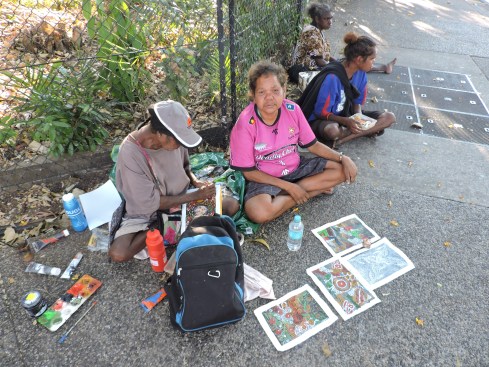
Aboriginal women painting and selling their art in the street. They are not from Darwin but further south
To the left of them there was a man painting on a big canvass. He was not unfriendly but he didn’t want to have his picture taken, least of all, a picture of his picture.
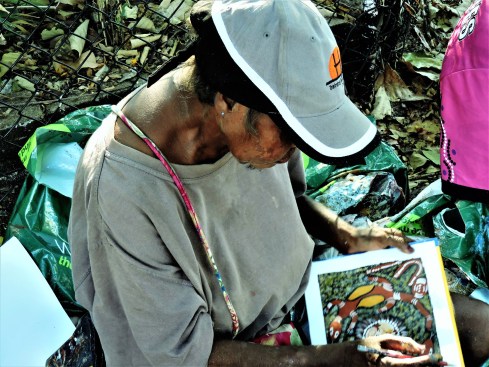
2 WOMEN DIGGING for GOANNA & EGGS; CAROLYN KENTA, ERNABELLA PUKATJA. This is what the lady is writing on the white rim
Without signature and explanation the picture is less valuable.
In the Art Gallery I got to talk to Edward Watts Blitner from the Ngukkurr area and a member of the Marra tribe. At first I was really worried that I might disturb him. He seemed so absorbed in what he was doing, highly concentrated. In the end he turned out to be very open and forthcoming and the only thing I was sorry about was that I had such little familiarity with the Australian accent.
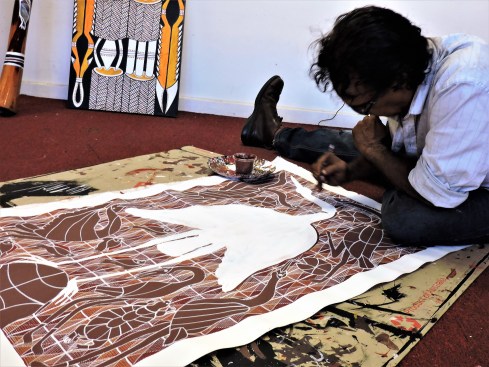
painting a Brolga (crane)
The pictures often tell mythological stories which were once told in song and dance cycles at ceremonies, stories about a narrow escape or with an educational intent. One myth is about a man who escaped two hunters that were about to kill him jumping into a billabong and getting transformed into Ngalyod the Rainbow Serpent. As a snake he bit his pursuers and killed them. Later the man who had saved his life by becoming a serpent became a Brolga crane and as such was able to avoid further persecution and danger. Fan-tas-tic!
Another story tells about two sisters who loved to dance near a billabong in spite of being warned by their tribe not to do so. Now, if one thing is true: young girls and boys never listen to their elders, anywhere in the world. The consequences for breaking the rules in aboriginal life are rather harsh! You want to have your own way? Fine, you will, but only once. The Rainbow Serpent got upset and transformed the disobedient young girls into Brolgas. Actually, these birds are very beautiful. They live on the waterside where they make dance movements which have been imitated by the Aborigines.
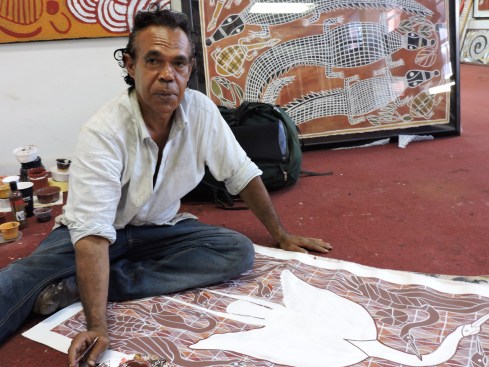
I had a long discussion with the artist about aboriginal art, which, in his opinion, is a natural kind of flow that comes out of a person, you can’t be taught and you can’t teach it.
My opinion: the exact opposite. You teach, the children sit down and learn, at school, in courses, at home, wherever.
He kept shaking his head: “No, no, no … It doesn’t work like that.”
Now, look at the picture he is painting. Doesn’t it look carefully … painstakingly planned?
I was to understand what he tried to convey to me much later when I talked to Coco, who had lived with aborigines for a long time. (But I still believe in teaching and learning, I just can’t help it).
And I fell in love with aboriginal art …

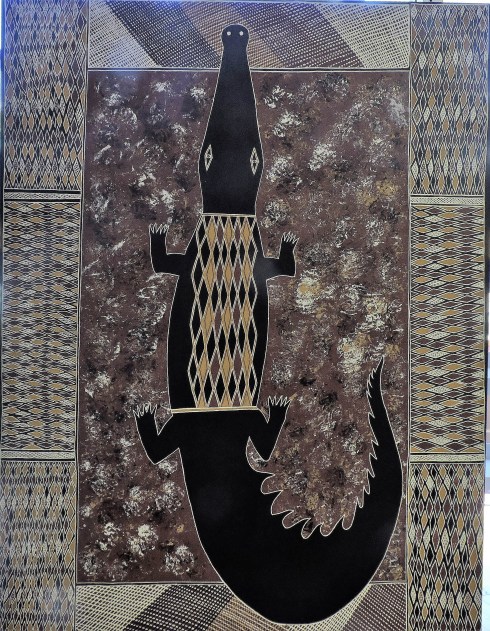


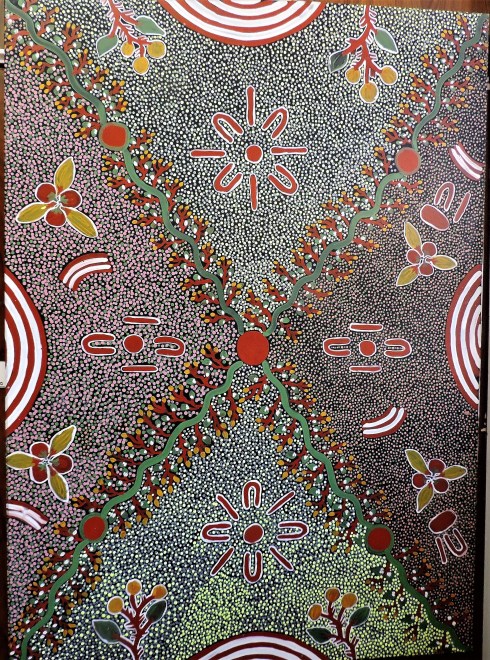

Just a little help in reading the aboriginal art iconography – Courtesy of What is Aboriginal Art? By Margo Birnberg, a short introduction to the understanding of aboriginal art
… and I started getting interested in didgeridoos, musical instruments, which I would get to know better on my trip to Kakadu National Park.
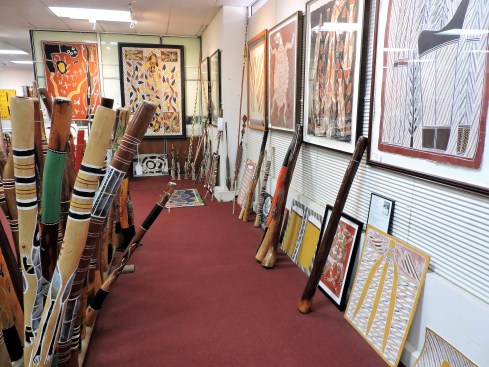
Didgeridoos are those long artfully painted tubes with a wax rim on top where the mouthpiece is
… my TRIP from DARWIN TO LITCHFIELD AND KAKADU NATIONAL PARKS
How difficult it can be to get there, that is a whole different story which I will tell you in my next letter.
Cheers
Gerburg
 gerburgkamm
Leave a comment